Present! No…Absent!

Can you remember the last time you had nothing do to? I mean literally, nothing. No e-mail to check, no e-demands of any sort in fact, all chores done, and complete freedom from anything other than that which you choose. If you are over 50 years old as I am, you probably do recall such a time. If you are much younger than that, you might have to search your memory banks a little deeper for the do-nothing moments.

I listened to a radio interview this morning with author Michael Harris about his book The End of Absence. It sparked a day-long contemplation and left me with a bit of a quandary. Here we are with the pending launch of a major book ourselves, The Compassionate Equestrian, in which we have suggested a period of quiet contemplation before working with your horse, or even before entering the barn. Not that this is a “do-nothing” moment, but it is meant to help you quiet the mind, restore a deeper breath, slow the heart rate, and approach your horse with a sense of calm and peacefulness.
However, in this high-speed, short attention span world, we have to build a digital marketing plan and customer acquisition process the way business must be done now, and that is via social networking and the internet. Therefore while we suggest creating the ever so rare moments of solitude and quiet, which are of tremendous benefit, at the same time I have been busy on the computer for endless hours learning from online webinars and videos how to increase Facebook likes to over a million, fill live events, drive more customers to the website, and so forth. We expect a lot of followers to come from the attachment to technology. Sometimes I feel as though I am fighting for mental stability in this age of After the Internet arrived. What is this odd feeling? Why is it so pervasive? When did it become normal to have 5 windows open on 3 different e-mail addresses with a webinar held on pause in another window and a Word document started in yet another?

“But those of us who have lived both with and without the crowded connectivity of online life have a rare opportunity. We can still recognize the difference between Before and After. We catch ourselves idly reaching for our phones at the bus stop. Or we notice how, mid-conversation, a fumbling friend dives into the perfect recall of Google.

In The End of Absence, Michael Harris argues that amid all the changes we’re experiencing, the most interesting is the one that future generations will find hardest to grasp. That is the end of absence—the loss of lack. The daydreaming silences in our lives are filled; the burning solitudes are extinguished. There’s no true “free time” when you carry a smartphone. Today’s rarest commodity is the chance to be alone with your own thoughts.”

http://www.endofabsence.com/home/

I began my working career in advertising and marketing but that was in 1977 and things were very different then. We used radio, television, newspaper, flyers and billboards to spread the message. You had the choice to look or listen if you wish, but nobody could ever say they were addicted to their media!

Silence. How often can you say your world is truly quiet? Can you even stand it when everything around you goes quiet? Noise seems to be an addictive factor in many people’s lives too. There is a nervousness that creeps in when suddenly nobody has anything to say. Even if you are a sensitive person in a group meditation practice, you can detect the subtle nuances of people going through lists, analyzing situations, or perhaps thinking about where they need to be next. People have a lot of noise in their heads now, even if they don’t want it there.

I feel strangely guilty for all this rising of the endlessly busy ones. I lived in a computer lab, literally, in the days of the dot com explosion, and had a front row seat in watching the great divide emerge…the Before and After as Harris describes it. My ex-boyfriend, who was president of the high-tech company, had a freakish ability to see how the past and future connected. He forged onwards as everyone was doing it to see who could win the race to make money selling “minutes” amongst other then non-existent products. Few believed it could really happen. It was like a surreal dream. If we needed to reach through time and scream, “noooo don’t do it” it probably wouldn’t have made any difference. It all ballooned and got away from everyone, the expectations of money and reality of connecting humans all over the globe has happened, for better, for worse, and everything in between. Many of the smaller entrepreneurial companies did not survive, and I think we know who won in the end.

Young genius engineers, venture capitalists, and horses simultaneously surrounded me. Yes, the lab was initially on our ranch property in one of the outbuildings. That was the early 1990s. Personal computing was still clunky and archaic compared to what it is now and only the military and a handful of industry insiders had cell phones, which were like bricks compared to today’s smartphones.

My front row seat as all of this unfolded still astonishes me with the short blip in history that it took to go from the Before to the After. As a collective species, I think many of us are still in shock and exhausted from trying to keep up. As The End of Absence notes, children born within the past two decades will have no memory of what the world was like before the internet.

I kept riding, training, and teaching as all this was happening. People weren’t too affected by their attachments to e-leashes (a term coined by one of our progressive sound engineers), or constant checking of phones because they didn’t exist. So neither were the horses terribly affected by distracted, busy humans whose ability to spend 3 or 4 hours at the barn hadn’t yet been condensed to crushingly intense minutes of anxiety and demands. This is an animal that has not adapted to our distractions and lack of presence. With horses, a moment of distraction can put a rider in danger or a compromising position too.

I am currently in the very unusual position of being able to grant myself moments of utter nothingness if I choose to do so. It means consciously registering when I need to close the lid on the computer, and stop it all. It is part of that ongoing battle for sanity and my plan is to win. Just like when I was a child and could take time to simply sit in the grass, enjoying the passing clouds and the company of one of our pets, or walk the dry riverbed looking for agates, spend a couple of hours taking apart a bridle and giving it a good cleaning, or reading book after book, savouring each bit of valuable information.

Oh yes, we can sure learn a lot from the internet too, can’t we? Some useful, some frighteningly misleading, especially when it comes to horse training. This is a segment of the Before and After that I find incongruous. It is incredibly useful to be able to connect with people all over the globe, finding like-minded friends, future clients, or new interests, all with the click, click, click method. We are here in the After and that is what is required for business…but how do we tell people to stop doing that for a few minutes, especially when they go to interact with their horses? How do we convey the difference between valuable information and that which could be disastrous or misconstrued?

If you are too young to remember the Before, it may be an especially difficult task to put all technology and rapidly firing thoughts to rest for the time you are with your horse. If you recall the Before but are caught up in the After, try some self-analysis and go back to the transition time that led us from certain freedoms to virtually none in 2015. Even without having a spouse, children, or my own animals to look after, just managing my own life and finding quiet moments without feeling the need to check the iPad, MacBook, or the MotoGo phone is becoming more of a challenge. I feel like I should be doing more, more and more. It is a strange and alien sensation. This isn’t normal. If this is the new normal, then we as humans need to evolve our physiology or brain chemistry to keep from making ourselves crazy with the flood of resulting stress hormones.

And if we evolve to that kind of state, what of our beloved horses? Will they have a place in a future that might look like something out of recent sci-fi movies? Is this an organic evolution and those of us who know Before will pine for the “good old days” until there are none left who remember? I don’t know the answer to that.

I do know that if we don’t retrain ourselves to find those quiet, gap moments of solitude and quiet, we will become further and further separated from the mind and nature of the horse. Of course, we can use technology for good, in ways that help with connection, care and welfare, used with compassion to relieve the suffering of others.

As of now, there are still millions of horses and horse owners worldwide, but the numbers are dwindling, especially where youth are concerned. I read the press releases and follow results of big shows, and look carefully at the bodies and expressions of the horses. While some still exude a great enthusiasm for what they are doing, there is a lot of stress appearing in the body language and eyes of many horses, possibly going unnoticed by busy, time-pressured people.

I consider myself extremely fortunate to be able to look back and understand how all of this has happened. It has made me mindful enough to shape my life around luxurious moments of being absent. I was actually a latecomer to the internet and smartphone myself due to having been immersed in the early days of these communications technologies, observing the changes in people firsthand. I resisted the fact that I would have to lessen quiet time with the horses and spend more time on a computer. Like so many other people, I caved in eventually. Now the horse-to-computer ratio has adjusted considerably, and I miss teaching and arena-time.

I have been determined enough to keep focus when working with a horse or student that the cell phone stays in the car and no thoughts are given as to who might have e-mailed something important. It is getting harder to refrain from the feeling of needing to check though. I am still resisting. I have also found myself pulling the phone out to record photos or videos with the intention to post to Facebook and the horses oblige but are quizzical. They aren’t too sure about this After life yet…and actually, neither am I. I would certainly be more than happy to let the social networking do its “thing” and subsequently allow me to do mine…which is to teach people how to have their best rides, ever. I will have to ask you to leave your phones in the car however, and I will do the same 😉
Concentrated Learning

My ability to focus isn’t what it used to be. This is somewhat disconcerting because I learned a long time ago that to be a successful rider, the ability to concentrate and focus for long periods of time was imperative.

I could blame aging, but I’m not going to. At 54, I am extremely fit with a very low-stress, peaceful life that is all of my own creation, and no health issues. I consider myself extremely blessed to be where I am and feeling as well as I do. So no, I don’t attribute my waning ability to focus to getting older. However, it is possible that I might have caught the meme that seems to have affected most of the civilized world.

____________

     meme:

mēm/noun

an element of a culture or system of behavior that may be considered to be passed from one individual to another by nongenetic means, especially imitation.

a humorous image, video, piece of text, etc. that is copied (often with slight variations) and spread rapidly by Internet users.

____________ 

A while ago I began noticing odd typos in my writing. Things I had never done before, yet was seeing more and more of in online posts, e-mails, and even on a sign held up by spectators at a half-marathon. For example, it is now so commonplace to spell “your” when what is really meant is “you’re” that I think people have forgotten the distinction. I have caught myself making the error several times, much to my dismay. How does this happen? It also seems increasingly difficult to walk away from the computer, smartphone, or other electronic device. This has been a very rapid change in the evolution of human beings. Horses, however, haven’t changed much in the hundreds of years they have been harnessed and trained for domestic use. If they are approached by a distracted, busy person whose adrenaline is on “high” then they are already compromised by a rider or trainer who may be missing everything from subtle signs of distress in the horse to a pending blow-up resulting in an accident. Is it possible to re-train the human mind back into the clear-thinking, focused instrument that is our natural state of being?

Modern science says “yes.” Dr. Schoen has suggested that as contemplative studies are being incorporated into Ivy League schools, then surely the practices would also be of tremendous benefit to those working with horses. As a trainer who remembers life in the pre-digital-obsession age, I agree.

     In the halls of Ivy League learning and advanced academics, a new field is emerging, and it is now a formal major at the illustrious Brown University.

http://www.huffingtonpost.com/2014/11/10/contemplative-studies-brown_n_6124030.html?utm_hp_ref=world&ir=World

The meditations, or MedLabs as they are called at Brown, are an integral part of an effort the Ivy League university has undertaken in recent years to incorporate the study and practice of yoga, meditation and mindfulness techniques into its curriculum. In August, Brown launched one of the first formal undergraduate concentrations in the country in contemplative studies.

Photo: www.naldgraphics.net, source: jen2cal, deviantart.com

Photo: http://www.naldgraphics.net, source: jen2cal, deviantart.com

Many years ago I was helping someone with a particularly unruly horse in the busy warm-up ring at a horse show. Perhaps it was simply that I had spent most of my childhood studying and handling the many animals in our household, or possibly that I connected better with animals than with people, but regardless, I understood how important it was to focus intently on what I was doing with a horse in any given moment and not be distracted by anything. Animals have such a heightened level of awareness that most humans cannot match it unless they are both extremely sensitive and well trained in animal behavior.

The bucking, fully energized thoroughbred I had hopped on soon settled down and was quietly working amidst the hunters and jumpers getting ready for the day’s classes. One of the other trainers called out to me and asked, “Do you have that same effect on people too?”

I could not answer him because I didn’t even think of having any particular effect on the horses, and especially not on people (people kind of scared me). I just knew that I had the ability to stick to the saddle thanks to good instruction and perhaps some natural talent and inherent rhythm. There was something about my method though that could get even the most difficult, pull-like-a-freight-train kind of horse to soften and melt like butter in my hands. We somehow bonded on another level. I believe it had a lot to do with the fact that I could shut out anything that didn’t involve what I was doing with the horse and be in full awareness of every nuance the horse was communicating.

There wasn’t a lot of research to back up the productiveness of a quiet, contemplative mind at the time however, and certainly it was still in the early days of sports psychology research. It was also the days before I had any formal meditation training. My ego, like that of so many trainers, kept my own “threat response” and related behaviors on full alert for quite a few years and I can think back on numerous reactions that I would be quite embarrassed about today. The missing element was my lack of compassion for others, especially other riders and trainers, whom I saw as competitors, always seeking ways to be critical of one or another.

Now there is evidence as to what was affecting the horses I rode…and perhaps opening to possibilities that I wasn’t aware of previously as to how I could have been affecting other humans too.

This is also something we can use to bring together the diverse equestrian community, a common bond beyond the horses. If it works for Ivy League Universities, it can work for equine-based educational models too. It can be brought right into the barns by the facility owners, trainers, and riders of all kinds and backgrounds. The subjective culture that has caused  much suffering and so much division in the horse world now has access to the information and research confirming a practical technique that changes hearts and minds for the better.

I had to laugh when I saw this post on Facebook today (yes, another one of the contemporary distraction-memes!):

“A quiet man is a thinking man. A quiet woman is usually mad.”

Since I was married to a three-day-eventing trainer for a few years when I first turned professional, I can only say this statement was probably true all too often. It inevitably cost us that relationship. I wish I had the training in compassion and meditation then that I do now.

There’s a saying “when the student is ready, the Teacher will appear,” and so it was in my case, as it has been for millions of other human beings throughout the millennia. Speaking from first-hand, personal experience, as the students at Brown and other programs are finding, meditation and training in mindfulness changes the way we think. It also affects our health and wellbeing, and that of others with whom we interact. Imagine what it could mean to a relationship with a horse, as well as our interpersonal relationships with other human beings.

     “One of the challenges for mindfulness and contemplative practice is to see it not only as a tool for stress-reduction, but as a means for going deeper into different subjects and ways of living. It’s not just about student well-being, which of course we care about, but it’s about how a contemplative approach to research can actually enhance understanding,” said Arthur Zajonc, president of the Mind and Life Institute in Hadley, Massachusetts, a nonprofit that focuses on creating dialogue between scientists, philosophers and contemplative practice.”

Contemplating

Contemplating

Picture having a riding lesson with an instructor who practices mindfulness and contemplative meditation. How would that look and feel as you rode into the arena to begin your warm-up and lesson? Would it be a different kind of lesson or training session than you usually participate in? What elements would possibly be involved with the incorporation of mindfulness and compassion? Perhaps the following:

Focus

Clear thinking

Enhanced understanding

Reduced stress

Increased self-awareness

Empathy with the horse/instructor

Better body-mind connection with another being

Have I personally taken meditation into the barn? Up until writing The Compassionate Equestrian with Dr. Schoen, I generally kept my practice private. While all of the elements of conscious breathwork, awareness, and other aspects and benefits of meditation were incorporated into my training and lessons, I did not make a point of suggesting that my students also follow suit. As it was, I spent a decade teaching in a place that is known for highly conscious people and was fortunate to have been the instructor to some unusually mindful, compassionate children and adults. I began to feel more comfortable bringing a holistic philosophy into the lessons.

I have also gained confidence and learned even more about the benefits of meditation by spending the past two years co-authoring the book with Dr. Schoen. He has spent many years himself experiencing and observing the results of a compassionate heart and mind while working with horses and other animals in his veterinary practice.

Now that I’m riding again, I am bringing more of the contemplative practices directly to each session with the horses. I want my focus to come back to what it was at a time before WiFi took over our lives. I want to be able to put in a solid, productive 30-minute ride by feel, not by looking at my watch every few minutes. I want to not be rushing out of the house to get to the barn, running late again because 5 more e-mails popped up or I remembered that I had to do a Facebook post, then promptly got distracted by fifteen other posts. Sigh. Yes, that happens. I would like to be able to get back to the gap in time where I could sit in deep meditation for an hour or more and not feel the slightest twinge of anxiety at having to do anything else. Those twinges come all too often in this age of zillions of passwords and too much to do, even without having nearly as complex a life as most people. I cannot even imagine the stress of living in a city, having a family, a job, and trying to find enough time to dedicate to a horse in a way that is most conducive to everyone’s wellbeing.

I have ridden my new charge twice now and have decided to try ten to fifteen minutes of a walking meditation with the horse at the end of each mounted session. She seems to enjoy it. When I returned the mare to her pasture after our first ride, she quickly walked off to join the other horses. Today after our ride and walk, she stayed right at the pasture gate, watching intently as I packed up and got in the car to leave. A stoic horse, I thought I almost saw a little smile on her face. I know I had a smile on mine, and yes, I would hope to have that effect on people too.

I leave you with this final thought from Glimpse After Glimpse; Daily Reflections on Living and Dying by Sogyal Rinpoche:

November 11

Open people ask me: “How long should I meditate? And when? Should I practice twenty minutes in the morning and in the evening, or is it better to do several short practices during the day?” Yes, it is good to meditate for twenty minutes, though that is not to say that twenty minutes is the limit. I have not found in the scriptures any reference to twenty minutes; I think it is a notion that has been contrived in the West, and I call it Meditation Western Standard Time.

The point is not how long you meditate; the point is whether the practice actually brings you to a certain state of mindfulness and presence, where you are a little open and able to connect with your heart essence. And five minutes of wakeful sitting practice is of far greater value than twenty minutes of dozing!

Rigpa Glimpse of the Day

Sogyal Rinpoche

The Story in Our Eyes

Compassion is gritty. It can be fiery. It is a natural part of being human but sometimes it needs to be uncovered from the layers of conditioning we experience throughout our lifetimes. It takes practice, as it literally transforms the brain. It changes our hearts and the way we think.

It isn’t all about simply being nice to others, or extending kindness to those we also see as kind. The really hard part is convincing ourselves to have empathy for those whom we view as not benevolent to others at all. Sometimes it is hard to see the suffering in others if they are also inflicting suffering on another.

In the horse world we can tell the sad tales of equine abuse all day long. Thousands and thousands of times over, somewhere, at any moment, a horse is suffering at the hands of a human.

Yes, we want to be optimists. We want to see pictures of beautiful, healthy animals and people enjoying the presence and connection with horses of all kinds. Whether it be the wild herds racing through scrub forests at sunset or a lovely PRE stallion engaged in a liberty performance with its handsome handler. That’s what we all hope for when we desire to have horses parked in our minds as an enriching, joyful image that makes our hearts sing.

The romantic visions so delightedly sprinkled all throughout the social media world and popping up on endless websites are easily misinterpreted as the utopian reality for all horses. As our ego recedes with the increased practice of compassion, the other side of the coin emerges and we become more responsible horse-people. We acknowledge that while there is so much enjoyment when horses and humans interact, there is also a very heavy, dark side to the entire spectrum of the industry. How can we be completely content and happy when so many others are suffering?

I can’t help but immediately put myself in the horse’s shoes every time I am near one. Even when viewing photos and videos of horses, I see myself standing beside them, looking back at the humans looking at them. I identify with them, because of all the years I spent living either above the barn, in the same yard as the barn, or right beside it. Even though it was living with domesticated horses, you still begin to feel like one of the herd and highly responsible for the other herd members that are entrusting you with their care and daily routines.

The Dalai Lama tells us that compassion is all about “the other.” Of course, that means having compassion for ourselves too, as loving ourselves translates to how we respond to everyone and everything outside of us.

Some stories are much harder to tell than others. We want people to respond, but not in a way that paralyzes them with an overwhelming sense of helplessness. Sometimes the task can seem too enormous for one person, and yet history has proven over and over again how much one person can actually make a difference.

The sense of a situation being too much to handle makes it much easier to shut out the photos that are hard to look at, and turn the other way when faced with sad stories. If nobody looks, and nobody responds though, what is going to happen this week, this month, or this year, to thousands of horses that will end up in the auctions and shipped to processing plants?

We can talk about all the wonderful things horses do for people and how fabulous it is to bond with them and allow their spirits to be guiding beacons for humans and yet…once we have that kind of relationship with them, do we not all sense the collective stress of a global herd in trouble?

There are many issues affecting the equine world that are raising the red flags about the sustainability of this industry. Climate change is a factor, especially in drought-ridden areas where water and pasture are becoming scarce and expensive. There is a compounding factor in the numbers of horses that are being discarded due to the rapidly rising costs of care and feed, further splitting the gap between the wealthy owners and those who are more economically challenged. As rescues fill to the brim, they too are strained by shrinking resources and donors.

Then there are the numbers of horses who are the result of uncontrolled breeding practices and training methods that are not producing safe, rideable saddle horses. There is virtually no market for poorly trained horses unfortunately, and it isn’t much better for those that have not been started under saddle at all. This is why so many of the horses in the auction pens are actually young and healthy…not the broken down old horses some people envision as being the only horses “sent to the knackers.”

So if we hear the stories, or read them, or watch the videos, how do we respond? Is it with a Facebook post that reads something like, “Oh, that is just so sad”? Or, do we go to the website of a local horse rescue and see where we can volunteer or donate? How do we inspire truly practical action, and raise the fire of a compassionate heart and mind?

As Karen Armstrong, winner of the 2008 TED prize and creator of the Charter for Compassion states:

“Storytelling is fine as long as you can encourage people to act on the stories. I don’t want this charter, for example, to degenerate into a sort of club where people exchange compassionate and inspiring stories, because there’s just too much work to be done. If we want to create a viable, peaceful world, we’ve got to integrate compassion into the gritty realities of 21st century life.

     Let’s use our stories to encourage listening to one another and to hear not just the good news, but also the pain that lies at the back of a lot of people’s stories and histories. Pain is something that’s common to human life. When we ignore it, we aren’t engaging in the whole reality, and the pain begins to fester. We need to encourage full storytelling—unless people also talk about the bad things that happen, this is just going to be some superficial feel-good exercise.”

http://charterforcompassion.org/node/4287

Karen Armstrong Argues for Practical Compassion

If there is one beautifully written story that could possibly make a difference to people who still might not want to look at the hard statistics, pictures, websites or videos that describe the fate of far too many horses, perhaps this would be it: (reposted from Facebook with permission)

     From Sabrina Connaughton, Serene, WA, U.S.A.:

I’m sitting here listening to the rain pour down as the tears pour down my cheeks. I thought I didn’t cry anymore but the rain keeps coming down. I feel like each raindrop is a tear for each and everyone of these horses. This is their last supper here as they begin their journey to slaughter. Horses are lined up for as far as you can see munching on their hay. I just sat there by myself on some hay watching them eat, feeling like I should have done something for them, done more, found homes, made one more trip to the feedlot last week, something, just wishing I could do something to change what was in front of me. It is desperation with no remedy, the most helpless feeling, complete despair. These horses will be slaughtered and there is nothing I can do. At that point I don’t even want to look at them, as if not looking at them makes them less real, but it is happening and they are real, so I say my goodbyes to those that’ll stand for a hug and make my rounds in the slaughter pens. They were all somebody to someone, and yet they are here, thrown away and betrayed by someone somewhere along the way. I want to say it’s the young ones that get to me the most because they never even had a chance to be something, but it’s the old who were robbed of a retirement, and everyone in between, it’s all of them, and completely unfair. It just makes you wonder what horrible twist of fate occurred that resulted in all of these horses now gathered in a line eating their last meal together here. I wish the pretty little appy filly didn’t get an abscess. I wish the appy gelding I’ve now met there twice didn’t have to go. I wish the sweet Arab mare had a child to take her to shows. I wish there were people for all of them, but there just aren’t. I feel completely defeated and broken. There is nothing I can do for them so I pick myself back up and work on the adjacent line of horses that still have a chance. They will be posted tomorrow. Tonight I am spent. I am just going to listen to the rain.

http://www.auctionhorses.net/ 

They’re in the Gate…

…and they’re off!

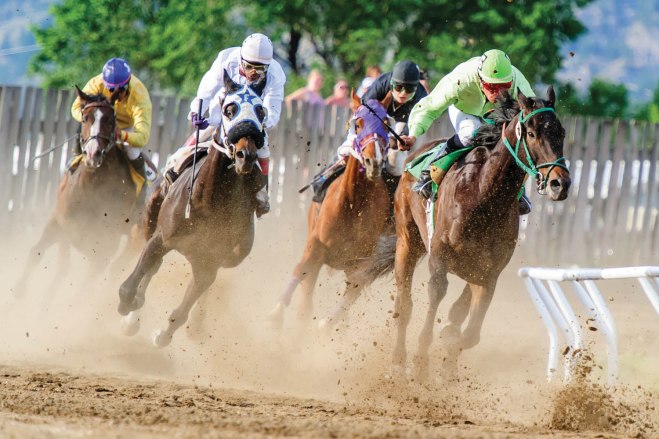
A row of antsy thoroughbreds, waiting for the bell to ring and the gates to fly open with a great bang, dance in place and chew on their bits in anticipation. Their muscles are tense and their jockeys poised for the veritable lift-off. I know this feeling from riding ex-racehorses into the start box of a 3-day event or standing on the starting line of a road race with thousands of other runners. It is like a sense of urgency. It is an all-encompassing, impatient waiting for the inevitable. The preparation for this moment has been everything. Without the preparation, for either man or beast, going from a standing start to a dead run can easily spell disaster, as it is too much force for muscles and tendons to take. We imagine the worst case scenario, but we have trained well, and expect to survive the event ahead of us.

Kicking up dirt

Kicking up dirt…Desert Park Track, Osoyoos B.C. (photo: Osoyoostimes.com)

If there is any fear in our desire for accomplishment, it has been overridden by now. Fear would paralyze us and leave us in the starting gate while everyone else takes off. Therefore, we have made allies out of our fears and doubts, and know the way forwards. The sense of urgency translates to a conditioned response… run!

When it comes to our collective response to the pressing needs of our planet however, the reaction time has been a little less focused, and somewhat slow off the start. If we were racehorses moving with such hesitation, you can bet the jockeys would be quick with the whip, or, as described by the attached article, the “goad.”

      “The same imperatives that apply to our personal dealings with life’s uncertainties can be extended to our response to climate change. The two run along parallel tracks. One conveys us through the upheavals in our private lives with a mind unshaken by sickness, loss and death. The other should convey us through the grim portends of the future and enable us to avert worst-case scenarios. In both spheres, the personal and the collective, we need the courage to see through our illusory sense of security, discern the lurking danger and set about making the transformations needed to reverse the underlying dynamics of disaster.”

 http://www.truth-out.org/opinion/item/26602-feeling-the-touch-of-the-goad-a-sense-of-urgency-as-a-spur-to-climate-action

At the beginning of my professional riding career, if I had been advised that in 20 years climate change would force me to rethink what I was doing working outdoors with horses, I would have cocked my head sideways like a curious puppy and wondered what the heck they were talking about.

As it is, the risks we have assumed by not moving quickly enough to resolve the momentous problems we now face are going to become the bane of our existence, and ultimately have a major effect on not only humans, but also our horses and all other living species on Earth. I have previously written a post about a couple of ranches in California where the wells have run dry. We need a lot of water every day, but horses need a lot more. Now we are hearing that due to the drought our fruits and vegetables in the Pacific Northwest will increase by more than 30% in the coming year. This will affect hay, grain and other feed prices for livestock too. There is no end in sight to this issue.

Now we’re really in a race…the race for our lives, and those of everyone and everything we love and call home.

Years ago, the first thing I noticed was the hot weather beginning earlier in the year and lasting longer. The air inversions, haboobs, and regular windstorms became stronger. The temperature swings wilder. What had been “normal” was no longer. It seems that where the environment is at its most fragile and extreme in the first place is where the evidence of climate change has been most noticeable, especially to those of us who spend most of our time outdoors. Sometimes the changes are subtle at first, but if you are a keen observer of nature, the signs of change have been glaring all along. Finally, others are starting to believe the ones who have been sounding the alarms, but perhaps too late in some instances. I couldn’t take it anymore, and left Phoenix for the higher desert area of Sedona. Then bizarre weather patterns began to emerge there too.

It began in the mid-2000s as the windstorms became a weekly occurrence with ever-increasing strength. At first it was just annoying. I had an adorable but flighty Arabian gelding in training at the time. He was afraid of two main things… the UPS truck and wind. I only rode him one day a week and that was Wednesday. I also had after-school students in the arena that day. It became a standing joke around the barn…Windy Wednesday. It always seemed to be the day of the week the skies would turn white from their usual cobalt bright blue after being criss-crossed with persistent aircraft contrails. An odd phenomenon indeed, but I have a number of photographs and videos that show the long trails of white spreading and merging with others, blanketing the entire sky from horizon to horizon. Both the horses and humans began to get sick far too often. Long-term respiratory ailments became common and allergies worsened. The horses did not appear to be “bloomy” or as healthy as they should have been.

At first I was in denial too. This couldn’t be happening. Several more years went by and it became impossible to ignore. Almost every time I went to the arena I was picking up the remnants of jumps and pieces of the PVC dressage arena boards that had been blown around by the windstorms, now increasing in frequency and strength. Even though stapled down, most of the jump’s decorations of plastic flowers were ripped away and blown far and wide. The jump standards were getting destroyed by the wind too, and much of the arena footing was gone as well.

Windy Wednesdays weren’t funny any more. It had gone from an annoyance to having to regularly cancel lessons as nobody could jump if the wind was constantly blowing the jumps over, raising massive clouds of dust, and making it difficult for anyone to hear me.

Whatever bits of rock and other debris could be lifted by the wind would be blasted across the open arena with the strength of a BB gun and it hurt! I could tell the horses just wanted to go back to the barn, and I didn’t blame them. Everybody, including the resilient teenagers, was commenting on how grouchy they became when the “creepy” windstorms hit. Such storms were now coming 2 or 3 days a week as were other wild weather swings. Incredible heat, freezing cold, downpours as only can happen in the desert…

One early morning in May my digital thermometer went blank. That meant it had gone past the limit of the readout, which was 124 degrees Fahrenheit. By the time I decided it was time to quit I was having thoughts of virtually needing to wear a HazMat suit to teach lessons. Between the constantly swirling fine dust, extreme UV index and high heat, there were no more tools left to protect oneself from the ever-changing climate-related weather fluctuations. I could no longer keep a regular schedule of lessons, as by 2008, I would say at least half of my bookings had to be cancelled due to wind advisories or other extreme weather. In years previous, such was not the case.

 “While fear over climate disruption often spurs denial and ends in panic or mental paralysis, it may equally well give rise to samvega, a sense of urgency leading to wise decisions to avert the crisis. Everything depends on how we metabolize our fear.”

     I know this sounds kind of pessimistic. I don’t believe irrational optimism should apply to our current issues with climate change however. Consider those who have to house, feed and water horses. In some places, this is now a very expensive and almost impossible proposition. It may not be so radical in other parts of North America or the world just yet, but it is only a very short matter of time before millions more people and animals will be in dire straits and displaced due to extreme weather and climate events. How do you sell your property and move elsewhere if there is no available water? No one will buy such a place!

Imagine you own a ranch or a boarding stable and there is no more water for your horses. Hay is over $15 a bale, if you can even get half-decent hay to begin with. You can’t charge your boarders enough to cover the costs of feed and hauled-in water, so then what happens? This is the reality for some people – now. Where does it go from here? I certainly don’t have the answers to that.

Why have we not acted and responded to this pending disaster sooner? This is like taking your horse out of the pasture and hoping he can instantly adapt to a foreign and hostile environment, run a mile and seven-eights and win the race without breaking down. It just won’t happen that way.

     “What lies behind this indifference and denial? How do we explain it? When we look at this phenomenon closely, we can see that it is sustained by two primal drives. One is desire or craving, which in this case is the fundamental desire for security, a wish that events will follow their familiar patterns. The other is fear, an instinctive dread of disruption. Beneath our outward self-assurance lies a volatile whirlpool of anxiety, a suppressed concern that things will swerve off-course and confront us with challenges we aren’t equipped to meet. When this anxiety is provoked, it erupts in outbursts of angry denial and denunciation of those who speak plain truth, the arch-enemy of self-deception.”

I do believe we need to step up to the line though, and not be waiting for the “touch of the goad” any longer. It is not only an awful lot of horses depending on our human ingenuity for their survival; it is also our entire species, and every other sentient being on this planet.

We want to be compassionate to our horses and not “goad” them into activity. We can choose to offer compassion to ourselves in the same way when considering our responses to the changing climate, and the environment in which we would love to be able to ride and enjoy our horses. If we have been inadequately prepared for this race, I believe it is time to bring an awareness to better training and conditioning, as well as an acceptance of where we are now so that we can all work towards a viable and sustainable future.

The tectonic plates beneath our sense of normalcy undergo a seismic shift and can never be restored. In Pali, the language of early Buddhism, the natural response to this shift is called samvega, a word best rendered as “a sense of urgency.” The sense of urgency draws upon desire and fear, but instead of pushing us to run amuck, it instills in us a compelling conviction that we have to do something about our situation, that we have to embark in a new direction profoundly different from everything we’ve tried before.  

The Buddha compares the arising of the sense of urgency to a horse’s response to its master’s goad:

Here, an excellent thoroughbred horse acquires a sense of urgency as soon as it sees the shadow of the goad, thinking: ‘What task will my trainer set for me today? What can I do to satisfy him?’ So too, an excellent thoroughbred person hears: ‘In such and such a village or town some woman or man has fallen ill or has died.’ He acquires a sense of urgency and strives carefully. Resolute, he realizes the supreme truth and, having pierced it through with wisdom, he sees it. (Anguttara Nikaya 4:113)

* * * * * 

Thank you to Dr. Schoen for sourcing the article from http://www.truth-out.org on which this post is based.

Changing Leads Gracefully

For a rider, being able to execute the perfect flying lead change with consistency is an accomplishment that comes only after a lot of hard work, determination, and a clear understanding of the horse you are mounted on. There are so many elements that have to come together before a horse can gracefully hop from left lead canter to right lead canter and back again, on cue. At the pinnacle of this accomplishment are the “tempi-changes” in Grand Prix dressage tests where the horse appears to be skipping as it remains on a straight line while changing leads every step. In theory it sounds so simple. Left lead, right lead. In practice, well, anyone who has been there with a horse or multiple horses can tell you that while there may be a common goal, every horse learns differently and has a unique set of parameters that may have them changing leads more easily and quickly than other horses, while some may never have an easy time of it. It is a step by step process for both horse and rider.

Flying lead change sequence (photo: www.equisearch.com)

Flying lead change sequence (photo: http://www.equisearch.com)

1) The long-term goals for reaching those smooth, consistent changes have to be clearly formed in the rider’s mind. You need the picture in your head of what constitutes a correct flying lead change. Then you develop a training plan you can follow, making particular decisions each step of the way to achieve the goal.

2) As a rider, hard work, education and training is everything. Before you can relay the aids in proper sequence to have a horse change leads, all of your basics should be solid, and ideally, you would have had a schoolmaster horse and excellent, compassionate trainer to learn from before being gaining the competence to pass that level of training on to another horse. You can never be excessively competent!

3) Be prepared for what might not work. Visualize failure too. In the understanding of what is correct about a lead change, the rider, like a dressage or reining judge, also has to know which elements will produce a lower score, or cause potential imbalances and possibly painful injuries to the horse. Tension, stiffness, deflection off the straight line, swinging haunches, too wide in the placement of the hind feet, hollow back, and many other issues can cause further problems. You cannot correct the mistakes if you don’t know what they are in the first place, so you want to be prepared in advance with the skills to identify and decide what to do should errors occur.

4) Enlist a group of extremely competent people to help you reach your goals. Communication with others who can support you in reaching your flying lead change goal helps you take each step with confidence. Part of communicating well involves listening well too, which every great riding student eventually comes to realize can make all the difference between a good performance and one that is below par. This is why a team of great people, including “eyes on the ground,” excellent veterinary care and a top notch farrier are all part of the picture when you are on the path to reaching your long-term goals.

5) With any horse, you may need to consider metaphorically switching leads at any time. As any experienced horseman will tell you, all that we do has an impermanence and even fragility about it. We can go on for so long taking for granted our wonderful horses and the equestrian lifestyle, forgetting how quickly things can change. What makes us feel the best as human beings is to give back. If we accept that the one simple thing we can hold on to is our knowledge, and how we apply that knowledge, our perception of life becomes a broader picture. We can step back a bit, as we so often have to do in the process of training horses, take a deep breath and ask ourselves, “how can my response to this situation be the most beneficial to all involved?” We can change our behaviors to accommodate a more productive situation for ourselves, our horses, and everyone else along the way.

6) When a rider has achieved a high level of competence and confidence, combined with many years of experience having learned from the failures and tribulations of life with horses and life in general (partnerships are partnerships whether with a horse or another human being), they may reach a state of beauty, joy, and a radiating sense of grace. When you get to that stage, you have a sense of having done something that goes beyond yourself. It is because such accomplishments require a tremendous amount of giving in the first place. It requires your time, your focus, your kindness and consideration of the horse. It does not happen automatically with a horse, and it does not typically happen for those who are just at the beginning of their careers or relationships. There is always the process of setting goals, then deciding what you will do next that will line up with your goals, whether it is to make those flying lead changes or to make major life changes. The key is to not blame the horse, or anyone else if there are bumps on the road to your goals. Blaming is easy, but it is changing our own behaviors that affect the greatest changes, personally, professionally, and for the good of all beings.

Astronaut Chris Hadfield at We Day:

http://www.huffingtonpost.ca/2014/10/03/chris-hadfield_n_5929992.html

The impetus for this post is derived from a video that was relayed to me by Dr. Schoen. It is astronaut Chris Hadfield speaking to an audience of primarily students on We Day, asking the question of what we can do to change the world. So what does this have to do with the accomplishment of teaching a horse to change leads smoothly? A lot actually. It is all about us.

Chris is asked, “What is the one cause you care about the most?” From his perspective of seeing the planet from above, all 7-billion human beings every 90 minutes over the course of the space station’s orbit, he says one’s perspective changes somewhat as to what is most important. He speaks of how everything is connected, and how much togetherness we need to sustain the planet.

He states his most important goal as follows:

“To raise the standard of living for as many people as possible and make it sustainable.”

The other question he raises is “what is one simple thing people can do to drive change?” The answer… “stop blaming other people.” Here is where we may need to make a lead change of our own sometimes. These are the suggestions from Chris (and this might sound familiar):

  • Have an overarching goal, then purposefully make decisions to make it happen.
  • Build everything on competence – there is no substitute for hard work. Chris put years of education and training into his dream before being chosen to be commander.
  • Visualize failure – be prepared for all possibilities.
  • Communicate with others – they will be there for you, and good communication includes good listening.
  • Give back – there is a fragility to the things we take for granted – make good use of your education to give back to others.
  • Seek grace – in grace we find tranquility, joy, accomplishment, and a sense of having done something that goes beyond ourselves.


Ultimately, what we learn from becoming compassionate equestrians applies to everything Chris Hadfield is relaying to the students in his We Day address. I don’t know if the famous astronaut has ever had contact with horses, but somehow I believe he would immediately recognize the factors that allow for the creation of high standards of accomplishment in the equine world are also the same qualities that apply to the process of making this a better world for all sentient beings. What we can learn from our connection to a horse can be extended to everyone we encounter in all of our human relationships, and beyond.


Condensing Time and Space

This is the new world. Nobody has time, and almost everybody is reading things in very small, narrow windows. We have condensed our world. Faster, smaller… better?

I was in an electronics store a short time ago and for the first time took a look at our blog and website on a smartphone screen. I’m a latecomer to the world of these devices, as I haven’t needed one, until now. Since we also have to travel lighter the power of the small screen decidedly trumps the necessity of packing a computer. In the world of condensed everything, even these two paragraphs are too long for most people. If you’ve been able to get this far – good for you!

When you squeeze text into a narrower window, obviously it makes the content appear much longer than it does on a wide-screen. So I’ve decided to try to make these posts shorter and sweeter so that everyone can get back to their busy-ness and other activities in due course.

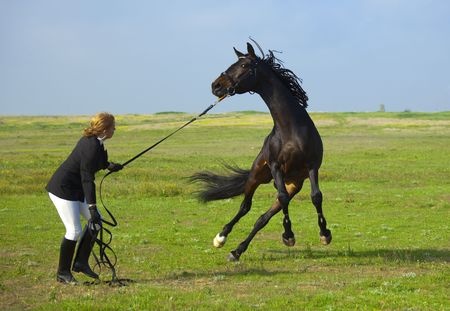
photo: americashorsedaily.com "Bad Warmup Behavior"

photo: americashorsedaily.com
“Bad Warmup Behavior”

What does this have to do with horses? Compassion?

I have seen the tiny electronic devices cause a considerable deflection from the intense focus that’s required to school a horse correctly. I’m old enough to have comparative values of the pre-cellphone and post-cellphone worlds. When my teenage students first started showing up at the barns sporting their new e-toys, I could sense  trouble was brewing. I knew what was coming down the high-tech pipelines too as I actually lived in a computer lab that was full of engineers and programmers developing this stuff. Nobody figured teenagers would be the first demographic addicted to tiny phones.

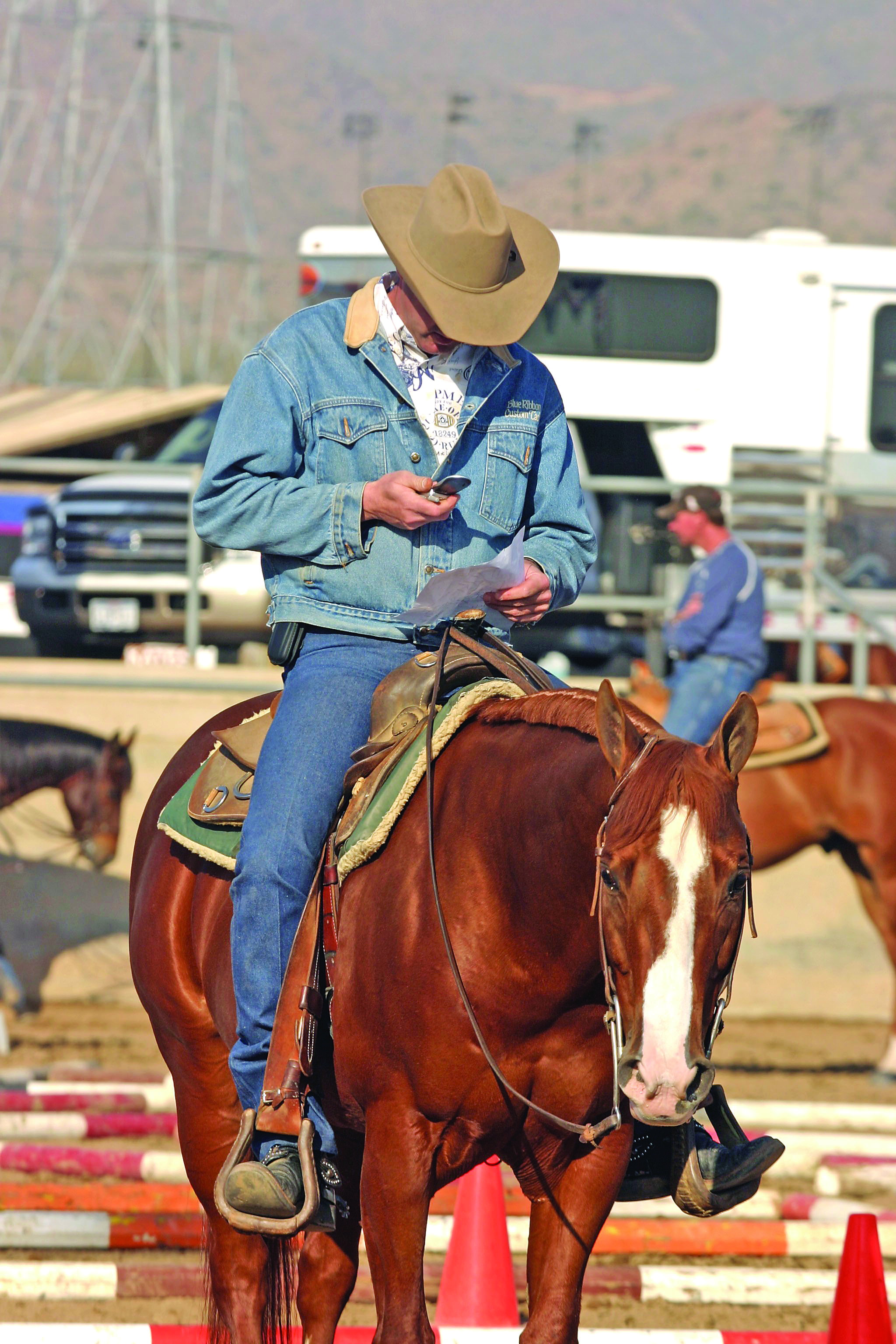
I will never forget the sight of one of the younger girls who was on her new 17.2 h.h. off-track thoroughbred for the first time. I was waiting in the arena for her to start her lesson and couldn’t figure out why the horse was drifting well away from the in-gate. Then I noticed the reins were on the buckle. No, wait. Not even on the buckle, they were dropped on the big gelding’s neck. The young rider had her head down, both hands on her phone, texting. The horse had no idea where he was supposed to go.

It wasn’t long before the lure of the e-device became far more important than the horse, who soon after began to act out on all the issues that come with an ex-racehorse. He ended up standing in his paddock for the next two years while the girl’s grandmother did her best to care for the high-energy thoroughbred, as none of the other kids had the patience for him either.

Everybody had to get back to their phone calls and texts.

It’s not going to get any better, I’m afraid. Not unless more people decide that it simply isn’t being mindful or compassionate to our horses as distracted humans carry on in this faster, smaller, (better?) world of narrow windows, too much to do, too much traffic, rising costs of everything, complex data plans, endless passwords, typing, typing and more typing (with thumbs, no less), and having to get information across in smaller and smaller chunks. How does anybody learn anything this way? How in the world did we all end up with so much to do and no time to do it? The mind is just too packed with fragmented bits of information to be focused…

…and riding a horse really well requires focus. Otherwise, somebody gets hurt, or somebody (usually the horse) IS hurting, and it goes unnoticed – because the mind is elsewhere – or the rider is in such a rush to get in and out of the barn that something else in the horse’s training goes amiss.

Obviously, I haven’t done a very good job of condensing this post either! So if you’ve also had the time to read this far – good for you again!

The only answer I can see – and Dr. Schoen has spoken about this many times and puts it into practice daily – is that we have to take control of our mind-space and consciously retrain, or re-wire, our thinking to where we can be more mindful. Being mindful means being more compassionate as with that clearer, calmer focus, it’s much easier to notice if somebody, especially our silent horse, is actually suffering in some way.

If you have patiently scrolled all the way through this post, thank you! Apparently I still have a lot to say about things – maybe too much – but in a very condensed conclusion, all I have to say is, when I finally get my first smartphone next week, I hope I’ll remember to put it down when necessary, look up and around and acknowledge everybody and everything that needs some attention and real human contact.

As the Barn Turns

We all have our stories about “barn drama”. No matter what breed, what discipline, or what type of facility you board your horse at, there will be drama.

A recent article in the Wall Street Journal spelled out just how bad things can get:

Horse therapy (photo www.yourhorse.co.uk)

Horse therapy
(photo http://www.yourhorse.co.uk)

‘Barn Drama’ Puts Riders on Their High Horses
People Who Board Horses Know That Misbehavior by Human Owners Is Common Hazard

by Lauren Lipton, April 13, 2014 http://www.wsjonline.com

Scot Gillies has a good idea of the kind of horse people who will fit in at Gryffindor Farm, the small barn he helps manage in Lexington, Ky. So his advertisements for new boarders spell it out in detail: Owners must be “laid-back,” “happy” and above all, “drama-free.”

In an example of ‘barn drama,’ an unknown culprit cut the tail of a prized stallion at a Kentucky horse show. Vicky Castegren
Mr. Gillies, a marketing consultant by day and a horse owner himself, says that during his 14 years in the equestrian world, “I’ve seen the full range of drama that is associated with horse people.”

A few categories of problematic individuals reign: There are overprotective owners who insist their animals be treated like porcelain figurines, and neglectful owners who never show up. There are “back seat riders,” as some call them, who love to criticize other people’s technique. Some freak out over a stray wisp of hay in the barn aisle; others let their animals leave unwanted souvenirs…

I’ve been on both sides of the fence myself, as a boarder and managing a boarding barn. From a small backyard operation of a couple of horses to one of the most famous show-jumping facilities in the world. I could write an entire book on this topic alone.

We all know this kind of “stuff” happens all the time at barns so why does it continue? Can’t we be civilized enough to allow our fellow horse-people to enjoy their mounts and their time at the barn without the concerns of being criticized, harassed, bullied, insulted, or even robbed? Where is the compassion for other humans amongst human horse owners?

Are horse-people just an inherently nasty personality type who can’t resist the chance to flaunt their “superior knowledge” at every chance? Sometimes one has to wonder…

The setup of a boarding barn almost guarantees unstable behavior: Take a group of passionate, opinionated individualists. (Riding, a solo activity, doesn’t attract “team players.”) Give them a consuming hobby centered on a delicate, expensive living creature. Put them in close quarters, often with children and dogs that run amok, spooking the horses, and let the backbiting begin.

Yikes. That doesn’t make us look too good as a subset of society does it?

I wonder if it’s just that horses bring up the deepest part of ourselves, perhaps even mirroring our most repressed fears and long-buried personality traits that we ourselves are surprised to discover when they surface. I can remember many incidents over the years, even going back to my teens, where being around horses made me more reactive and opinionated around people than usual. In fact, I was pretty shy and reclusive around people, even quite nervous, when I didn’t have a horse nearby to “cover” for me. There is definitely new research emerging that confirms a neurobiological basis to our interactions and behaviors between species.

At horse barns I’ve found most people only get to know each other as they relate to their horses and their specific activity at the barn. We don’t get to know each other well and so there may be assumptions made about others causing us to form opinions about them that are untrue or incomplete. This can cause rifts amongst people who might become friendlier if they understood each other a little better. Some riders may form more lasting or bonding friendships and enjoy great camaraderie, but it always seems to split into “cliques”, just like high school. This seems especially true if there’s multiple disciplines involved at the barn:

Some barns attract more drama than others. High-end facilities with riders who compete on the show circuit in events like jumping and dressage can be hotbeds of jealousy; trail-rider barns are said to be easier-going. A mix of disciplines and levels, from serious equestrians to children taking lessons, can make problems worse.

“The minute you start mixing the hunter-jumpers with the dressage people with the Western pleasure people, that is like drama times three,” says Macala Wright, who boards her two horses in a facility that also includes a nonprofit equestrian-therapy group.

“The affluent people look down on the everyday horse owners. The dressage people don’t like the hunters, and every group looks down on the nonprofits,” says Ms. Wright, a Los Angeles branding consultant who has shuttled one of her horses through four barns in two years. At the second, which catered mostly to wealthy riders, “People would comment, ‘Oh, your dressage saddle isn’t very good quality,’ ” recalls Ms. Wright.

Something seems to be missing. Perhaps that would be “compassion,”  – the desire to relieve the suffering of another. Given the scenarios mentioned in this article, it would appear that compassion for others, and even other people’s horses, is sadly absent. I wonder if it’s possible to create a barn with a boarding contract that spells out something more profound than a “no drama” clause…

The best defense against drama may be a no-nonsense management style. “Three strikes and you’re out!” works for Donna Hyde, who juggles 22 horses, 18 boarders and disciplines including therapeutic riding, Western dressage and trail riding at her Norco, Calif., facility.

It’s an unfortunate commentary on the business when a barn manager has to constantly be on the defence for bad behavior. It just makes the barn manager appear to be angry or potentially angry much of the time too. In fact, if they’re dealing with or perpetuating the drama themselves, they may actually be angry! The attitude from the top-down affects everyone at the barn, including the horses.

By the time a boarder has reached the “three strikes and you’re out!” order, they’ve usually already left a trail of destruction ranging from hurt feelings to causing others to leave the barn. You can end up losing a good client because of a disruptive one.

Our answer with The Compassionate Equestrian is to create a new paradigm for horse-people and the equine industry that will allow a barn to follow the program Dr. Schoen and I have been working on. Its principles are designed to encourage the development of self-compassion, compassion for horses, and for all beings. There will eventually be a database of compassionate barns and trainers who will be doing their best to ensure everyone under their care and management is mindful of others and coming from a place of compassionate awareness.

We believe that horse-people are highly influential in their communities, both in and outside of their equestrian activities. If we are known as a “hazard” to each other and noted as “unstable personalities” we are not setting a good example for others, and especially not for young people who need safe, happy environments in which to enjoy their horses. Nobody should ever have to arrive at their barn and be afraid of what negative things will be said or done to them or their horse.

Everyone has the capacity to become more compassionate, and it does take a conscious effort to maintain compassion when situations may become difficult. For the sake of our community, our horses, and peaceful interactions in our barns, it’s our wish that all horse-people consider the benefits of compassion and the extraordinary, broad-reaching impact it can have on our world, well beyond that of the barn.


The Benefits – or Not – of Freedom

Imagine the Earth before there were any countries or borders of any kind. No lines, no names of this or that, no maps, no fences… nothing. The only sounds were the sounds made by Nature. There was no “time” according to human parameters. Just the continuous, ever flowing cycles of life. All creatures were free to wander wherever they would, or could. They were unbound by man-made constraints and the defining qualities brought about by the human tendencies of wants, needs, and ownership.

We couldn’t leave well enough alone, could we? We had to make countries and borders then create weapons of war to protect the countries and make enemies of those from other places. Horses were captured and domesticated to assist humans in their pursuits to “divide and conquer”. Unwitting participants along our path of so-called civilization.

It’s almost like we’ve painted ourselves into a corner after centuries of nation-building and social development. Are we free or not free? We’re surrounded by borders and rules telling us where and when we can and cannot go to visit or live. What of all the animals we’ve domesticated and bred? If we and they have wonderful, fulfilling lives, should there be judgement placed on how such great societies have been created? What about the millions of people and animals who still suffer so greatly on this planet, with no freedom to escape bad situations? If we have compassion for all beings, how can we be at peace until all beings on Earth are at peace?

According to Professor Lori Gruen’s interesting viewpoint, there are serious ethical questions to be asked about keeping animals in cages… or in the case of horses, the reference would be to keeping them in stalls and barns as our “captives”.

http://www.psychologytoday.com/blog/animal-emotions/201404/the-ethics-captivity-new-book-covers-all-the-issues

“Though conditions of captivity vary widely for humans and for other animals, there are common ethical themes that imprisonment raises, including the value of liberty, the nature of autonomy, the meaning of dignity, and the impact of routine confinement on physical and psychological well-being.”

Now, imagine what the implications would be if everybody just quit riding their horses, opened all the stall doors and paddock fences and set them free. It’s likely chaos would ensue. Sure, they might run amok for awhile or stop by the neighbour’s apple trees but most would be right back at the barn doors at feeding time looking for their next meal. Some wouldn’t leave at all. A few might join the wild herds, as in the deserts of the American Southwest where the economic downturn really did lead some people to turn their show and companion horses loose to fend for themselves. Rescue operations bordering desert communities have found themselves with “strays” looking for food and water.  Domestic horses don’t do well on their own.

"Nick" - photo by Natascha Wille

“Nick” – photo by Natascha Wille

Let’s face it. Horses are big animals that leave a big hoofprint on the environment. In our “non-ideal” world as Dr. Gruen refers to, we have to “do the very best we can for them while their lives are compromised to various degrees in captive settings”.

Dr. Marc Bekoff, the writer of the article states, ” let’s hope that open discussion of the issues and the questions at hand, including what we know about the cognitive and emotional lives of animals and their capacity to suffer and to empathize with others, will work on behalf of those unfortunate billions of individuals who lives are a mess because of their confinement”.

So somewhere in the middle of “let’s turn all the horses loose” and “let’s keep them confined for our own pleasure and use” is the question “what is the most compassionate way to care for and interact with our horses?”

There is new, emerging research all the time that is telling us what causes distress to horses. We know for sure that ulcers are a man-made condition in equines, caused by stress placed on them due to excessive confinement, travel and showing. In our human rush to conquer and control everything, have we gone too far with horses and committed them to a lifestyle that is so unnatural for them that we’ve changed their genetic makeup? Probably. Is this bad? What have we done to other humans with such a mindset? Even in such things as personal relationships. Are we being compassionate to our partners when we hold them “captive” according to our wants, needs, schedules and whims?

Ah freedom. Look your horse in the eye and ask if he’d rather be turned loose to run and graze wherever he wants. No more grooming, hoof trimming, veterinary care, clean hay and water or forced exercise. Would he tilt his head like a curious puppy and ask “why”? Or would he immediately start nodding his head, pounding on the stall door with the enthusiasm of a football player charging into the opponent’s end zone for a touchdown? What would happen if you told your human partner or spouse they were free to go wherever they choose, whenever, and with whom?

My guess is the equine and human responses would vary, but most would fall somewhere in the middle of the extremes. Having compassion and wishing to alleviate another’s suffering means first of all, to be mindful of the fact that they’re suffering. Is your horse (or human partner) suffering in silence and you’re not seeing it? If you opened the door to set them free, would they go? Would they come back to you after realizing how kind and compassionate you were to them? Do they recognize freedom as being of benefit to them, or are they looking for the security of the home they’ve become so accustomed to and are willing to compromise their freedom to remain “captive” in a potentially less-than-ideal situation? These are the gists of the ethical questions posed by Dr.s Gruen and Bekoff.

Freedom is not about owning and controlling. Perhaps we need to consider that with our “captive” animals and being mindful as to how they are affected by confinement and the tasks we ask of them. Horses have evolved to fit with a domesticated lifestyle, as have humans, and many of the other pets we keep. Turning them all loose would not necessarily be conducive to their health and wellbeing. We all need to depend on each other for care and love, otherwise we lead a lonely and vulnerable life. The kindest approach of all is to acknowledge everyone as a free spirit, accepting who and what they are, with a compassionate heart and mind.


A Happy Horse, of Course!

We do everything else online these days so why not learn how to be happy by taking an online course too!? I had to think about this for a few days, and try to compute what “happy” really means. Especially to a horse. Does a horse think “happy thoughts”? I think with humans, part of the problem is we think too much. Part of being happy is to stop it. “Thinking” too much that is. At least so far as instructions in mind-training go as we are taught to let go of binding attachments to desires and things and just “be”. Yet even when taught to observe the mind as an instrument of desire, we still have wants and needs. It’s part of being human. It depends on what those wants and needs are. Do we want “stuff” or do we want to be of benefit to all beings?

For a horse to be happy, does he have to stop thinking or start thinking? Perhaps with animals, it’s simply a matter of how they respond in the moment as opposed to deciding how they will do everything from selecting a partner to where they will live and work and what they will acquire that will supposedly “make” them happy. They go about their horse-business and seem to be most at peace when they’re turned out in a pasture together and can function as closely to their natural herd behavior as much as possible.

The "herd" waiting to be brought in for dinner.

The “herd” waiting to be brought in for dinner.

What’s interesting about the fundamental ideas behind the “happiness course” is that they sound a lot like the way a herd of horses naturally operates. “Strong social ties”. Check. “A sense of purpose or connection to the greater good”. Check. “Reading people’s emotions”. Oh yes, horses are really good at that too. Do they have compassion? Empathy? I believe many of us who have worked with horses a long time can cite stories of horses displaying all the qualities this course teaches us about being happy. How fascinating!

http://www.huffingtonpost.com/2014/04/23/why-thousands-of-people-a_n_5175603.html?utm_hp_ref=mostpopular

“The [course] starts with the idea that happiness and health are fundamentally about strong social connections and being immersed in a strong social community,” says Keltner, citing research that strong social ties can add years to your life. “We’re going to zero in on things that build strong social ties and communities — things like compassion, empathy, how to read people’s emotions, gratitude, charity, generosity and giving.”

The course emphasizes two main (scientifically-proven) keys to happiness: Strong social ties, and a sense of purpose or connection to the greater good.

Granted, the definition of true happiness can be somewhat broad-based and subjective. A quick online search for the definition provided this description:

hap·pi·ness
ˈhapēnis/
noun
the state of being happy.
“she struggled to find happiness in her life”
synonyms: pleasure, contentment, satisfaction, cheerfulness, merriment, gaiety, joy, joyfulness, joviality, jollity, glee, delight, good spirits, lightheartedness, well-being, enjoyment;

For horses, that could translate to the pleasure of eating a bucket full of tasty grain or taking off across the field, bucking and playing as a delighted free spirit with the rest of the herd. Sounds similar to what humans find satisfying and joyful. Eating, playing… it appears all beings might be looking for the same thing.

Can happiness-seeking take a wrong turn? I can see all the heads nodding now.

This goes back to our desire for self-satisfaction and thinking we’re going to find that either through others, or through the acquisition of material goods. It looks like the online happiness course is scientifically-backed to prove there are definitely errors made in human thinking as to what will make us happy.

I had a landlord once who lived right below my apartment. He and his girlfriend were generous, caring souls, but he was convinced she was supposed to “make him happy”. It’s a fragile way to maintain a human relationship. As soon as he was “unhappy” the arguments would ensue and it became an unpleasant environment not only for them as a couple, but for everyone else in the vicinity who was subjected to their unhappy behaviors. They would eventually make up and the entire cycle would start again.

Horses don’t seem to have these problems.

I’ve watched horses respond to other horses in distress many times. They don’t like it when a herd-member is in trouble or hurting, even if they only know the horse as a stable-mate who lives in another stall in the barn. They will exhibit signs of stress and call out to the distressed horse. Is this not a sign of compassion and empathy? I’ve seen an entire herd of pasture-mates form a procession and circle around one of their own who was dying. Is this not a sign of sentience, intelligence and compassion?

I believe that amongst domesticated horses, we humans are often thought of as part of their herd. Perhaps more so by some horses than others, but I’ve seen signs of acceptance in that regard as well. It’s probably why so many people feel so protective and emotionally attached to their horses. It’s hard not see them as objects of desire and “things” that exist to make us happy, but they are so much more than that.

As the happiness course indicates, the factors that make for true happiness are strong social circles and caring for others. So our real happiness with horses comes from that aspect of being with them, and not so much from the aspect of how much they cost, how much fancy tack we can dress them up with, or how many ribbons we can win in the show ring with them. All that “stuff” simply pales in light of the real reasons horses can bring us true happiness. No wonder they’re so inherently happy 🙂


When a “Behavioral Problem” Really is Just That

In The Compassionate Equestrian Dr. Schoen and I stress repeatedly that when a horse exhibits behavioral issues, first rule out pain as the root cause.  This is especially true if there’s a change in the horse’s base personality.  Sometimes this takes more than one veterinarian’s opinion.   Diagnosis of subtle lamenesses can be difficult to pinpoint and the first sign of a problem might be the new or increasingly difficult behavior.

However, in my many 30+ years of working with all kinds of horses of varying breeds, ages, backgrounds and temperaments, there are a few quirky personalities in the crowd that are simply, well, weird.  They have legitimate behaviors that are out of the context of “normal” for most horses and sometimes the most compassionate thing to do is let them be exactly as they are.  If you can hang on, or tolerate them that is.

Sometimes you just hang on! (photo Alina Pavlova, 123rf.com)

Sometimes you just hold on!
(photo Alina Pavlova, 123rf.com)

Some of the most interesting have been the off-track thoroughbreds.  The subject of this post is one little, classic, plain bay gelding.  Nothing particularly spectacular to look at, but he had the kind of personality that made everyone look.  Kind of in the way you can’t take your eyes off the cars in a demolition derby.

His name was Earthquake.  As the story went, he was born in California during an actual earthquake.  We never did confirm whether or not this was true.  He was booted off the track in San Diego due to his “bad behavior”.  He ended up in a backyard in Phoenix that housed the other off-track thoroughbred jumpers belonging to his owners.  Besides a string of successful racehorses, they had produced some of the top amateur jumpers on the circuit.

Earthquake’s owner, Tracy, is the sister of the trainer I was working for at the time.  She told us “Quake” was almost impossible to ride on the flat.  Even with all of her experience in showing and winning at the “A” Circuit level, this little bay gelding scared her.  He would scoot out from under her, spin, leap, and generally act like a crazy horse.  She didn’t know what to do with him.

One day he was turned loose in the arena to play.  Tracy watched, somewhat stunned, while ‘Quake galloped over jump after jump all on his own, apparently inspired from watching her other horses school over fences.  So she clung through the flatwork with him and began to train him for jumper classes.

I had the task of helping her with him at his first show.  Lucky me!

I always maintained that somebody had to be the “entertainment of the day” at a horse show and frequently it was our barn.  Tracy’s brother was an excellent, caring horseman and would never consider drugging a horse to calm it down or make it easier to ride.  He just quietly rode whatever was underneath him in the moment, and so did his sister.

Taking thoroughbreds from the track to their first few shows is always a wild card.  ‘Quake was at least consistent with his quirky behavior.  I watched the crowded warm-up arena from the barns and it was easy to spot him.  That would be the horse and rider leaping above all the others, unrelated to where the warmup jumps were placed.

He was so excited to go in the show ring for his rounds, he couldn’t be contained.  He would paw, stretch, almost drop himself to the ground, spin, leap, and spook other horses at the in-gate.   Tracy hung on.  Then he would go in the arena, focus, clear every jump, and won almost every class he was entered in.  He was phenomenal.  Just impossible outside of the jumper ring!

He got better at his routine as he began to get the hang of showing.

I had to tack him up before one of the classes and it was exhausting.  He spun around in the stall.  He couldn’t stay still for a second.  I even tried pressing on an acupressure point on the coronary band, in the center of a front hoof.  It actually seemed to work, much to my relief.  He calmed down and I finished getting him saddled for his class.

Another day, and another class.  We got him tacked up and Tracy left him tied in his stall to go walk the course.  ‘Quake knew where she was going and he was apparently upset that he wasn’t going to the jumper ring with her.  I went in the tack room for a moment when I heard a loud crash from ‘Quake’s stall.  Mortified, I saw that he’d somehow jumped over the stall guard while still tied to the inside of the stall.  I have no idea how he could have maneuvered his body in such a way through a small opening and over the barrier.  Luckily he was unhurt in his desperation to follow his rider to the arena.

All you can do with that kind of enthusiasm is support it and hope the horse connects with the right rider and the right activity to accommodate his energy and ability.  In this case, the stars lined up and what would have been an extremely difficult ride for many equestrians, turned out for the best.  Last I heard ‘Quake was winning Grand Prix classes in the southwest.

Not every horse with behavioral “quirks” is lucky enough to find its way to a compassionate, competent owner that has the patience to simply let him “be” and allow the talent to shine through.  If ‘Quake had been punished for his leaping and spinning who knows what kind of a different horse he may have turned into.  Most likely not such an enthusiastic jumper who seemed completely enamoured with his owner.

If you have been able to rule out pain as the cause of your horse’s “behavior problem” and have determined he’s just of the personality type to be the way he is, then kudos to you for your compassion and understanding.  In my mind, I can see the happy little grins on all those clownish horses out there whose joy for life just can’t be constrained.


____________________

The Compassionate Equestrian is pleased to be affiliated with the International Charter For Compassion’s new Sector on the Environment

For information about the Charter for Compassion, and the upcoming Compassion Relays, click on the following link:

http://compassiongames.org/compassion-relays/