They’re in the Gate…

…and they’re off!

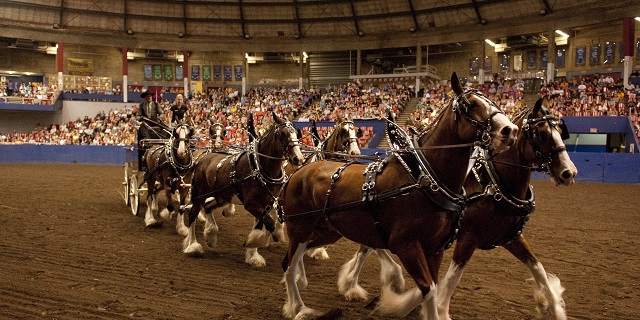
A row of antsy thoroughbreds, waiting for the bell to ring and the gates to fly open with a great bang, dance in place and chew on their bits in anticipation. Their muscles are tense and their jockeys poised for the veritable lift-off. I know this feeling from riding ex-racehorses into the start box of a 3-day event or standing on the starting line of a road race with thousands of other runners. It is like a sense of urgency. It is an all-encompassing, impatient waiting for the inevitable. The preparation for this moment has been everything. Without the preparation, for either man or beast, going from a standing start to a dead run can easily spell disaster, as it is too much force for muscles and tendons to take. We imagine the worst case scenario, but we have trained well, and expect to survive the event ahead of us.
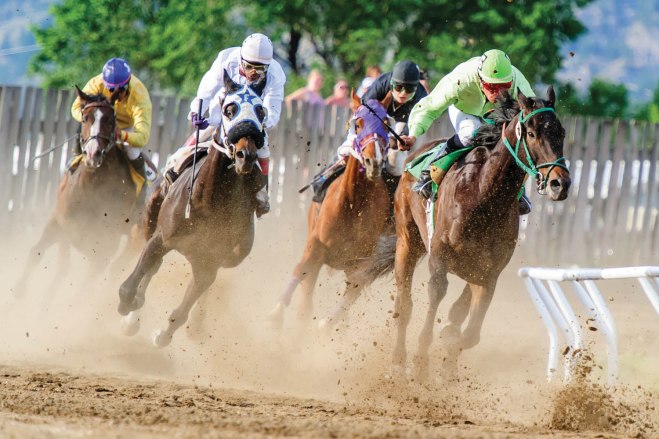
Kicking up dirt

Kicking up dirt…Desert Park Track, Osoyoos B.C. (photo: Osoyoostimes.com)

If there is any fear in our desire for accomplishment, it has been overridden by now. Fear would paralyze us and leave us in the starting gate while everyone else takes off. Therefore, we have made allies out of our fears and doubts, and know the way forwards. The sense of urgency translates to a conditioned response… run!

When it comes to our collective response to the pressing needs of our planet however, the reaction time has been a little less focused, and somewhat slow off the start. If we were racehorses moving with such hesitation, you can bet the jockeys would be quick with the whip, or, as described by the attached article, the “goad.”

      “The same imperatives that apply to our personal dealings with life’s uncertainties can be extended to our response to climate change. The two run along parallel tracks. One conveys us through the upheavals in our private lives with a mind unshaken by sickness, loss and death. The other should convey us through the grim portends of the future and enable us to avert worst-case scenarios. In both spheres, the personal and the collective, we need the courage to see through our illusory sense of security, discern the lurking danger and set about making the transformations needed to reverse the underlying dynamics of disaster.”

 http://www.truth-out.org/opinion/item/26602-feeling-the-touch-of-the-goad-a-sense-of-urgency-as-a-spur-to-climate-action

At the beginning of my professional riding career, if I had been advised that in 20 years climate change would force me to rethink what I was doing working outdoors with horses, I would have cocked my head sideways like a curious puppy and wondered what the heck they were talking about.

As it is, the risks we have assumed by not moving quickly enough to resolve the momentous problems we now face are going to become the bane of our existence, and ultimately have a major effect on not only humans, but also our horses and all other living species on Earth. I have previously written a post about a couple of ranches in California where the wells have run dry. We need a lot of water every day, but horses need a lot more. Now we are hearing that due to the drought our fruits and vegetables in the Pacific Northwest will increase by more than 30% in the coming year. This will affect hay, grain and other feed prices for livestock too. There is no end in sight to this issue.

Now we’re really in a race…the race for our lives, and those of everyone and everything we love and call home.

Years ago, the first thing I noticed was the hot weather beginning earlier in the year and lasting longer. The air inversions, haboobs, and regular windstorms became stronger. The temperature swings wilder. What had been “normal” was no longer. It seems that where the environment is at its most fragile and extreme in the first place is where the evidence of climate change has been most noticeable, especially to those of us who spend most of our time outdoors. Sometimes the changes are subtle at first, but if you are a keen observer of nature, the signs of change have been glaring all along. Finally, others are starting to believe the ones who have been sounding the alarms, but perhaps too late in some instances. I couldn’t take it anymore, and left Phoenix for the higher desert area of Sedona. Then bizarre weather patterns began to emerge there too.

It began in the mid-2000s as the windstorms became a weekly occurrence with ever-increasing strength. At first it was just annoying. I had an adorable but flighty Arabian gelding in training at the time. He was afraid of two main things… the UPS truck and wind. I only rode him one day a week and that was Wednesday. I also had after-school students in the arena that day. It became a standing joke around the barn…Windy Wednesday. It always seemed to be the day of the week the skies would turn white from their usual cobalt bright blue after being criss-crossed with persistent aircraft contrails. An odd phenomenon indeed, but I have a number of photographs and videos that show the long trails of white spreading and merging with others, blanketing the entire sky from horizon to horizon. Both the horses and humans began to get sick far too often. Long-term respiratory ailments became common and allergies worsened. The horses did not appear to be “bloomy” or as healthy as they should have been.

At first I was in denial too. This couldn’t be happening. Several more years went by and it became impossible to ignore. Almost every time I went to the arena I was picking up the remnants of jumps and pieces of the PVC dressage arena boards that had been blown around by the windstorms, now increasing in frequency and strength. Even though stapled down, most of the jump’s decorations of plastic flowers were ripped away and blown far and wide. The jump standards were getting destroyed by the wind too, and much of the arena footing was gone as well.

Windy Wednesdays weren’t funny any more. It had gone from an annoyance to having to regularly cancel lessons as nobody could jump if the wind was constantly blowing the jumps over, raising massive clouds of dust, and making it difficult for anyone to hear me.

Whatever bits of rock and other debris could be lifted by the wind would be blasted across the open arena with the strength of a BB gun and it hurt! I could tell the horses just wanted to go back to the barn, and I didn’t blame them. Everybody, including the resilient teenagers, was commenting on how grouchy they became when the “creepy” windstorms hit. Such storms were now coming 2 or 3 days a week as were other wild weather swings. Incredible heat, freezing cold, downpours as only can happen in the desert…

One early morning in May my digital thermometer went blank. That meant it had gone past the limit of the readout, which was 124 degrees Fahrenheit. By the time I decided it was time to quit I was having thoughts of virtually needing to wear a HazMat suit to teach lessons. Between the constantly swirling fine dust, extreme UV index and high heat, there were no more tools left to protect oneself from the ever-changing climate-related weather fluctuations. I could no longer keep a regular schedule of lessons, as by 2008, I would say at least half of my bookings had to be cancelled due to wind advisories or other extreme weather. In years previous, such was not the case.

 “While fear over climate disruption often spurs denial and ends in panic or mental paralysis, it may equally well give rise to samvega, a sense of urgency leading to wise decisions to avert the crisis. Everything depends on how we metabolize our fear.”

     I know this sounds kind of pessimistic. I don’t believe irrational optimism should apply to our current issues with climate change however. Consider those who have to house, feed and water horses. In some places, this is now a very expensive and almost impossible proposition. It may not be so radical in other parts of North America or the world just yet, but it is only a very short matter of time before millions more people and animals will be in dire straits and displaced due to extreme weather and climate events. How do you sell your property and move elsewhere if there is no available water? No one will buy such a place!

Imagine you own a ranch or a boarding stable and there is no more water for your horses. Hay is over $15 a bale, if you can even get half-decent hay to begin with. You can’t charge your boarders enough to cover the costs of feed and hauled-in water, so then what happens? This is the reality for some people – now. Where does it go from here? I certainly don’t have the answers to that.

Why have we not acted and responded to this pending disaster sooner? This is like taking your horse out of the pasture and hoping he can instantly adapt to a foreign and hostile environment, run a mile and seven-eights and win the race without breaking down. It just won’t happen that way.

     “What lies behind this indifference and denial? How do we explain it? When we look at this phenomenon closely, we can see that it is sustained by two primal drives. One is desire or craving, which in this case is the fundamental desire for security, a wish that events will follow their familiar patterns. The other is fear, an instinctive dread of disruption. Beneath our outward self-assurance lies a volatile whirlpool of anxiety, a suppressed concern that things will swerve off-course and confront us with challenges we aren’t equipped to meet. When this anxiety is provoked, it erupts in outbursts of angry denial and denunciation of those who speak plain truth, the arch-enemy of self-deception.”

I do believe we need to step up to the line though, and not be waiting for the “touch of the goad” any longer. It is not only an awful lot of horses depending on our human ingenuity for their survival; it is also our entire species, and every other sentient being on this planet.

We want to be compassionate to our horses and not “goad” them into activity. We can choose to offer compassion to ourselves in the same way when considering our responses to the changing climate, and the environment in which we would love to be able to ride and enjoy our horses. If we have been inadequately prepared for this race, I believe it is time to bring an awareness to better training and conditioning, as well as an acceptance of where we are now so that we can all work towards a viable and sustainable future.

The tectonic plates beneath our sense of normalcy undergo a seismic shift and can never be restored. In Pali, the language of early Buddhism, the natural response to this shift is called samvega, a word best rendered as “a sense of urgency.” The sense of urgency draws upon desire and fear, but instead of pushing us to run amuck, it instills in us a compelling conviction that we have to do something about our situation, that we have to embark in a new direction profoundly different from everything we’ve tried before.  

The Buddha compares the arising of the sense of urgency to a horse’s response to its master’s goad:

Here, an excellent thoroughbred horse acquires a sense of urgency as soon as it sees the shadow of the goad, thinking: ‘What task will my trainer set for me today? What can I do to satisfy him?’ So too, an excellent thoroughbred person hears: ‘In such and such a village or town some woman or man has fallen ill or has died.’ He acquires a sense of urgency and strives carefully. Resolute, he realizes the supreme truth and, having pierced it through with wisdom, he sees it. (Anguttara Nikaya 4:113)

* * * * * 

Thank you to Dr. Schoen for sourcing the article from http://www.truth-out.org on which this post is based.

Changing Leads Gracefully

For a rider, being able to execute the perfect flying lead change with consistency is an accomplishment that comes only after a lot of hard work, determination, and a clear understanding of the horse you are mounted on. There are so many elements that have to come together before a horse can gracefully hop from left lead canter to right lead canter and back again, on cue. At the pinnacle of this accomplishment are the “tempi-changes” in Grand Prix dressage tests where the horse appears to be skipping as it remains on a straight line while changing leads every step. In theory it sounds so simple. Left lead, right lead. In practice, well, anyone who has been there with a horse or multiple horses can tell you that while there may be a common goal, every horse learns differently and has a unique set of parameters that may have them changing leads more easily and quickly than other horses, while some may never have an easy time of it. It is a step by step process for both horse and rider.

Flying lead change sequence (photo: www.equisearch.com)

Flying lead change sequence (photo: http://www.equisearch.com)

1) The long-term goals for reaching those smooth, consistent changes have to be clearly formed in the rider’s mind. You need the picture in your head of what constitutes a correct flying lead change. Then you develop a training plan you can follow, making particular decisions each step of the way to achieve the goal.

2) As a rider, hard work, education and training is everything. Before you can relay the aids in proper sequence to have a horse change leads, all of your basics should be solid, and ideally, you would have had a schoolmaster horse and excellent, compassionate trainer to learn from before being gaining the competence to pass that level of training on to another horse. You can never be excessively competent!

3) Be prepared for what might not work. Visualize failure too. In the understanding of what is correct about a lead change, the rider, like a dressage or reining judge, also has to know which elements will produce a lower score, or cause potential imbalances and possibly painful injuries to the horse. Tension, stiffness, deflection off the straight line, swinging haunches, too wide in the placement of the hind feet, hollow back, and many other issues can cause further problems. You cannot correct the mistakes if you don’t know what they are in the first place, so you want to be prepared in advance with the skills to identify and decide what to do should errors occur.

4) Enlist a group of extremely competent people to help you reach your goals. Communication with others who can support you in reaching your flying lead change goal helps you take each step with confidence. Part of communicating well involves listening well too, which every great riding student eventually comes to realize can make all the difference between a good performance and one that is below par. This is why a team of great people, including “eyes on the ground,” excellent veterinary care and a top notch farrier are all part of the picture when you are on the path to reaching your long-term goals.

5) With any horse, you may need to consider metaphorically switching leads at any time. As any experienced horseman will tell you, all that we do has an impermanence and even fragility about it. We can go on for so long taking for granted our wonderful horses and the equestrian lifestyle, forgetting how quickly things can change. What makes us feel the best as human beings is to give back. If we accept that the one simple thing we can hold on to is our knowledge, and how we apply that knowledge, our perception of life becomes a broader picture. We can step back a bit, as we so often have to do in the process of training horses, take a deep breath and ask ourselves, “how can my response to this situation be the most beneficial to all involved?” We can change our behaviors to accommodate a more productive situation for ourselves, our horses, and everyone else along the way.

6) When a rider has achieved a high level of competence and confidence, combined with many years of experience having learned from the failures and tribulations of life with horses and life in general (partnerships are partnerships whether with a horse or another human being), they may reach a state of beauty, joy, and a radiating sense of grace. When you get to that stage, you have a sense of having done something that goes beyond yourself. It is because such accomplishments require a tremendous amount of giving in the first place. It requires your time, your focus, your kindness and consideration of the horse. It does not happen automatically with a horse, and it does not typically happen for those who are just at the beginning of their careers or relationships. There is always the process of setting goals, then deciding what you will do next that will line up with your goals, whether it is to make those flying lead changes or to make major life changes. The key is to not blame the horse, or anyone else if there are bumps on the road to your goals. Blaming is easy, but it is changing our own behaviors that affect the greatest changes, personally, professionally, and for the good of all beings.

Astronaut Chris Hadfield at We Day:

http://www.huffingtonpost.ca/2014/10/03/chris-hadfield_n_5929992.html

The impetus for this post is derived from a video that was relayed to me by Dr. Schoen. It is astronaut Chris Hadfield speaking to an audience of primarily students on We Day, asking the question of what we can do to change the world. So what does this have to do with the accomplishment of teaching a horse to change leads smoothly? A lot actually. It is all about us.

Chris is asked, “What is the one cause you care about the most?” From his perspective of seeing the planet from above, all 7-billion human beings every 90 minutes over the course of the space station’s orbit, he says one’s perspective changes somewhat as to what is most important. He speaks of how everything is connected, and how much togetherness we need to sustain the planet.

He states his most important goal as follows:

“To raise the standard of living for as many people as possible and make it sustainable.”

The other question he raises is “what is one simple thing people can do to drive change?” The answer… “stop blaming other people.” Here is where we may need to make a lead change of our own sometimes. These are the suggestions from Chris (and this might sound familiar):

  • Have an overarching goal, then purposefully make decisions to make it happen.
  • Build everything on competence – there is no substitute for hard work. Chris put years of education and training into his dream before being chosen to be commander.
  • Visualize failure – be prepared for all possibilities.
  • Communicate with others – they will be there for you, and good communication includes good listening.
  • Give back – there is a fragility to the things we take for granted – make good use of your education to give back to others.
  • Seek grace – in grace we find tranquility, joy, accomplishment, and a sense of having done something that goes beyond ourselves.


Ultimately, what we learn from becoming compassionate equestrians applies to everything Chris Hadfield is relaying to the students in his We Day address. I don’t know if the famous astronaut has ever had contact with horses, but somehow I believe he would immediately recognize the factors that allow for the creation of high standards of accomplishment in the equine world are also the same qualities that apply to the process of making this a better world for all sentient beings. What we can learn from our connection to a horse can be extended to everyone we encounter in all of our human relationships, and beyond.


CAUGHT YOU LOOKING!

It is a classic accusation amongst humans in relationships… subtle (or sometimes not so subtle) body language and gestures that make one person jealous of another. For example, women tend to be hyper-vigilant and sensitive to the attention their male partners pay to other women, and immediate judgments are formed about “the other” who is receiving the attention. Even if someone does not want to feel that way, or exhibit the sometimes-embarrassing behavior that arises from those feelings, jealousy seems to happen as a matter of fundamental neurochemistry. Is it an inherent mechanism? If so, what is it for?

Two brown horses nuzzling each other

French saddlebred horses. Photo: http://www.horsesoflegend.com

Sometimes the basis for jealousy, which is actually a label for the fear of loss, is well founded. This can be especially true in humans where children or personal security are of concern. The situation that triggers jealousy also evokes thoughts of steps that would need to be taken in the event of losing their partner to the object of their jealousy. It is a defensive mechanism, in short, and should the underlying causes not be dealt with directly, it can lead to anger, depression, and other associated psychological effects.

In adolescents, the negative behaviors associated with jealousy are more common amongst those with low self-esteem. They may perceive their friendships as being easily threatened by others, sometimes leading them to aggressive actions [1]. Jealousy differs from “envy,” which is the desire to have something that someone else has.

Jealousy is an anticipatory emotion and one of the most common, yet unsettling behaviors exhibited by humans… and remarkably, other beings too. I say “other beings,” because it is apparent that animals can also become jealous when their “person” gives attention to another member of that animal’s species, or even another human. If dogs experience such emotions, then horses likely do too, as they also have an amygdala and correlating neurochemistry.

http://news.therawfoodworld.com/animals-can-experience-emotions-like-people-can-jealousy/

My brother and I used to laugh at our dogs when they would immediately get in between our parents as they embraced. The dogs would bark excitedly and turn anxiously from one parent to the other. We could never determine if they thought our parents were trying to hurt each other and the dog was attempting to “save” one or another, or if the dog was actually jealous that one of their “people” was paying too much attention to the other. Apparently, now we know the answer to that.

Fortunately, animals can’t quite go as far as humans in exhibiting abnormal types of jealousy, which can become quite threatening and dangerous to other people. This can enter the realms of extreme insecurity and may move well beyond the typical fighting over emotional infidelity or other common issues encountered in romantic relationships, particularly where “attachment” has been mistaken for love. In fact, there may be a neurochemical basis for jealous reactions that persist when there is no actual threat present and the fears are entirely unfounded. Neurotic jealousy may become associated with a disorder such as schizophrenia, paranoia or chemical imbalance in the brain.

It is sometimes all too easy to anthropomorphize what a horse might be thinking, and sometimes, as with the dogs, their apparent jealous responses when we give attention to another being can be quite amusing. As science continues to produce more confirmation as to the actual biochemical basis for the behaviors of sentient beings however, perhaps it is not such a stretch to be thinking that our horse might be jealous when we pay attention to another.

I have experienced observations of apparent jealousy in horses on many occasions and when Dr. Schoen suggested the article about the dogs as a blog post, reading it brought back many memories.

One such incident was with a big dun Saddlebred gelding I would ride every now and then when his owner was away. He had been rescued from abusive circumstances prior to the owner I was working with, and found himself in a loving, compassionate situation with Katie, his new “person.” During her lessons, it had become very apparent that this horse was quite possessive of his owner, and he would make challenging faces at any horse that got too close to her. As it happened, Katie and I were very similar in appearance and energy, so it was no surprise when her horse took on the same possessive characteristics with me as he did with her.

One day I was grooming him in his pipe-rail stall, preparing to tack up for a ride. Off in the distant paddock, a young horse was playing with a ball, going through some hilarious antics as he was doing so. While still brushing the big dun, my attention was on the colt that was having such a good time entertaining himself. Within a minute or so, the Saddlebred noticed my attention had been distracted to the other horse. He swung his head in the colt’s direction and his ears went back. Knowing how possessive he was of Katie I realized what he was responding to. After glaring in the direction of the playful youngster that was well off in the distance, he swung his head in my direction and gave me a “look that could kill.” Then he promptly re-positioned his body so that his neck, held regally high on his shoulders as is typical of his breed, completely blocked my view of the colt. What else could I do but laugh and return my full attention to the jealous gelding?!

Trakehner stallion

Young, dun Trakehner stallion. Photo: http://www.animalgenetics.us

I think one really has to spend a lot of time around animals to fully realize and appreciate the similarities between our emotions and theirs. As Dr. Schoen and I have cautioned in The Compassionate Equestrian however, there is still the need to recognize that an animal is an animal, and that they are not “us.” Common sense has to dictate the way we handle and train them so they are safe and untraumatized, to the best of our knowledge and abilities. It takes a long time to acquire the sensitivity and skills necessary in determining when an animal’s behavior is related to normal responses and when it may be reactions to fear, pain, or other negative stimuli that can put a less-experienced handler in danger.

Have you recognized jealousy-related behaviors in your own horse? Tell us your story too! We would love to hear from you.

__________

Compassion, With Consequences

   I spent the past two weeks in the busy, crowded city that is my hometown. It is allegedly the 3rd most livable city in the world, yet I barely got any sleep due to the sheer amount of noise and constant attack on every sense. Even on the paved suburban forest trails near my brother’s home, people are distracted by their smartphones and controlling their dogs while balancing Starbucks coffee cups, many simultaneously pushing strollers with toddlers in tow, dodging cyclists and runners on the pathways. Near the house, tunnel construction for the new transit line operates through the night, while trains run hazardous materials through the terminal at the water’s edge and large tankers loom in the distance.


   “Survival” is the word that comes to mind in an overstuffed urban setting. Although I’m told Vancouver is nothing like Shanghai or any other enormous metropolis with millions of residents. It is a wonder to me that people don’t go completely crazy when everywhere you go it is shoulder-to-shoulder and very high-density living. Or maybe they do, as I think back to the expressions of obviously over-committed suburbanites on the trails. So when I found out it was “Horse Day” at the Pacific National Exhibition, I decided to attend since the fairgrounds were accessible via public transportation. This particular route into the downtown area is particularly challenging for drivers of cars and busses, as shortly past the racetrack and fairgrounds is one of the worst sections for homeless people in pretty much any city in the civilized world. People who are mentally ill and/or under the influence of mind altering drugs and alcohol spill from the sidewalks on to the streets, and at any given time of day, a sense of mayhem ensues.


   The bus was standing room only on that Wednesday morning, and it was hot. I got off a block early simply to get relief from the heat and the packed vehicle. I knew exactly where I was headed and easily navigated through the usual array of food stands, vendors hawking all kinds of fascinating, tacky objects, colorful rides with screaming patrons, and chatty teenagers looking forward to a fun day at the fair. Up ahead was Hastings Park racetrack with its deteriorating barns and uncertain future, hidden by the cupped roof of the old Agrodome and high fencing. The PNE had been a tradition in my family as early as I could remember. Mom took my brother and I there every year, with Dad dropping us off at the main gate, as he did not enjoy the racket, the rides or the exhibits. As an adult, I was showing horses in the annual competition, many of which were thoroughbreds that had previously raced on the track next to the agricultural building. They were frequently unnerved by the proximity of the track and the cramped, dark, smelly barns attached to the Agrodome’s indoor arena.

Horse Day in the PNE Agrodome, Vancouver, B.C. (photo: m.pne.ca via Horse Council of B.C.)

Horse Day in the PNE Agrodome, Vancouver, B.C.
(photo: m.pne.ca via Horse Council of B.C.)


PNE

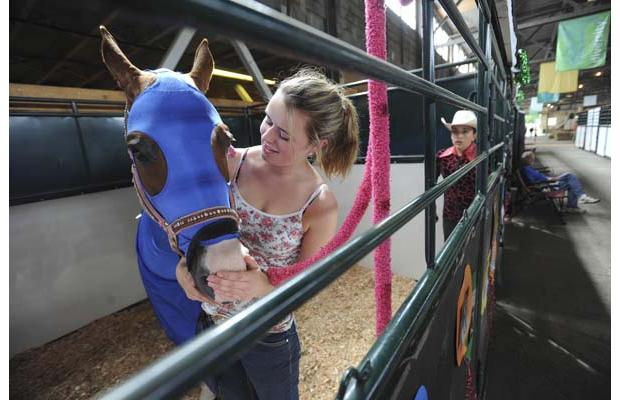
In the barns at the Pacific National Exhibition (photo: province.ca)


I entered the barns and made my way past the goats, cows and chickens, up to the horse stalls and the Horse Council of British Columbia’s display of breeds and horse-related businesses. I was impressed with the selection of brochures that were clear and concise with regards to safety, nutrition, and guides for new or newly interested riders. Many breeds were represented, as were a number of disciplines, each taking turns in the big arena with the huge domed roof. It was always an odd experience riding in there, as the acoustics amplified every footfall of the horse and every breath you took. I could see the stress in the horses that were in the tiny stalls, as groups of school children made their way through and sounds from the midway rattled down the shed-rows. Everyone survived their demonstrations however… the Pony Clubbers jumped and nobody fell off when the odd pony decided to buck, the vaulters performed without a hitch, and in spite of a raucous Friesian foal, everyone held it together during the parade of breeds.


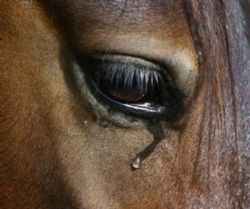
   I returned to the barns afterwards to look at more horses and chat with some of the riders, and noticed a small pony with a watery eye. I looked closely and saw there was a chunk of alfalfa hay stuck to its eyeball, probably only minutes earlier as the irritation appeared fresh. The piece of hay was not budging as the pony blinked, trying to relieve its discomfort. In the next stall was one of the young Pony Club riders who had just returned from the arena. I asked if the pony in the next stall was hers. It was. Then I suddenly felt like I had a bit of dilemma. Obviously, the most compassionate thing to do for this little guy was to get the foreign object out of his eye and relieve his pain. The stream of fluid was now running all the way down his face. I remembered how annoying it was when I was showing horses at the fair, as members of the general public would come up with all kinds of strange things to say. We would all be tired and somewhat on a short fuse after being in those noisy, smelly, crowded conditions for even a day or two, and then have to deal with people and their opinions on top of that, some of which were inadvertently unkind, or at best not very mindful.

Photo: evaequinevet.com

Photo: evaequinevet.com


   I thought the least I could do is try to sound as caring as possible and not appear to be judgmental or blaming, knowing how sensitive horse-people are when told something may be “wrong” with their horse. I couldn’t believe the memories that were coming back and how I felt when somebody just “had to” tell me about something that, in their opinion, was wrong with my horse or something I had done was incorrect.


   I told the young lady her pony had a piece of hay stuck in his eye and that the eye appeared irritated as it was now watering profusely. Blank stare. I repeated myself. She said “oh, he got very upset when the other horses left for the arena.” I acknowledged her statement and agreed that the environment in the Agrodome and barns was very stressful for horses. I mentioned again that perhaps she should take a look at her pony’s eye. She thanked me but still did not leave the stall of the other horse to check on the pony. So I left, and can only hope the eye was properly taken care of.


   In The Compassionate Equestrian I have written, from experiences of my own and those of others, that as much as we want to “help”, sometimes it is construed more as “unsolicited advice” and not necessarily welcomed by the recipient. In the horse world, “helping” when you are not being asked for assistance, can be dangerous. I knew of a rider who was trying to get her horse over a jump at a show when somebody on the ground decided to cluck and encourage the horse to go forwards. It bolted through the jump, and then the rider fell off, sustaining a life-threatening head injury and long term coma.


   Many people are very compassionate by nature, and truly do want to alleviate the suffering of others, especially if they have the means to do so. I actually could have gone over to the next row of exhibits and asked the veterinary techs who had a display booth if one of them could help with the pony’s eye. Should I have done that? Or would that have been construed as “interference” and perhaps set up a chain of ethical and moral events that would have caused potential liability issues for myself, the pony’s owner, her parents, and so on. After all, the injury was neither severe nor life threatening and there was no need to involve an authority.   


   There is a law of physics, Newton’s Third Law, which states “for every action, there is an equal and opposite reaction.” This sets us up for a dilemma such as the one I was experiencing when with thinking about caring for the pony and taking action to alleviate its suffering. This makes me wonder if something in the field of consciousness responds to our intentions and the compassionate actions we take, and why we feel compelled to do or say something to another person or horse if we perceive them to be suffering. What are the consequences of the action we take, if we are even privy to know those consequences? Could this have anything to do with the “human condition” and why it may be so difficult to solve some of our most pressing issues of humanity? Of course I would not have expected anything in return for helping the pony, nor do I ever expect anything in return for assisting someone or an animal, yet don’t we at least expect our good intentions to result in positive feelings and an increased awareness of gratitude for both our own lives and the lives of other beings?


   I left the fairgrounds and the horses behind, getting back on the same bus route that continued into downtown. A mile or two down the road was the sight that never fails to make me stare in disbelief.


   There are hundreds of people out on the streets, many of who are in terrible mental and physical condition. They are addicts, mentally ill, destitute, and homeless. Every time the city adds housing or more care, more people appear looking for assistance. It has been like this for decades in this otherwise bright and shiny west coast utopia; a blight on the city’s “green” image and international reputation. It is overwhelming, and it seems endless, no matter how many people the agencies, the city and individuals try to help. The film school I went to is only a block from this district, and it is a frightening place to be. When I see these people, I wonder if any amount of compassion can save them. It is no wonder so many care givers, both of human and of horses or other animals, can reach a point of complete exhaustion and “compassion fatigue.” There seems to be an endpoint to the amount of personal and emotional resources we are able to give to others, in spite of our best intentions and desire to help everyone and every animal in need.


   I watched the attached video with great interest, as it does provoke considerable emotion:

Unsung Hero

It is like a short documentary about an “unsung hero”, an extraordinarily compassionate young man who gives everything he can to help people in need and those less fortunate than himself. It is a well-done story created by Thai Life Insurance as an advertisement for their services. Their motto is “Believe In Good.” The script, music, the close-ups on the eyes of the giver and his recipients are all elements of a cleverly crafted film, exemplifying everything I was taught in film school that makes for a impactful message. It makes you believe that everything you give, and everyone you give to will result in a positive return, for the benefit of all those involved. It makes us admire the compassionate young fellow who neither asks for nor receives anything material in return, and we weep at the sight of the young girl who rises from poverty to become a scholar at the end of the story. We really can believe in good after watching this narrative video.


   When Dr. Schoen sent me the video for discussion, it was embedded in the San Francisco Globe’s blog page, which sports a number of stories with headlines designed to “hook” a reader. The kinds of headlines that really draw your interest and make you want to click on that link. Looking at the comments below the video, we are reminded of the “human condition.” Some people react as though the actor in the commercial is actually a person in real life doing all of these daily good deeds. They seem  to be unaware that it is an advertisement for an insurance company. Yet others who have made comments are aware of the commercial context, and have made the kind of comments that raised ire in those who believed the young man to be legitimate. To get the code to embed this video, I went to the YouTube site, and found, as expected, an even broader array of interpretations and comments, ranging from the very tearful and emotional to degenerative uses of language and harsh judgments of others. Sigh. Yes, the human condition, and the filters each one of us comes through.


   We know that “compassion fatigue” is a legitimate term. Dr. Schoen has experienced it as a caring veterinarian doing his absolute best for animals and I have experienced complete burnout as a horse trainer, leaving the equine world several times. We have to ask, what are the real benefits, in the real world, of our offering of compassion to other sentient beings, and how do we do so without expending our own selves to the detriment of our own health and welfare? What about those horses that are asked to work for many hours with a herd of distressed humans who are looking to them for compassion and psychotherapy? Do those horses experience compassion fatigue and burnout too? Chances are they do if we compare their tasks with those of captive zoo animals, as research with “enrichment programs” for the animals’ environment has discovered.


   In developing our compassion, how do we apply ourselves to real-world situations, knowing that it would be almost impossible to cultivate the degree of loving-kindness exhibited by the fellow in the insurance commercial? How do we apply ourselves to offering compassion in the horse world without appearing to be interfering in somebody else’s affairs, giving unsolicited advice, or even offending others who may not actually be suffering in a way that we think they are? How do we avoid the effect of Newton’s Third Law as a consequence to our compassion?


   I have been thinking about this a lot since returning to my writer’s retreat on this pretty little island in the Pacific. The contrast of experiences in the city are still fresh in my mind, and I am actually hoping to catch up on some sleep this week, hearing only birds and waves crashing on the shoreline each morning. I think about all the times I felt compelled to “help” somebody and was given a nasty look, a blank stare, or even a “thank you”, but then there would be other events that occurred as a result. Sometimes it is all too easy to overthink compassionate action, and over-thinking something can be paralyzing. Is it best to simply act, or take the time to go through a list of what might happen if you do? Do you pull that last $5 out of your wallet and give it to the beggar, leaving yourself without bus fare, or do you walk past him, bless him with kind thoughts, and say a prayer for his health and recovery from whatever may be the root cause of his having to beg?


   Oh my, that does make things a little more complex doesn’t it? Well, life with other life forms actually can be complicated, especially in today’s world of having so many choices available to us in an instant. There are possibly more details involved when offering compassion to others than we may be aware of. Maybe we are more powerful than we could even know, and perhaps there is a “field” of compassionate energy we can work with, instead of giving away our last dollar, exhausting ourselves by taking care of another, or allowing ourselves to be taken advantage of by someone who may see us as a means to support their own wants and needs?


   Unlike the lovely fellow acting in the insurance commercial, our experiences in giving without expectation may be different than what is illustrated – or they may be as eloquent. Everyone has different experiences in life. What we can do is use our consciousness in extraordinarily unlimited ways, and tap into that pool of compassionate energy that has built up over eons of mindful meditations and the prayers of others. The joyful, heartfelt mantras and perpetual wheels of wise words directed towards the benefit of all beings has set up a never-ending field of compassion, like an ocean of love for all to dive into whenever one wishes. It is simply “there.”


   Consequences? Besides compassion fatigue from over-caring, there are detrimental consequences to our health and wellbeing if we give to someone or to an animal out of feelings of guilt, shame, or the assumption that we “have to” give to that person or they will no longer appreciate us. In the video the young man was met with a glare from the woman on the street when he hesitated to empty his wallet into her cup one day. It appeared he then felt guilty and gave her the rest of his money. What condition caused the woman to be on the street in the first place? Does the woman he leaves bananas for really use or need all those bananas or do they go to waste? What are her other needs? What is the nature of the young man’s suffering…because we know all beings suffer? Nobody in the comments seemed to feel as though he was in need of compassion himself, or at least no mention was made in that direction.


   With compassion, there is a benefit in also recognizing wisdom, mercy, and ultimately, love. All of these things we can give and extend to others from our heart, with infinite possibilities and no time or material things attached to them. As we pass by the ill and poverty-stricken on the street, we can offer blessings and prayers that the root cause of their suffering be alleviated, because the truth is, we really do wish for them to be well. It is the same for thousands of horses that may be suffering and in dire straits. The consequences of meditation and mindfulness training are that we begin to realize the subtleties of how effective and how powerful simply using our mind can be. It is not as easy to convey that concept in a short video however, and more difficult to arouse a strong emotional response in the viewer, as was the intention of the insurance company.


   So with the horses, and with my fellow humans, I try to live with a compassionate heart, and compassionate thoughts at all times. I have learned much from my compassionate co-author, Dr. Schoen in this regard. If I can legitimately help or give my time or finances to someone, I do, but I have had to teach myself (and am still working on this) not to feel guilty or ashamed if I cannot contribute. As most of us do, I get daily requests from organizations seeking financial donations or other commitments. It may be horses, the environment, an international crisis… it is overwhelming. I could have emptied my bank account a long time ago and filled my house with friends or strangers who need a place to stay.


   I find my greatest power and clarity comes in moments of solitude, and this is where I am most compassionate to myself first so that I can actually be of benefit to others. Less than a whisper, there are messages of love that seem to come out of nowhere, and I feel like I am “home.” I believe that when that feeling of being home in your heart arises, if you stay still and quiet, not necessarily taking action at the time, you will find the magical still-point – and you may call that still-point what you wish (some may say G-d) – and will find the answers as to what you need to do, if anything at all, or if the simple, potent, act of being compassionate within yourself will radiate through to all other sentient beings, for their benefit as well as yours.


   I also noticed in the video the compassionate young man feeds a big chunk of chicken to the dog. Those of us who have had dogs know not to ever feed them chicken bones because they can splinter and cause the dog to choke. I guess in that way the commercial was also a success…it is a good idea to be compassionate but have insurance too! And I sure hope that pony’s eye got taken care of in due time.


   A simple conclusion to all of this complexity and questioning is one of my favorite quotes by the 14th Dalai Lama, as he states:

“Our prime purpose in this life is to help others. And if you can’t help them, at least

don’t hurt them.”


Helping Horses Helping People

I will never forget the day my brother and I came home from school, only to find Dad home early from work and Mom nowhere in sight. He said to us, “I’m afraid your mother has had a bit of a nervous breakdown, and she’s in the hospital.” It was shortly after Christmas, 1973. Mom’s drinking finally had her “hitting bottom” to the point that medical intervention became necessary. To this day, I have no idea what the inciting incident was that had her hospitalized, nor do I have much recall of the months that followed. It was all a blur. I just knew there had been too many times Mom was drunk when we needed her, and I had already altered my young life around her episodes. I had given up on bringing friends home long before this day because it was just too embarrassing. I do not remember who got my brother and I to school after that day, who made our dinners, how we managed to keep the dogs and cats fed, or even if I had a birthday celebration that January. There are family photos of every year of my birthday except my 14th. What I do recall is spending a lot of time talking to my therapist. We communicated at least twice a day, if not more. It was necessary, as nobody else was going to get up before school started and go out there in the pouring rain to feed her. If I looked out the bedroom window, she was usually staring in my direction, her big brown eyes wondering when I was coming out next.

My "therapist"

My “therapist”

Nobody in the family understood my attraction to horses. They all knew I had an affinity for animals, but the horse was an anomaly. Mom came from a traumatized heritage, and scientists have now proven certain traumas carry through to the next generation. Her parents left Poland in 1930, when she was just a week old. The oppression they escaped from with little money or belongings made for a hard life farming on the Canadian prairies before they moved west.  Mom’s most vivid memory of a horse was getting kicked in the chin by one of the farm’s plough horses when she was playing underfoot as a small child. She retained the scar for the rest of her life. So when I first began begging for a horse, it took some convincing. Horses were work animals in her world, as they were for my father’s family, where they had also been a status symbol in the horse and buggy days of a developing western metropolis. They most certainly were not considered “therapists” or co-facilitators for human psychological care, and in fact, the lofty new titles afforded these wonderful animals has not been applied to their species until very recently.

Every behavior a horse does naturally has now been carefully analyzed and their herd dynamic has been extrapolated to human behavior. When I started riding there was basically Western and English and not much deviation from traditional methods. I rode both ways, and as most kids enjoy doing, I also rode bareback with a halter when I was too lazy to tack up. Little did I know, all of those long, quiet hours spent feeding, mucking, grooming, and riding White Cloud, were therapy for the sad days of not having a Mom who was fully present and healthy in my early teenage years. Allegedly, every time the mare followed me, every time she moved in accordance with how I made the request, and every time she responded to my voice, has a meaning in Equine Assisted Guidance and Learning.

According to a recent article Dr. Schoen and I have discussed, horses can help humans in 8 ways:

http://m.huffpost.com/us/entry/5634554?utm_hp_ref=mostpopular  

1. They help us find common ground.

2. They help keep us calm.

3. They help us learn by developing

empathy and social skills.

4. They keep us healthy, physically

and mentally.

5. They relieve Alzheimer’s symptoms.

6. They can be our best therapists.

7. They help us live in the present.

8. They inspire a sense of wonder in

all of us.

These ideas began in the early 1990s after Linda Kohanov released her book, The Tao of Equus. By then, I had continued getting unofficial therapy from horses, long after Mom had been going to AA and managed a full recovery, helping other alcoholics recover from their addictions too. Ala-Teen was the organization that helped my brother and I understand what had happened to our mother, and helped us avoid going down that same path as adults. I really could have used an organization like Horses Healing Hearts for children of alcoholics and addicts, but nothing like it existed at the time:

http://www.chronofhorse.com/article/horses-healing-hearts-adds-equine-assisted-learning-program-through 

The horses and all of their awe-inspiring mystical personalities kept me drawn into their lives until I became a full-time professional trainer instead of the zoologist I wanted to become prior to the experience with Mom’s addiction. Without realizing it, the horses really did mirror everything I was going through. My focus on them was what eventually led to the abilities I acquired insofar as being able to evaluate, calm, and transform the most traumatized and difficult of mounts that found their way into my hands.

As horses have come into their new starring roles in the past few years, fueled by the rise of stories such as Linda’s, the entertaining shows of Cavalia and Odysseo, or popularized in movies like the Horse Whisperer and others, there has also been the emergence of a new type of horse-person. They are drawn to horses by the mystique of equine nature, and not so much by the desire to ride and compete. In the past, as I, and many others in my field either as professionals or competitive amateurs and juniors, took our horses over jumps, we did not think in terms of the jumps being metaphors for obstacles in our lives. I have watched YouTube videos of Equine Assisted Psychotherapy with fascination as a group of people are taken into the horses’ pen and asked what obstacles they need to clear for themselves. Metaphorically, as they coerce a loose horse to hop over a low jump, that is a clearing for their own personal issue. I guess you could say that during my 30+ years of jumping horses that I have cleared a lot of obstacles. Of course, many just seem to keep returning too! Maybe I should still be riding 🙂

While I can see how incredible these new programs are for people, coming from the perspective of a trainer, and for Dr. Schoen as a pioneering holistic, integrative veterinarian, our primary concern is for the welfare of the horses themselves, and their overall wellbeing. The horse-person that is emerging from this new field is one that, as a trainer, we could consider a “beginner” around horses, although some long-time riders are benefitting from the recent revelations too. From my viewpoint, I have noticed several issues that may need to be taken into consideration when relaying equine imagery to public. It appears some safety concerns are not always being addressed, both in and out of the workshop situations, and people are left with the impression that horses can be treated as pets.

When articles such as the one from the Huffington Post show a child mounted on a horse and he is not wearing a helmet or proper footwear, this sends the wrong impression that all horses are safe to ride in this way. Those of us who know horses well also know that it is not a good idea to stand directly in front of them and grab them around the head or give them a kiss either. Not every horse is receptive to such a direct invasion of their space, and people could be hurt if they walk right up to a horse and try to interact in such manner. Having worked at a barn with an active therapeutic riding program, I can say from experience that not all horses are suitable for use in therapy, even if all they have to do is “act like a horse.”

These programs, such as EAGALA are becoming so popular however, that the new-comer to horses is going to need a very warm and compassionate welcome from those of us who have had four-legged therapists to count on for decades, and have also developed the professional skills necessary to help those who wish to explore horses more personally. Some of the newcomers to horses will hopefully want to learn how to ride and handle them correctly for the purposes of keeping the horses as sound, fit, and healthy as possible, as well as enjoying the benefits horses provide to human wellness. We are aware that it takes much more than a few experiences and encounters with horses to gain the ability to work with them independently, or in a boarding-barn situation.

Taking the current research about how horses can help humans with an array of psychological and physical disorders we can see a future for horses that potentially allows for those horses that may not be suitable for traditional riding and showing to lead a life of usefulness and engagement with humans that they would not have been priviledged to in the past. While watching the videos of the therapy sessions on YouTube, I noticed some of the horses were not sound, and hoped they were getting proper veterinary care for their issues.

On the other hand, it seems somewhat ironic that the traditional side of showing and training horses is undergoing its own shift in priorities as the regulating bodies for equestrian sports are having to deal with the enormous problems created around the doping of horses in competition. It is appearing to me that we have conflicting divisions in the equestrian world, and this is where Dr. Schoen and I are optimistic about bringing compassion into every aspect of the equine environment, to benefit all those concerned.

There is a somewhat idealized, romantic version of working with horses gaining in predominance on the social-media networks via the popular clinics and inspirational shows that involve working with horses at liberty and training them with freedom and harmony. Some modes of thought are convincing newer horse-people that all the classical means of working with horses are inhumane and use force, whereas their methods do not. Since everyone has varying filters on what constitutes force and humane or inhumane treatment, there tends to be some confusing techniques presented to eager audiences who genuinely want to learn how to communicate with horses. Some of the “branded” takes on training are not as humane as they are made out to be. In my opinion, pretty much everything we do with a horse is forcing it to do something it would not likely be doing otherwise. On the other hand, sometimes the use of force is legitimately abusive to the horse. It is simply a label, and how we use language. The use of language in the equine industry is what has been causing much of the division, and we would like to see a more nonviolent, compassionate way of communicating with all horse-people become the norm. This includes those who have had the enlightening experience of engaging horses in an EAL workshop, those who are learning some type of popular training method, or those who have been immersed in training and showing in various disciplines for many years. We all need to work together for the sake of horses at large.

As rescues become overwhelmed with the numbers of unwanted horses, and hay prices continue to increase while land for horses decreases in availability, there will be a need to create a new paradigm, and a new life for many more horses.

I am amazed, excited, and cautiously optimistic, as is Dr. Schoen, for this extraordinary rise of former “beasts of burden” to their new roles as helpers of humanity. What we need to ensure as human beings is that we do not judge the “other” kind of rider, or horse-person, or blame them in any way using the labels we have created for them, as it only serves to divide us from the common goals of being of benefit to horses, and our fellow humans. Everyone suffers in some way, from the stressed out executive who walks away from an EAP session with a huge smile and new leadership skills, to the wealthy socialite mounted on her imported dressage stallion. We are human. Our best therapists, apparently, are not. Let us find compassion for all, and move bravely forwards into this beautiful new consciousness. Thank you, horses.


White Cloud and I, 1973 (yes, I used to ride without a helmet and proper footwear...but I advocate strongly for proper safety gear now)

White Cloud and I, 1973 (yes, I used to ride without a helmet and proper footwear…but I advocate strongly for proper safety gear now)

Nobody was able to explain to me in 1974 just how valuable my $150 horse was to my well-being, or why. My Mom was a beautiful, generous, and caring person who probably felt misunderstood, and under-appreciated, and there is some irony in how White Cloud came into my hands. Mom was a volunteer for the Canadian Mental Health Association and taught dance classes to special-needs students. Cloudy had been the faithful ranch horse of one of those students. In some remote way, both Mom and the horse probably knew exactly what they were doing. We just didn’t have the formal definitions 40 years ago, and now we do.

Judge Not – Or A Lot… It’s Your Choice

Compassion is about “the other.” It means that we recognize the suffering of another, and have a desire to alleviate their suffering. Still, we find that many people understand compassion through their own filters and experiences, and may find it difficult to have compassion for others who exhibit behaviors that they deem to be non-compassionate. This is why compassion requires study and practice. It tends to challenge us the most in situations where our compassionate nature may become somewhat compromised.


One of the key barriers to compassion is our human tendency to gravitate to negativity, judgment and blame. It seems to be the “default” mechanism in our base-line nature. In the horse world, we can find many examples of divisive, inflammatory language in that regard. We even go to horse shows and pay a lot of money to be judged!

photo: irishtimes.com

photo: irishtimes.com


Dr. Schoen and I have just finished writing a very lengthy manuscript and we could have written more. We realized that The Compassionate Equestrian is not only a teaching journey for others, but it became a progressive journey for ourselves in writing the book and putting together the beginnings of the program. I have personally changed the way I use language and have become more acutely aware of my tendency to place judgment on others, even after years of contemplative study and telling myself I should know better.


And telling myself “I should know better” is an example of self-judgment, which requires an exploration of my own self-compassion, then self-forgiveness.


In 1977 I took riding lessons from one of Canada’s most respected hunter/jumper and dressage judges and Technical Delegate for the 3-Day Eventing discipline. She took me to horse shows as her assistant and taught me the finer points of determining who would be placed in what order according to the highest standards of the sport. It is not an easy job! In the end, somebody is very happy and somebody is ultimately very disappointed and blaming their loss on the judging.


For some reason, we are not as good at relaying the positive, more caring side of our observations, especially when it comes to photographs on social media sites. Not being present to voice an opinion in person seems to have sparked a modern-day phenomenon amongst not just horse-people, but people in general who tend to make a habit out of posting negative, sometimes extremely inflammatory comments, at the sight of a photograph of something as innocent as a moment caught in time, where something does not agree with their perception of “all that is right and good with the world.”


Some people blame social media technology itself, while others have declared it is simply humans displaying their innate feelings without having to actually confront the objects of their judgments.


http://blogs.vancouversun.com/2013/10/21/f-bombs-or-friendly-words-is-social-media-making-us-rude/

 “Technology and social media can certainly make negativity more visible,” he said. And social media amplifies messages instantly, giving no time for second thoughts.


Either way, I found it difficult to not take critical judgments personally when I was a professional trainer, and I still get a familiar little twinge in my stomach if someone posts a potentially inflammatory, negative remark about a photo I have put on our Facebook page. This is where I have a conversation with myself about meeting the needs that are behind one’s feelings about those comments. What compelled that person to find fault with something in the photograph? Why do I think that I must take responsibility for how that person feels about the photo?


The dialogue is very interesting. Some people can relate to what is positive in the photo and mention what they like, while others immediately gravitate to faults that relay visual information contrary to the observer’s perception of “what is compassionate about this photo?”


For the most part, the riders in the photos probably love their horses. They most likely feel as though they are compassionate equestrians and are doing everything right with their horses. Today’s picture was a lineup at a show, with riders anxiously waiting for the class results to be called. They may all feel like winners. They aren’t thinking what some people may have judged as “that horse is over-bent”, or “that’s a terrible bit to put in a horse’s mouth”, or “horses should never be forced into the show ring like that.” The list could go on.


Even if there is truth in the judgments, why are we compelled to make them? Why can’t we look at the same photo and say, “those horses have beautiful, shiny coats and are obviously very well cared-for”, or “the riders are so well turned out, they must have worked hard for this moment”, or perhaps something like, “this style of riding doesn’t agree with my version of compassionate training, but even so, I feel compassion for these people, as they believe they are doing the right things for their horses.”


If we judge them with divisive language, they will put their energy into becoming defensive, as this is what happens when people feel criticized instead of engaged with empathy.


This is the enigma we find with introducing compassion across the broad expanses of breeds, disciplines, training methods, and human nature within the collective of horses, and well beyond. It is part of the challenge in building a new paradigm for a compassionate community of horse-people that transcends our personal needs and wants, in consideration of horses at large. If we can accomplish this in the equine world, we can accomplish it for humanity in general.


I found this wonderful article on Speaking of the Faults of Others and will continue to share excerpts on The Compassionate Equestrian’s Facebook site. You are invited to join the dialogue, and choose how you will judge the pictures, or not.


http://www.thubtenchodron.org/DailyLifeDharma/speaking_of_the_faults_of_others.html

“I vow not to talk about the faults of others.” In the Zen tradition, this is one of the bodhisattva vows. For fully ordained monastics the same principle is expressed in the payattika vow to abandon slander. It is also contained in the Buddha’s recommendation to all of us to avoid the ten destructive actions, the fifth of which is using our speech to create disharmony.


Countdown!

Countdown!

   It has actually happened. In the weeks since acquiring a so-called “smart” phone, time does seem to have condensed and almost a month has gone by since my last post. Truly a phenomenon of the modern world. Perhaps I have just been so fully immersed in the final phases of writing The Compassionate Equestrian with Dr. Schoen, that the early days of summer have already slipped by in a blink. I haven’t even been to a horse show yet this season, but I do plan on heading to Spruce Meadows sometime soon to catch up on the activities of some of my favorite jumpers.

   I also made a quick weekend trip to the extraordinary, famous retreat center in Big Sur, California, Esalen. This is a place where life-transforming “incidents” occur and one can release past traumas, move forward, and awaken to a world of self-advancement with renewed energy and purpose. I am learning to speak with the power and intent that drives The Compassionate Equestrian on its path to making the earth a better place for horses and their humans.

windhorse

(image: http://dungkarling.tripod.com/id7.html)

   Sadly, I have recently learned that one of my former riding students broke her back. I was on a trip to Arizona a few months ago, and while visiting my old barn, this very astute, lovely lady happened to stop by. She was thrilled to see me and excited to tell me about the new horse she had just purchased. The last time I had worked with her, several years ago, she was still on the longe line on a schoolmaster, slowly developing a correct seat. She had very little time to ride and was a long ways from riding independently, much less owning a horse.

   As happens far too many times, the horse she purchased this year was not suitable for her skill level. It was a gaited horse with a lot of forwards energy. In the story that was relayed to me by friends last week, the student had hired a trainer who insisted on using a noseband with spikes in it to control the horse.

   One day, while riding alone, the horse was spooked by a loose horse and the still-novice rider did what most riders would do in that instance, which is to grab at the reins to keep her horse from running off. Unfortunately the horse’s reaction was in response to the pain of the spiked noseband and it flipped over on its rider, causing the severe injury. Luckily, she is not paralyzed from the fall and will recover, but ultimately, such an accident can dramatically change a person’s life.

   It seems like every time I ride, go to a barn, speak with other riders or former clients, I am reminded as to why Dr. Schoen and I have written The Compassionate Equestrian. It seems like it cannot get out to the horse world fast enough.

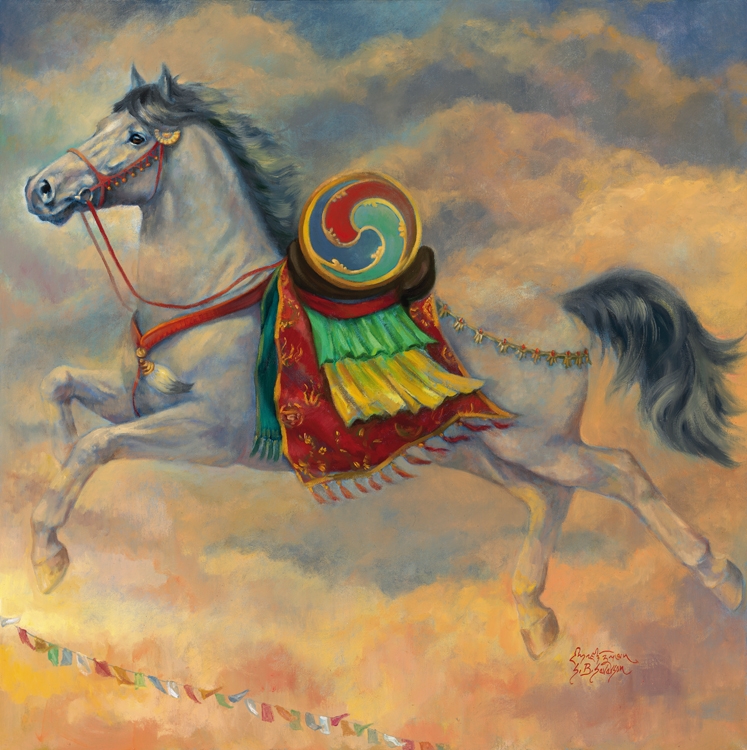
   As it is, we have tremendous confidence in our wonderful publisher, Trafalgar Square Books, to produce a book we will be extremely pleased with, and one that we can send out on the back of the Windhorse with prayers and blessings for all equines and their people. For this generation, the next, and all to come, we wish for compassion to become the base of all training methods, for the benefit of all beings.

A Happy Horse, of Course!

We do everything else online these days so why not learn how to be happy by taking an online course too!? I had to think about this for a few days, and try to compute what “happy” really means. Especially to a horse. Does a horse think “happy thoughts”? I think with humans, part of the problem is we think too much. Part of being happy is to stop it. “Thinking” too much that is. At least so far as instructions in mind-training go as we are taught to let go of binding attachments to desires and things and just “be”. Yet even when taught to observe the mind as an instrument of desire, we still have wants and needs. It’s part of being human. It depends on what those wants and needs are. Do we want “stuff” or do we want to be of benefit to all beings?

For a horse to be happy, does he have to stop thinking or start thinking? Perhaps with animals, it’s simply a matter of how they respond in the moment as opposed to deciding how they will do everything from selecting a partner to where they will live and work and what they will acquire that will supposedly “make” them happy. They go about their horse-business and seem to be most at peace when they’re turned out in a pasture together and can function as closely to their natural herd behavior as much as possible.

The "herd" waiting to be brought in for dinner.

The “herd” waiting to be brought in for dinner.

What’s interesting about the fundamental ideas behind the “happiness course” is that they sound a lot like the way a herd of horses naturally operates. “Strong social ties”. Check. “A sense of purpose or connection to the greater good”. Check. “Reading people’s emotions”. Oh yes, horses are really good at that too. Do they have compassion? Empathy? I believe many of us who have worked with horses a long time can cite stories of horses displaying all the qualities this course teaches us about being happy. How fascinating!

http://www.huffingtonpost.com/2014/04/23/why-thousands-of-people-a_n_5175603.html?utm_hp_ref=mostpopular

“The [course] starts with the idea that happiness and health are fundamentally about strong social connections and being immersed in a strong social community,” says Keltner, citing research that strong social ties can add years to your life. “We’re going to zero in on things that build strong social ties and communities — things like compassion, empathy, how to read people’s emotions, gratitude, charity, generosity and giving.”

The course emphasizes two main (scientifically-proven) keys to happiness: Strong social ties, and a sense of purpose or connection to the greater good.

Granted, the definition of true happiness can be somewhat broad-based and subjective. A quick online search for the definition provided this description:

hap·pi·ness
ˈhapēnis/
noun
the state of being happy.
“she struggled to find happiness in her life”
synonyms: pleasure, contentment, satisfaction, cheerfulness, merriment, gaiety, joy, joyfulness, joviality, jollity, glee, delight, good spirits, lightheartedness, well-being, enjoyment;

For horses, that could translate to the pleasure of eating a bucket full of tasty grain or taking off across the field, bucking and playing as a delighted free spirit with the rest of the herd. Sounds similar to what humans find satisfying and joyful. Eating, playing… it appears all beings might be looking for the same thing.

Can happiness-seeking take a wrong turn? I can see all the heads nodding now.

This goes back to our desire for self-satisfaction and thinking we’re going to find that either through others, or through the acquisition of material goods. It looks like the online happiness course is scientifically-backed to prove there are definitely errors made in human thinking as to what will make us happy.

I had a landlord once who lived right below my apartment. He and his girlfriend were generous, caring souls, but he was convinced she was supposed to “make him happy”. It’s a fragile way to maintain a human relationship. As soon as he was “unhappy” the arguments would ensue and it became an unpleasant environment not only for them as a couple, but for everyone else in the vicinity who was subjected to their unhappy behaviors. They would eventually make up and the entire cycle would start again.

Horses don’t seem to have these problems.

I’ve watched horses respond to other horses in distress many times. They don’t like it when a herd-member is in trouble or hurting, even if they only know the horse as a stable-mate who lives in another stall in the barn. They will exhibit signs of stress and call out to the distressed horse. Is this not a sign of compassion and empathy? I’ve seen an entire herd of pasture-mates form a procession and circle around one of their own who was dying. Is this not a sign of sentience, intelligence and compassion?

I believe that amongst domesticated horses, we humans are often thought of as part of their herd. Perhaps more so by some horses than others, but I’ve seen signs of acceptance in that regard as well. It’s probably why so many people feel so protective and emotionally attached to their horses. It’s hard not see them as objects of desire and “things” that exist to make us happy, but they are so much more than that.

As the happiness course indicates, the factors that make for true happiness are strong social circles and caring for others. So our real happiness with horses comes from that aspect of being with them, and not so much from the aspect of how much they cost, how much fancy tack we can dress them up with, or how many ribbons we can win in the show ring with them. All that “stuff” simply pales in light of the real reasons horses can bring us true happiness. No wonder they’re so inherently happy 🙂


Attached to That Horse?

Have you ever made a list of the attributes you’re looking for in a horse (or a relationship)?  Have you then gone to all the trouble to seek out exactly the horse or person of your dreams…and found them?  How did things turn out?

I’ve noticed something quite interesting about those “lists” over the years. My experience and observations have led to the conclusion that the more one pursues a relationship according to one’s list of “wants”, the more likely outcome is having chosen the wrong one.  Why is that?

First of all, whenever I went looking for the ideal horse, I ended up with a list of problems that I hadn’t anticipated.  For example, my off-track thoroughbred, Dusty.  I was looking for a suitable hunter-type for the 3′ amateur division.  There were several I tried out, but Dusty was the breed, color, age and temperament I was looking for.  He had been field-hunted after his racing career and presumably that meant he would be bold and safe over show-ring hunter jumps.  I chose him over an older, better-schooled, seasoned warmblood that would have actually been the better horse for me at the time.

Dusty was a problem from the get-go.  We’d only had a basic soundness exam done, which he passed at the time.  I was in a marriage to a horse trainer who was becoming difficult too.  I’d actually sold my horse trailer in order to purchase the perfect horse.  My husband’s mood swings were causing anxiety, and it was making me anxious about getting a new horse.  We were in a new barn and recently married, and a long way from my previous home with my parents.  I had no support system.  I really wanted and thought I needed that horse!

Dusty did not stay sound for long.  He had a crooked spine.  Interestingly, so do I.  He had anxiety attacks and purposely fell down on concrete flooring.  I was in an increasing state of anxiety at the time.  I could probably analyze every detail of my relationship with Dusty and find some way to relate his issues to my own.  He was like a mirror for my own problems.  With horses, as with people, it would probably be a valuable exercise if we realized the mirroring effect at the time, but usually we don’t.

That was over 30 years ago.  I learned to stop looking for horses after that and just let them show up in my life.  The ones that literally  “dropped into my lap” were much better overall.  The key?  I had to let go of the attachment to my list of what I wanted.  I didn’t realize the amount of suffering those attachments would cause.  Looking back, and knowing what I know now, the lessons were obvious.

I’ve had so many clients also make the wrong choice of horse.  Often against my better advice.  I don’t take commissions on sales horses as most trainers do so it’s not like my suggestions were related to money.  My preference was to see the right rider on the right horse, especially given my prior experience.  People still purchased the wrong horse, probably for reasons similar to why I bought Dusty.  You don’t even realize what’s happening or why.

Razzberry Zam.  An off-track thoroughbred who "dropped into my lap" as a sales project.  One of the most wonderful horses I've ever had the opportunity to ride.  So wonderful, in fact, he sold quickly.  His buyer was the perfect owner and a massage therapist to boot.  Love, compassion and no attachment.  I felt it with this horse and although sad to see him go, it seemed like the gratitude with which we approached each other had a most beneficial outcome for us both.

Razzberry Zam. An off-track thoroughbred who “dropped into my lap” as a sales project. One of the most wonderful horses I’ve ever had the opportunity to ride. So wonderful, in fact, he sold quickly. His new rider was the right person for him and a massage therapist to boot. Love, compassion and no attachment. I felt it with this horse and although sad to see him go, it seemed like the gratitude with which we approached each other had a most beneficial outcome for us both.

Then I learned about non-attachment.  Ah ha.  The “list” is all about what we’re attached to, whether it be in a person or a horse.  Buddhism teaches that attachment leads to suffering.  Yes.  I’m proof of that.  I’m sure many of you are too.  Those attributes we want so badly, or think we do, in a horse or in a relationship with another human, are exactly the attributes that will bring us suffering when things don’t turn out as we wish.

The perfect jumper goes lame.  Our perfect spouse sustains a head injury and his personality changes.  The horse ages and can no longer jump.  The husband decides he prefers a younger woman.  Are we still as excited about that horse or that person as we were when they fit our list of “wants”?  Can we have compassion for them when they no longer fulfill our desires, or if they’ve hurt our feelings?

Letting go of the attachments, especially an attachment to any outcomes, is a worthwhile practice.  The other is self-compassion… the desire to alleviate your own suffering, knowing that suffering comes from attachment.  I’ve found that letting go and living with a tremendous love and gratitude for all of life opens the door for loving and grateful relationships to return to you.

The surprise is that those who come into your life may not be anything at all like the list you’ve made.  The thoroughbred of your dreams might manifest as a scruffy little pony who needed to be rescued from somebody’s back-40, but that little pony could just end up being the best jumper you’ve ever had.

According to psychologist Lisa Firestone, Ph.D. “our style of attachment affects everything from our partner selection to how well our relationships progress to, sadly, how they end. That is why recognizing our attachment pattern can help us understand our strengths and vulnerabilities in a relationship. An attachment pattern is established in early childhood attachments and continues to function as a working model for relationships in adulthood.”

http://www.psychologytoday.com/blog/compassion-matters/201307/how-your-attachment-style-impacts-your-relationship

So we can make note of this, and then turn to the practice of compassion and developing non-attachment:

“Most of our troubles are due to our passionate desire for and attachment to things that we misapprehend as enduring entities.” ~Dalai Lama

http://zenhabits.net/zen-attachment/ 

If you do go looking for a new horse (or person), my final thought on the matter is to first,  ask yourself why you want this being to come into your life.  Where are you with your self-compassion?

“When you stop trying to grasp, own, and control the world around you, you give it the freedom to fulfill you without the power to destroy you. That’s why letting go is so important: letting go is letting happiness in.”  Lori Deschene, Tiny Buddha


HEROES for HORSES

As I’m reaching the final chapters on the first-edit of The Compassionate Equestrian, I’ve been thinking a bit more about Chapter 25 – Birth to Completion Life-Cycle Tracking.  This is a new term and a new idea for the equine industry at large.  It is also the key reason why I began writing about compassion and horses.

When I was in film school several years ago I was doing research for my student documentary about rehabilitating off-track thoroughbreds.  I went to the nearby riding club, a long-established community of primarily hunter/jumper and dressage barns, to look for a good story.  I was in luck.

I discovered a trainer  who had just purchased a 3-year old tall, handsome, grey gelding from a stable at Vancouver’s race track, Hastings Park.  He had a slight injury on one tendon, probably sustained in his final race, which he had won.  The short video I produced was only a superficial hint at the legitimately dark side of thoroughbred racing.  I wanted to slant the story to the happier endings of fortunate ex-race horses who find their way to a caring home and a chance at a second career.

http://vimeo.com/14392790  (link to my student film:  Racing Machine –  A Thoroughbred Story)

When the film instructor saw my rough cut, he immediately focused on the more contentious tidbits and told me I had to bring more “conflict” to the short documentary.  “That’s what makes a good doc” he said.  Me, being the non-confrontational, non-argumentative type, cringed at the idea but proceeded with further research anyway.

The thoroughbred racehorse, "Machine"

The thoroughbred racehorse, “Machine”

All I can say is that what I found out about the “deep, dark” side of the horse industry shocked me.  Even as a professional trainer all these years, I had no idea how many horses were ending up in slaughterhouses every year, and why.  I had no idea how horribly  horses were treated once they left the auction houses or race track.  I made myself look at the reports and videos on the Canadian Horse Defence Coalition website.  Most horse-people will not want to see this side of our industry, but I believe they need to.  My eyes were definitely opened.  Not only that, but my heart went out to all of the world’s homeless horses to the point that I felt overwhelmed and somewhat helpless at not being able to help them all, relieving them of a potentially terrifying completion to their lives.  Over 100,000 a year in fact.  Really??!!  Where are all these horses coming from?

http://defendhorsescanada.org/

I’d also found a very knowledgeable researcher who gave me a plentitude of information to mull over and include in the bigger film I was determined to produce.  The more I spoke to her, and the more I learned about homeless equines and their fate, the more I realized I would need a massive legal team to protect both myself and sources from the underworld of cabals that make their living on the acquisition and sales of unwanted horses.

So I shelved the film and looked for other ways I could help educate and enlighten the horse industry.  Then Dr. Schoen and I met in 2012 and through our dialogues, began writing the 25 Principles of Compassionate Equitation, followed by the book, which will be released in the spring of 2015.

While working on  the outline for the documentary I befriended a couple of extraordinary advocates for equine welfare.  They have both been on the “front-lines” of the worst of the worst kind of treatment you can image horses having to endure.  Most of us who love horses couldn’t possibly deal with what they have seen.  They are my heroes.

Brogan Horton is in her twenties and runs Animal Rescue Unit at her home in Maine.  Brogan is the kind of person who will put on a suit and lobby Congress on behalf of the wild burros and mules, or hook up her horse trailer and spend her last few dollars to go pick up a horse in need of rescue.   Animal Rescue Unit is an organization dedicated to revealing the truth about animal suffering, specializing in investigation, rehabilitation, education and legislation for animal welfare.  The following link is one of many heart-warming stories from ARU, and one with a very happy ending.  Further links to ARU information are included in the article, and Brogan can be found on Facebook for anyone interested in following her activities and if possible, helping with donations for the rescued animals.

http://www.pressherald.com/people/cth/donkey-delivers-a-christmas-miracle_2013-01-07.html

The other hero is Brogan’s former partner in another very intense animal welfare investigation organization, Richard Couto of Animal Rescue Mission.  Both Brogan and Richard are well trained and have been on some of the more dangerous missions regarding equine welfare.  Most of us in the horse world have no idea what goes on behind the fences and walls around illegal slaughter farms in Miami.  Nor would most of us want to know.  It’s cruelty to animals beyond our comprehension.

Richard became the exceptional cruelty investigator  he is today after rescuing a thoroughbred ex-racehorse from one of the illegal farms.  The horse, Freedom’s Flight, is a descendant of Secretariat.  Richard found him tied to a tree at the farm, next in line for a terrible demise.

Here’s a link to Richard’s bio:

http://www.animalrecoverymission.org/about-arm/founders-bio/

So in The Compassionate Equestrian, Dr. Schoen and I are doing our best to use language that inspires, unifies, and opens the hearts of equestrians.  We are coming from many years of experience in our collective fields and understand how easily one person’s opinion can immediately send another person into a defensive mode.  Or how upsetting some of these more difficult issues can be.  We also understand that people don’t want to discuss death, so we refer to the “completion” of life.  It’s why Principle 25, which recognizes “the importance of applying the Cradle-to-Cradle model of life-cycle assessment and tracking to the equestrian industry” – has been left to the end of the book.  Chapter 25 is also still largely unwritten as we structure the program and gather further information as to just how it could be applied to help the “global herd” of horses in need.

There isn’t an easy way to convey this information to a  generally loving, compassionate community of horse-people who are active on a day-to-day basis with these beloved animals.  It’s our belief that every human has the opportunity to be compassionate towards all beings, and that compassion just needs to be awakened.  In the hardest times, in the most difficult circumstances, and in facing the darkest side of humanity…that’s when extending compassion may become extremely challenging.

It’s the purpose of The Compassionate Equestrian and The 25 Principles of Compassionate Equitation to assist in the compassionate awakening of horse-people everywhere.  We hope that through their own personal practices, they will be able to see the need for compassion to be extended to all horses, and everyone who’s involved with them.  With such mindfulness, we can come together as a world-wide community and find a way to become heroes for horses ourselves.