CAUGHT YOU LOOKING!

It is a classic accusation amongst humans in relationships… subtle (or sometimes not so subtle) body language and gestures that make one person jealous of another. For example, women tend to be hyper-vigilant and sensitive to the attention their male partners pay to other women, and immediate judgments are formed about “the other” who is receiving the attention. Even if someone does not want to feel that way, or exhibit the sometimes-embarrassing behavior that arises from those feelings, jealousy seems to happen as a matter of fundamental neurochemistry. Is it an inherent mechanism? If so, what is it for?

Two brown horses nuzzling each other

French saddlebred horses. Photo: http://www.horsesoflegend.com

Sometimes the basis for jealousy, which is actually a label for the fear of loss, is well founded. This can be especially true in humans where children or personal security are of concern. The situation that triggers jealousy also evokes thoughts of steps that would need to be taken in the event of losing their partner to the object of their jealousy. It is a defensive mechanism, in short, and should the underlying causes not be dealt with directly, it can lead to anger, depression, and other associated psychological effects.

In adolescents, the negative behaviors associated with jealousy are more common amongst those with low self-esteem. They may perceive their friendships as being easily threatened by others, sometimes leading them to aggressive actions [1]. Jealousy differs from “envy,” which is the desire to have something that someone else has.

Jealousy is an anticipatory emotion and one of the most common, yet unsettling behaviors exhibited by humans… and remarkably, other beings too. I say “other beings,” because it is apparent that animals can also become jealous when their “person” gives attention to another member of that animal’s species, or even another human. If dogs experience such emotions, then horses likely do too, as they also have an amygdala and correlating neurochemistry.

http://news.therawfoodworld.com/animals-can-experience-emotions-like-people-can-jealousy/

My brother and I used to laugh at our dogs when they would immediately get in between our parents as they embraced. The dogs would bark excitedly and turn anxiously from one parent to the other. We could never determine if they thought our parents were trying to hurt each other and the dog was attempting to “save” one or another, or if the dog was actually jealous that one of their “people” was paying too much attention to the other. Apparently, now we know the answer to that.

Fortunately, animals can’t quite go as far as humans in exhibiting abnormal types of jealousy, which can become quite threatening and dangerous to other people. This can enter the realms of extreme insecurity and may move well beyond the typical fighting over emotional infidelity or other common issues encountered in romantic relationships, particularly where “attachment” has been mistaken for love. In fact, there may be a neurochemical basis for jealous reactions that persist when there is no actual threat present and the fears are entirely unfounded. Neurotic jealousy may become associated with a disorder such as schizophrenia, paranoia or chemical imbalance in the brain.

It is sometimes all too easy to anthropomorphize what a horse might be thinking, and sometimes, as with the dogs, their apparent jealous responses when we give attention to another being can be quite amusing. As science continues to produce more confirmation as to the actual biochemical basis for the behaviors of sentient beings however, perhaps it is not such a stretch to be thinking that our horse might be jealous when we pay attention to another.

I have experienced observations of apparent jealousy in horses on many occasions and when Dr. Schoen suggested the article about the dogs as a blog post, reading it brought back many memories.

One such incident was with a big dun Saddlebred gelding I would ride every now and then when his owner was away. He had been rescued from abusive circumstances prior to the owner I was working with, and found himself in a loving, compassionate situation with Katie, his new “person.” During her lessons, it had become very apparent that this horse was quite possessive of his owner, and he would make challenging faces at any horse that got too close to her. As it happened, Katie and I were very similar in appearance and energy, so it was no surprise when her horse took on the same possessive characteristics with me as he did with her.

One day I was grooming him in his pipe-rail stall, preparing to tack up for a ride. Off in the distant paddock, a young horse was playing with a ball, going through some hilarious antics as he was doing so. While still brushing the big dun, my attention was on the colt that was having such a good time entertaining himself. Within a minute or so, the Saddlebred noticed my attention had been distracted to the other horse. He swung his head in the colt’s direction and his ears went back. Knowing how possessive he was of Katie I realized what he was responding to. After glaring in the direction of the playful youngster that was well off in the distance, he swung his head in my direction and gave me a “look that could kill.” Then he promptly re-positioned his body so that his neck, held regally high on his shoulders as is typical of his breed, completely blocked my view of the colt. What else could I do but laugh and return my full attention to the jealous gelding?!

Trakehner stallion

Young, dun Trakehner stallion. Photo: http://www.animalgenetics.us

I think one really has to spend a lot of time around animals to fully realize and appreciate the similarities between our emotions and theirs. As Dr. Schoen and I have cautioned in The Compassionate Equestrian however, there is still the need to recognize that an animal is an animal, and that they are not “us.” Common sense has to dictate the way we handle and train them so they are safe and untraumatized, to the best of our knowledge and abilities. It takes a long time to acquire the sensitivity and skills necessary in determining when an animal’s behavior is related to normal responses and when it may be reactions to fear, pain, or other negative stimuli that can put a less-experienced handler in danger.

Have you recognized jealousy-related behaviors in your own horse? Tell us your story too! We would love to hear from you.

__________

When the Well Runs Dry

Next to not being able to breathe, the feeling one has when dehydrated and there is no water to be had is probably one of the worst feelings you can imagine. In the heat of the desert, your head begins to spin and your heart rate increases. The dryness in your mouth is unbearable and your limbs begin to weaken. Everything in your field of vision starts to shimmer, and your stomach begins to churn. Your gait staggers. Your body has sweated out the cell salts that keep you functional, but you don’t notice any sweat, only the salt stains on your clothing. You want to lie down and not wake up to make it all go away.


We can live a long time without food, but only a few days without water. I have experienced the symptoms of severe dehydration and I know all too well what it is like to stand in an arena at 120F with a hard wind blowing clouds of fine dust into my lungs. I cannot imagine the well running dry at a horse ranch, and having nothing at all coming out of the ground or the taps. Yet this is reality. Call it climate change, call it cyclic, or call it a disaster… whatever, however it is happening, it is for real. I have experienced the climate changes and weather anomalies first hand in the southwestern United States, and it is one of the main reasons behind my having left the business of teaching and training horses. The implications of environmental changes on the equine industry are huge, as they are with any ecosystem and the many millions of humans around the world who are already displaced as a result.

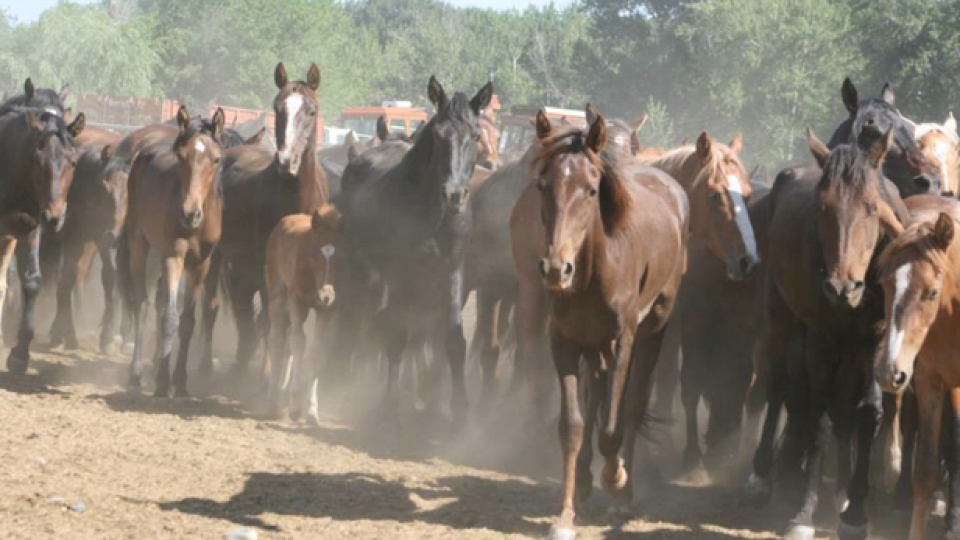
Wild horses (photo: returntofreedom.org)

Wild horses (photo: returntofreedom.org)

Right now, we are looking at having to haul in 6000 gallons of water per day to sustain the sanctuary and its residents. That is at a cost of roughly $500 per day . . . until California sees rain again and the water tables rise. This is the kind of crippling environmental crisis that you hope will never come.

http://www.returntofreedom.org/the-extended-drought-in-the-west-has-left-our-hills-barren-of-forage-and-has-caused-the-price-of-hay-to-rise-august-28-2014/

Horses caught in the California drought (photo: cnn.com)

Horses caught in the California drought (photo: cnn.com full story at: http://www.cnn.com/2014/01/22/us/california-drought-impact/)


The horses and their caretakers in the position of those at Return to Freedom are in need of compassion, and a lot of money. Understanding how quickly this kind of crisis can escalate, one can only have empathy for all those involved. For those of us with firsthand experience in hot, dry areas, it creates an overwhelming sense of helplessness and a looming question…”how can such a massive environmental emergency be resolved?” Not only do the horses and other livestock need adequate amounts of water, but the water also has to be uncontaminated and free of toxins such as algal blooms. Cyanobacteria can intensify quickly in hot conditions, causing issues like liver damage to the point of being fatal to the animals.


The average horse will intake 5 to 10 gallons of fresh water per day. Just like humans different horses crave or need different water amount intakes. A horse deprived of feed, but supplied drinking water, is capable of surviving 20 to 25 days. A horse deprived of water may only live up to 3 or 6 days. After lacking water intake for two days a horse may refuse to eat and exhibit signs of colic and other life-threatening ailments. 

http://extension.psu.edu/animals/equine/news/2012/how-much-drinking-water-does-your-horse-need


So imagine going to water your horses one morning and there is no water. How would you feel? It would be hard not to panic. It is one thing for this to happen to one ranch, but in the bigger picture, this could happen to many more facilities and affect considerably more horses and other animals in the very near future. Nobody knows when or if the drought conditions will improve. Forecast models are not too optimistic. When I was at the University of British Columbia’s Summer Institute of Sustainability in 2009, we had some of the most highly respected specialists in the field of sustainability telling us that the computer climate models at the time were conservative compared to the rate of actual changes that were occurring worldwide. What we are seeing now so far as temperature ranges and extreme climate events are exactly what the models were predicting five years ago.


As of August 12, 2014, most of California sits in a D4 “exceptional drought,” which is in the most severe category. Oregon, Arizona, New Mexico, Oklahoma, and Texas loiter in a substantially less severe D1 moderate drought.

http://www.futurity.org/american-southwest-megadrought-754652/

A "haboob" - a massive wall of dust - moves through Phoenix AZ in July of 2014. (photo: azcentral.com)

A “haboob” – a massive wall of dust – rolls across Phoenix AZ in July of 2014. (photo: azcentral.com)


While the only immediate answer for the horses and people at Return to Freedom and other affected properties is to pay to have water hauled in, the long-term answer to a water crisis is more vague. The only way it can end is if Mother Nature drops enough precipitation on the drought-plagued areas over a long enough duration to refill shrinking reservoirs and bring life back to ravaged grazing lands. Without a major correction in the climate, hay prices will continue to rise, and the water scarcity problems will have a domino effect on horses and all the humans who rely on produce grown in the parched agricultural regions of the southwest. There are already too many unwanted horses in the system and this situation will only add to those numbers too.


It is possible that such an extreme crisis will open the door for contractors who claim they can control the weather. As bizarre as it may sound to some, it is nothing new in the field of environmental and weather modification technology:


Weather-modification, according to the US Air Force document AF 2025 Final Report,

“offers the war fighter a wide range of possible options to defeat or coerce an adversary’, capabilities, it says, extend to the triggering of floods, hurricanes, droughts and earthquakes: ‘Weather modification will become a part of domestic and international security and could be done unilaterally… It could have offensive and defensive applications and even be used for deterrence purposes. The ability to generate precipitation, fog and storms on earth or to modify space weather… and the production of artificial weather all are a part of an integrated set of [military] technologies.”

In 1977, an international Convention was ratified by the UN General Assembly, which banned ‘military or other hostile use of environmental modification techniques having widespread, long-lasting or severe effects.’ It defined ‘environmental modification techniques’ as ‘any technique for changing –through the deliberate manipulation of natural processes – the dynamics, composition or structure of the earth, including its biota, lithosphere, hydrosphere and atmosphere, or of outer space.’

http://www.globalresearch.ca/the-ultimate-weapon-of-mass-destruction-owning-the-weather-for-military-use-2/5306386


Of course, controlling and modifying the weather brings up all kinds of ethical and moral questions, the least of which being the unknown effects of messing with the planet’s natural weather systems. As these programs are already in place and have been implemented in the U.S. through state-by-state policies, we may in effect be witnessing the aftermath and ongoing effects of manmade weather and climate changes due to the delivery of tropospheric aerosols. It would not surprise me if we begin to see corporations hawking weather modification in the future as a means to “fix” current climate changes and extreme weather. Unfortunately, I doubt if anybody really knows what the consequences would be if such action were taken on a mass scale.


Then there is a more esoteric approach, as described by scientists such as Gregg Braden. I just watched the YouTube presentation of his talk about his book, The Divine Matrix. Dr. Schoen and I have spoken of “the field” in The Compassionate Equestrian, and how it may be used for the benefit of interspecies communication. As Braden describes “the matrix” according to Max Planck’s theory, he gives examples by which healing can occur when one applies a particular method that engages the laws (as they are presently understood) of quantum consciousness.


“All matter originates and exists only by virtue of a force which brings the particle of an atom to vibration and holds this most minute solar system of the atom together. We must assume behind this force the existence of a conscious and intelligent mind. This mind is the matrix of all matter.”

Max Planck

Das Wesen der Materie [The Nature of Matter], speech at Florence, Italy (1944) (from Archiv zur Geschichte der Max-Planck-Gesellschaft, Abt. Va, Rep. 11 Planck, Nr. 1797)


In the talk, Braden describes how a young native man in the desert southwest “prayed rain,” as his ancestors taught him. Not prayed “for” rain, as this sets up an infinite possibility and incalculable time frame that may or may not happen according to the tribal lessons. Instead, they conduct a ceremony by which they feel the rain, feel the mud underfoot, and feel as though what they wish for already exists in that moment. As Braden noted, after the young man’s action, it did indeed rain.


Using “the field” we are taught to see everything from the heart, and use the energy of the field to see the situation as though it is already healed, and perfect:

http://youtu.be/MRedvbARVhM


In the west we have not been conditioned to operate in this way however, so the general populous is more reactive than responsive when all of a sudden it seems like everything has fallen apart. There is fear, and in the case of not being able to offer food and water to your animals, watching them suffer greatly is as heartbreaking as can be.


Perhaps if everyone had compassion, we would find the answers to all of our human conditions and the root causes of the planet’s problems, instead of using knowledge and inventions to enact wars on other countries. Maybe it is a combination of willpower, technology, and a coming together of science with ancient knowledge that will get us and our beloved horses, as well as all of the creatures of the earth out of the situations in which we now find ourselves. I do not know what will work, either in the interim, or the long term. I do know there are prophecies that have come down through tribal peoples such as the Hopi about the trials we now face, and there have been predictions by scientists in recent years that seem to back up what those ancient cultures have been telling us.


Can we turn to the horses themselves for answers? Can we watch other species and learn from them? What information do they convey to us? What would they do and where would they go? Can we simply be quiet and find compassion for our planet and all those sentient beings in need of help? We all need water to survive. For anyone who can contribute financially to the delivery of water for Return to Freedom, please do so, and if not, please offer compassionate thoughts and prayers for them and all others affected by water shortages and rising costs of hay and feed, especially the rescues that rely on donations. There is no more time left to try to decide why or how climate change is happening – it is already here.


Compassion, With Consequences

   I spent the past two weeks in the busy, crowded city that is my hometown. It is allegedly the 3rd most livable city in the world, yet I barely got any sleep due to the sheer amount of noise and constant attack on every sense. Even on the paved suburban forest trails near my brother’s home, people are distracted by their smartphones and controlling their dogs while balancing Starbucks coffee cups, many simultaneously pushing strollers with toddlers in tow, dodging cyclists and runners on the pathways. Near the house, tunnel construction for the new transit line operates through the night, while trains run hazardous materials through the terminal at the water’s edge and large tankers loom in the distance.


   “Survival” is the word that comes to mind in an overstuffed urban setting. Although I’m told Vancouver is nothing like Shanghai or any other enormous metropolis with millions of residents. It is a wonder to me that people don’t go completely crazy when everywhere you go it is shoulder-to-shoulder and very high-density living. Or maybe they do, as I think back to the expressions of obviously over-committed suburbanites on the trails. So when I found out it was “Horse Day” at the Pacific National Exhibition, I decided to attend since the fairgrounds were accessible via public transportation. This particular route into the downtown area is particularly challenging for drivers of cars and busses, as shortly past the racetrack and fairgrounds is one of the worst sections for homeless people in pretty much any city in the civilized world. People who are mentally ill and/or under the influence of mind altering drugs and alcohol spill from the sidewalks on to the streets, and at any given time of day, a sense of mayhem ensues.


   The bus was standing room only on that Wednesday morning, and it was hot. I got off a block early simply to get relief from the heat and the packed vehicle. I knew exactly where I was headed and easily navigated through the usual array of food stands, vendors hawking all kinds of fascinating, tacky objects, colorful rides with screaming patrons, and chatty teenagers looking forward to a fun day at the fair. Up ahead was Hastings Park racetrack with its deteriorating barns and uncertain future, hidden by the cupped roof of the old Agrodome and high fencing. The PNE had been a tradition in my family as early as I could remember. Mom took my brother and I there every year, with Dad dropping us off at the main gate, as he did not enjoy the racket, the rides or the exhibits. As an adult, I was showing horses in the annual competition, many of which were thoroughbreds that had previously raced on the track next to the agricultural building. They were frequently unnerved by the proximity of the track and the cramped, dark, smelly barns attached to the Agrodome’s indoor arena.
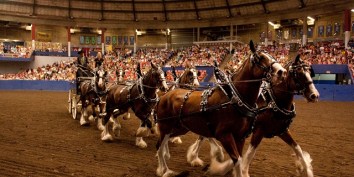
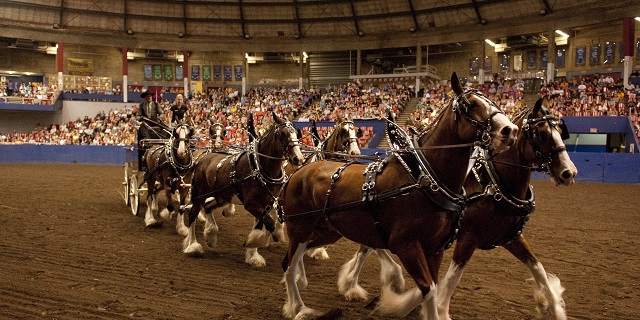
Horse Day in the PNE Agrodome, Vancouver, B.C. (photo: m.pne.ca via Horse Council of B.C.)
Horse Day in the PNE Agrodome, Vancouver, B.C.
(photo: m.pne.ca via Horse Council of B.C.)


PNE

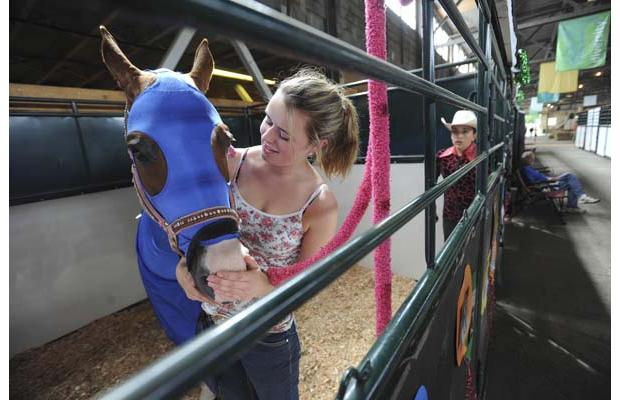
In the barns at the Pacific National Exhibition (photo: province.ca)


I entered the barns and made my way past the goats, cows and chickens, up to the horse stalls and the Horse Council of British Columbia’s display of breeds and horse-related businesses. I was impressed with the selection of brochures that were clear and concise with regards to safety, nutrition, and guides for new or newly interested riders. Many breeds were represented, as were a number of disciplines, each taking turns in the big arena with the huge domed roof. It was always an odd experience riding in there, as the acoustics amplified every footfall of the horse and every breath you took. I could see the stress in the horses that were in the tiny stalls, as groups of school children made their way through and sounds from the midway rattled down the shed-rows. Everyone survived their demonstrations however… the Pony Clubbers jumped and nobody fell off when the odd pony decided to buck, the vaulters performed without a hitch, and in spite of a raucous Friesian foal, everyone held it together during the parade of breeds.


   I returned to the barns afterwards to look at more horses and chat with some of the riders, and noticed a small pony with a watery eye. I looked closely and saw there was a chunk of alfalfa hay stuck to its eyeball, probably only minutes earlier as the irritation appeared fresh. The piece of hay was not budging as the pony blinked, trying to relieve its discomfort. In the next stall was one of the young Pony Club riders who had just returned from the arena. I asked if the pony in the next stall was hers. It was. Then I suddenly felt like I had a bit of dilemma. Obviously, the most compassionate thing to do for this little guy was to get the foreign object out of his eye and relieve his pain. The stream of fluid was now running all the way down his face. I remembered how annoying it was when I was showing horses at the fair, as members of the general public would come up with all kinds of strange things to say. We would all be tired and somewhat on a short fuse after being in those noisy, smelly, crowded conditions for even a day or two, and then have to deal with people and their opinions on top of that, some of which were inadvertently unkind, or at best not very mindful.
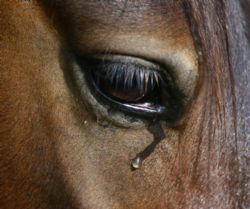
Photo: evaequinevet.com

Photo: evaequinevet.com


   I thought the least I could do is try to sound as caring as possible and not appear to be judgmental or blaming, knowing how sensitive horse-people are when told something may be “wrong” with their horse. I couldn’t believe the memories that were coming back and how I felt when somebody just “had to” tell me about something that, in their opinion, was wrong with my horse or something I had done was incorrect.


   I told the young lady her pony had a piece of hay stuck in his eye and that the eye appeared irritated as it was now watering profusely. Blank stare. I repeated myself. She said “oh, he got very upset when the other horses left for the arena.” I acknowledged her statement and agreed that the environment in the Agrodome and barns was very stressful for horses. I mentioned again that perhaps she should take a look at her pony’s eye. She thanked me but still did not leave the stall of the other horse to check on the pony. So I left, and can only hope the eye was properly taken care of.


   In The Compassionate Equestrian I have written, from experiences of my own and those of others, that as much as we want to “help”, sometimes it is construed more as “unsolicited advice” and not necessarily welcomed by the recipient. In the horse world, “helping” when you are not being asked for assistance, can be dangerous. I knew of a rider who was trying to get her horse over a jump at a show when somebody on the ground decided to cluck and encourage the horse to go forwards. It bolted through the jump, and then the rider fell off, sustaining a life-threatening head injury and long term coma.


   Many people are very compassionate by nature, and truly do want to alleviate the suffering of others, especially if they have the means to do so. I actually could have gone over to the next row of exhibits and asked the veterinary techs who had a display booth if one of them could help with the pony’s eye. Should I have done that? Or would that have been construed as “interference” and perhaps set up a chain of ethical and moral events that would have caused potential liability issues for myself, the pony’s owner, her parents, and so on. After all, the injury was neither severe nor life threatening and there was no need to involve an authority.   


   There is a law of physics, Newton’s Third Law, which states “for every action, there is an equal and opposite reaction.” This sets us up for a dilemma such as the one I was experiencing when with thinking about caring for the pony and taking action to alleviate its suffering. This makes me wonder if something in the field of consciousness responds to our intentions and the compassionate actions we take, and why we feel compelled to do or say something to another person or horse if we perceive them to be suffering. What are the consequences of the action we take, if we are even privy to know those consequences? Could this have anything to do with the “human condition” and why it may be so difficult to solve some of our most pressing issues of humanity? Of course I would not have expected anything in return for helping the pony, nor do I ever expect anything in return for assisting someone or an animal, yet don’t we at least expect our good intentions to result in positive feelings and an increased awareness of gratitude for both our own lives and the lives of other beings?


   I left the fairgrounds and the horses behind, getting back on the same bus route that continued into downtown. A mile or two down the road was the sight that never fails to make me stare in disbelief.


   There are hundreds of people out on the streets, many of who are in terrible mental and physical condition. They are addicts, mentally ill, destitute, and homeless. Every time the city adds housing or more care, more people appear looking for assistance. It has been like this for decades in this otherwise bright and shiny west coast utopia; a blight on the city’s “green” image and international reputation. It is overwhelming, and it seems endless, no matter how many people the agencies, the city and individuals try to help. The film school I went to is only a block from this district, and it is a frightening place to be. When I see these people, I wonder if any amount of compassion can save them. It is no wonder so many care givers, both of human and of horses or other animals, can reach a point of complete exhaustion and “compassion fatigue.” There seems to be an endpoint to the amount of personal and emotional resources we are able to give to others, in spite of our best intentions and desire to help everyone and every animal in need.


   I watched the attached video with great interest, as it does provoke considerable emotion:

Unsung Hero

It is like a short documentary about an “unsung hero”, an extraordinarily compassionate young man who gives everything he can to help people in need and those less fortunate than himself. It is a well-done story created by Thai Life Insurance as an advertisement for their services. Their motto is “Believe In Good.” The script, music, the close-ups on the eyes of the giver and his recipients are all elements of a cleverly crafted film, exemplifying everything I was taught in film school that makes for a impactful message. It makes you believe that everything you give, and everyone you give to will result in a positive return, for the benefit of all those involved. It makes us admire the compassionate young fellow who neither asks for nor receives anything material in return, and we weep at the sight of the young girl who rises from poverty to become a scholar at the end of the story. We really can believe in good after watching this narrative video.


   When Dr. Schoen sent me the video for discussion, it was embedded in the San Francisco Globe’s blog page, which sports a number of stories with headlines designed to “hook” a reader. The kinds of headlines that really draw your interest and make you want to click on that link. Looking at the comments below the video, we are reminded of the “human condition.” Some people react as though the actor in the commercial is actually a person in real life doing all of these daily good deeds. They seem  to be unaware that it is an advertisement for an insurance company. Yet others who have made comments are aware of the commercial context, and have made the kind of comments that raised ire in those who believed the young man to be legitimate. To get the code to embed this video, I went to the YouTube site, and found, as expected, an even broader array of interpretations and comments, ranging from the very tearful and emotional to degenerative uses of language and harsh judgments of others. Sigh. Yes, the human condition, and the filters each one of us comes through.


   We know that “compassion fatigue” is a legitimate term. Dr. Schoen has experienced it as a caring veterinarian doing his absolute best for animals and I have experienced complete burnout as a horse trainer, leaving the equine world several times. We have to ask, what are the real benefits, in the real world, of our offering of compassion to other sentient beings, and how do we do so without expending our own selves to the detriment of our own health and welfare? What about those horses that are asked to work for many hours with a herd of distressed humans who are looking to them for compassion and psychotherapy? Do those horses experience compassion fatigue and burnout too? Chances are they do if we compare their tasks with those of captive zoo animals, as research with “enrichment programs” for the animals’ environment has discovered.


   In developing our compassion, how do we apply ourselves to real-world situations, knowing that it would be almost impossible to cultivate the degree of loving-kindness exhibited by the fellow in the insurance commercial? How do we apply ourselves to offering compassion in the horse world without appearing to be interfering in somebody else’s affairs, giving unsolicited advice, or even offending others who may not actually be suffering in a way that we think they are? How do we avoid the effect of Newton’s Third Law as a consequence to our compassion?


   I have been thinking about this a lot since returning to my writer’s retreat on this pretty little island in the Pacific. The contrast of experiences in the city are still fresh in my mind, and I am actually hoping to catch up on some sleep this week, hearing only birds and waves crashing on the shoreline each morning. I think about all the times I felt compelled to “help” somebody and was given a nasty look, a blank stare, or even a “thank you”, but then there would be other events that occurred as a result. Sometimes it is all too easy to overthink compassionate action, and over-thinking something can be paralyzing. Is it best to simply act, or take the time to go through a list of what might happen if you do? Do you pull that last $5 out of your wallet and give it to the beggar, leaving yourself without bus fare, or do you walk past him, bless him with kind thoughts, and say a prayer for his health and recovery from whatever may be the root cause of his having to beg?


   Oh my, that does make things a little more complex doesn’t it? Well, life with other life forms actually can be complicated, especially in today’s world of having so many choices available to us in an instant. There are possibly more details involved when offering compassion to others than we may be aware of. Maybe we are more powerful than we could even know, and perhaps there is a “field” of compassionate energy we can work with, instead of giving away our last dollar, exhausting ourselves by taking care of another, or allowing ourselves to be taken advantage of by someone who may see us as a means to support their own wants and needs?


   Unlike the lovely fellow acting in the insurance commercial, our experiences in giving without expectation may be different than what is illustrated – or they may be as eloquent. Everyone has different experiences in life. What we can do is use our consciousness in extraordinarily unlimited ways, and tap into that pool of compassionate energy that has built up over eons of mindful meditations and the prayers of others. The joyful, heartfelt mantras and perpetual wheels of wise words directed towards the benefit of all beings has set up a never-ending field of compassion, like an ocean of love for all to dive into whenever one wishes. It is simply “there.”


   Consequences? Besides compassion fatigue from over-caring, there are detrimental consequences to our health and wellbeing if we give to someone or to an animal out of feelings of guilt, shame, or the assumption that we “have to” give to that person or they will no longer appreciate us. In the video the young man was met with a glare from the woman on the street when he hesitated to empty his wallet into her cup one day. It appeared he then felt guilty and gave her the rest of his money. What condition caused the woman to be on the street in the first place? Does the woman he leaves bananas for really use or need all those bananas or do they go to waste? What are her other needs? What is the nature of the young man’s suffering…because we know all beings suffer? Nobody in the comments seemed to feel as though he was in need of compassion himself, or at least no mention was made in that direction.


   With compassion, there is a benefit in also recognizing wisdom, mercy, and ultimately, love. All of these things we can give and extend to others from our heart, with infinite possibilities and no time or material things attached to them. As we pass by the ill and poverty-stricken on the street, we can offer blessings and prayers that the root cause of their suffering be alleviated, because the truth is, we really do wish for them to be well. It is the same for thousands of horses that may be suffering and in dire straits. The consequences of meditation and mindfulness training are that we begin to realize the subtleties of how effective and how powerful simply using our mind can be. It is not as easy to convey that concept in a short video however, and more difficult to arouse a strong emotional response in the viewer, as was the intention of the insurance company.


   So with the horses, and with my fellow humans, I try to live with a compassionate heart, and compassionate thoughts at all times. I have learned much from my compassionate co-author, Dr. Schoen in this regard. If I can legitimately help or give my time or finances to someone, I do, but I have had to teach myself (and am still working on this) not to feel guilty or ashamed if I cannot contribute. As most of us do, I get daily requests from organizations seeking financial donations or other commitments. It may be horses, the environment, an international crisis… it is overwhelming. I could have emptied my bank account a long time ago and filled my house with friends or strangers who need a place to stay.


   I find my greatest power and clarity comes in moments of solitude, and this is where I am most compassionate to myself first so that I can actually be of benefit to others. Less than a whisper, there are messages of love that seem to come out of nowhere, and I feel like I am “home.” I believe that when that feeling of being home in your heart arises, if you stay still and quiet, not necessarily taking action at the time, you will find the magical still-point – and you may call that still-point what you wish (some may say G-d) – and will find the answers as to what you need to do, if anything at all, or if the simple, potent, act of being compassionate within yourself will radiate through to all other sentient beings, for their benefit as well as yours.


   I also noticed in the video the compassionate young man feeds a big chunk of chicken to the dog. Those of us who have had dogs know not to ever feed them chicken bones because they can splinter and cause the dog to choke. I guess in that way the commercial was also a success…it is a good idea to be compassionate but have insurance too! And I sure hope that pony’s eye got taken care of in due time.


   A simple conclusion to all of this complexity and questioning is one of my favorite quotes by the 14th Dalai Lama, as he states:

“Our prime purpose in this life is to help others. And if you can’t help them, at least

don’t hurt them.”


Helping Horses Helping People

I will never forget the day my brother and I came home from school, only to find Dad home early from work and Mom nowhere in sight. He said to us, “I’m afraid your mother has had a bit of a nervous breakdown, and she’s in the hospital.” It was shortly after Christmas, 1973. Mom’s drinking finally had her “hitting bottom” to the point that medical intervention became necessary. To this day, I have no idea what the inciting incident was that had her hospitalized, nor do I have much recall of the months that followed. It was all a blur. I just knew there had been too many times Mom was drunk when we needed her, and I had already altered my young life around her episodes. I had given up on bringing friends home long before this day because it was just too embarrassing. I do not remember who got my brother and I to school after that day, who made our dinners, how we managed to keep the dogs and cats fed, or even if I had a birthday celebration that January. There are family photos of every year of my birthday except my 14th. What I do recall is spending a lot of time talking to my therapist. We communicated at least twice a day, if not more. It was necessary, as nobody else was going to get up before school started and go out there in the pouring rain to feed her. If I looked out the bedroom window, she was usually staring in my direction, her big brown eyes wondering when I was coming out next.

My "therapist"

My “therapist”

Nobody in the family understood my attraction to horses. They all knew I had an affinity for animals, but the horse was an anomaly. Mom came from a traumatized heritage, and scientists have now proven certain traumas carry through to the next generation. Her parents left Poland in 1930, when she was just a week old. The oppression they escaped from with little money or belongings made for a hard life farming on the Canadian prairies before they moved west.  Mom’s most vivid memory of a horse was getting kicked in the chin by one of the farm’s plough horses when she was playing underfoot as a small child. She retained the scar for the rest of her life. So when I first began begging for a horse, it took some convincing. Horses were work animals in her world, as they were for my father’s family, where they had also been a status symbol in the horse and buggy days of a developing western metropolis. They most certainly were not considered “therapists” or co-facilitators for human psychological care, and in fact, the lofty new titles afforded these wonderful animals has not been applied to their species until very recently.

Every behavior a horse does naturally has now been carefully analyzed and their herd dynamic has been extrapolated to human behavior. When I started riding there was basically Western and English and not much deviation from traditional methods. I rode both ways, and as most kids enjoy doing, I also rode bareback with a halter when I was too lazy to tack up. Little did I know, all of those long, quiet hours spent feeding, mucking, grooming, and riding White Cloud, were therapy for the sad days of not having a Mom who was fully present and healthy in my early teenage years. Allegedly, every time the mare followed me, every time she moved in accordance with how I made the request, and every time she responded to my voice, has a meaning in Equine Assisted Guidance and Learning.

According to a recent article Dr. Schoen and I have discussed, horses can help humans in 8 ways:

http://m.huffpost.com/us/entry/5634554?utm_hp_ref=mostpopular  

1. They help us find common ground.

2. They help keep us calm.

3. They help us learn by developing

empathy and social skills.

4. They keep us healthy, physically

and mentally.

5. They relieve Alzheimer’s symptoms.

6. They can be our best therapists.

7. They help us live in the present.

8. They inspire a sense of wonder in

all of us.

These ideas began in the early 1990s after Linda Kohanov released her book, The Tao of Equus. By then, I had continued getting unofficial therapy from horses, long after Mom had been going to AA and managed a full recovery, helping other alcoholics recover from their addictions too. Ala-Teen was the organization that helped my brother and I understand what had happened to our mother, and helped us avoid going down that same path as adults. I really could have used an organization like Horses Healing Hearts for children of alcoholics and addicts, but nothing like it existed at the time:

http://www.chronofhorse.com/article/horses-healing-hearts-adds-equine-assisted-learning-program-through 

The horses and all of their awe-inspiring mystical personalities kept me drawn into their lives until I became a full-time professional trainer instead of the zoologist I wanted to become prior to the experience with Mom’s addiction. Without realizing it, the horses really did mirror everything I was going through. My focus on them was what eventually led to the abilities I acquired insofar as being able to evaluate, calm, and transform the most traumatized and difficult of mounts that found their way into my hands.

As horses have come into their new starring roles in the past few years, fueled by the rise of stories such as Linda’s, the entertaining shows of Cavalia and Odysseo, or popularized in movies like the Horse Whisperer and others, there has also been the emergence of a new type of horse-person. They are drawn to horses by the mystique of equine nature, and not so much by the desire to ride and compete. In the past, as I, and many others in my field either as professionals or competitive amateurs and juniors, took our horses over jumps, we did not think in terms of the jumps being metaphors for obstacles in our lives. I have watched YouTube videos of Equine Assisted Psychotherapy with fascination as a group of people are taken into the horses’ pen and asked what obstacles they need to clear for themselves. Metaphorically, as they coerce a loose horse to hop over a low jump, that is a clearing for their own personal issue. I guess you could say that during my 30+ years of jumping horses that I have cleared a lot of obstacles. Of course, many just seem to keep returning too! Maybe I should still be riding 🙂

While I can see how incredible these new programs are for people, coming from the perspective of a trainer, and for Dr. Schoen as a pioneering holistic, integrative veterinarian, our primary concern is for the welfare of the horses themselves, and their overall wellbeing. The horse-person that is emerging from this new field is one that, as a trainer, we could consider a “beginner” around horses, although some long-time riders are benefitting from the recent revelations too. From my viewpoint, I have noticed several issues that may need to be taken into consideration when relaying equine imagery to public. It appears some safety concerns are not always being addressed, both in and out of the workshop situations, and people are left with the impression that horses can be treated as pets.

When articles such as the one from the Huffington Post show a child mounted on a horse and he is not wearing a helmet or proper footwear, this sends the wrong impression that all horses are safe to ride in this way. Those of us who know horses well also know that it is not a good idea to stand directly in front of them and grab them around the head or give them a kiss either. Not every horse is receptive to such a direct invasion of their space, and people could be hurt if they walk right up to a horse and try to interact in such manner. Having worked at a barn with an active therapeutic riding program, I can say from experience that not all horses are suitable for use in therapy, even if all they have to do is “act like a horse.”

These programs, such as EAGALA are becoming so popular however, that the new-comer to horses is going to need a very warm and compassionate welcome from those of us who have had four-legged therapists to count on for decades, and have also developed the professional skills necessary to help those who wish to explore horses more personally. Some of the newcomers to horses will hopefully want to learn how to ride and handle them correctly for the purposes of keeping the horses as sound, fit, and healthy as possible, as well as enjoying the benefits horses provide to human wellness. We are aware that it takes much more than a few experiences and encounters with horses to gain the ability to work with them independently, or in a boarding-barn situation.

Taking the current research about how horses can help humans with an array of psychological and physical disorders we can see a future for horses that potentially allows for those horses that may not be suitable for traditional riding and showing to lead a life of usefulness and engagement with humans that they would not have been priviledged to in the past. While watching the videos of the therapy sessions on YouTube, I noticed some of the horses were not sound, and hoped they were getting proper veterinary care for their issues.

On the other hand, it seems somewhat ironic that the traditional side of showing and training horses is undergoing its own shift in priorities as the regulating bodies for equestrian sports are having to deal with the enormous problems created around the doping of horses in competition. It is appearing to me that we have conflicting divisions in the equestrian world, and this is where Dr. Schoen and I are optimistic about bringing compassion into every aspect of the equine environment, to benefit all those concerned.

There is a somewhat idealized, romantic version of working with horses gaining in predominance on the social-media networks via the popular clinics and inspirational shows that involve working with horses at liberty and training them with freedom and harmony. Some modes of thought are convincing newer horse-people that all the classical means of working with horses are inhumane and use force, whereas their methods do not. Since everyone has varying filters on what constitutes force and humane or inhumane treatment, there tends to be some confusing techniques presented to eager audiences who genuinely want to learn how to communicate with horses. Some of the “branded” takes on training are not as humane as they are made out to be. In my opinion, pretty much everything we do with a horse is forcing it to do something it would not likely be doing otherwise. On the other hand, sometimes the use of force is legitimately abusive to the horse. It is simply a label, and how we use language. The use of language in the equine industry is what has been causing much of the division, and we would like to see a more nonviolent, compassionate way of communicating with all horse-people become the norm. This includes those who have had the enlightening experience of engaging horses in an EAL workshop, those who are learning some type of popular training method, or those who have been immersed in training and showing in various disciplines for many years. We all need to work together for the sake of horses at large.

As rescues become overwhelmed with the numbers of unwanted horses, and hay prices continue to increase while land for horses decreases in availability, there will be a need to create a new paradigm, and a new life for many more horses.

I am amazed, excited, and cautiously optimistic, as is Dr. Schoen, for this extraordinary rise of former “beasts of burden” to their new roles as helpers of humanity. What we need to ensure as human beings is that we do not judge the “other” kind of rider, or horse-person, or blame them in any way using the labels we have created for them, as it only serves to divide us from the common goals of being of benefit to horses, and our fellow humans. Everyone suffers in some way, from the stressed out executive who walks away from an EAP session with a huge smile and new leadership skills, to the wealthy socialite mounted on her imported dressage stallion. We are human. Our best therapists, apparently, are not. Let us find compassion for all, and move bravely forwards into this beautiful new consciousness. Thank you, horses.


White Cloud and I, 1973 (yes, I used to ride without a helmet and proper footwear...but I advocate strongly for proper safety gear now)

White Cloud and I, 1973 (yes, I used to ride without a helmet and proper footwear…but I advocate strongly for proper safety gear now)

Nobody was able to explain to me in 1974 just how valuable my $150 horse was to my well-being, or why. My Mom was a beautiful, generous, and caring person who probably felt misunderstood, and under-appreciated, and there is some irony in how White Cloud came into my hands. Mom was a volunteer for the Canadian Mental Health Association and taught dance classes to special-needs students. Cloudy had been the faithful ranch horse of one of those students. In some remote way, both Mom and the horse probably knew exactly what they were doing. We just didn’t have the formal definitions 40 years ago, and now we do.

Judge Not – Or A Lot… It’s Your Choice

Compassion is about “the other.” It means that we recognize the suffering of another, and have a desire to alleviate their suffering. Still, we find that many people understand compassion through their own filters and experiences, and may find it difficult to have compassion for others who exhibit behaviors that they deem to be non-compassionate. This is why compassion requires study and practice. It tends to challenge us the most in situations where our compassionate nature may become somewhat compromised.


One of the key barriers to compassion is our human tendency to gravitate to negativity, judgment and blame. It seems to be the “default” mechanism in our base-line nature. In the horse world, we can find many examples of divisive, inflammatory language in that regard. We even go to horse shows and pay a lot of money to be judged!

photo: irishtimes.com

photo: irishtimes.com


Dr. Schoen and I have just finished writing a very lengthy manuscript and we could have written more. We realized that The Compassionate Equestrian is not only a teaching journey for others, but it became a progressive journey for ourselves in writing the book and putting together the beginnings of the program. I have personally changed the way I use language and have become more acutely aware of my tendency to place judgment on others, even after years of contemplative study and telling myself I should know better.


And telling myself “I should know better” is an example of self-judgment, which requires an exploration of my own self-compassion, then self-forgiveness.


In 1977 I took riding lessons from one of Canada’s most respected hunter/jumper and dressage judges and Technical Delegate for the 3-Day Eventing discipline. She took me to horse shows as her assistant and taught me the finer points of determining who would be placed in what order according to the highest standards of the sport. It is not an easy job! In the end, somebody is very happy and somebody is ultimately very disappointed and blaming their loss on the judging.


For some reason, we are not as good at relaying the positive, more caring side of our observations, especially when it comes to photographs on social media sites. Not being present to voice an opinion in person seems to have sparked a modern-day phenomenon amongst not just horse-people, but people in general who tend to make a habit out of posting negative, sometimes extremely inflammatory comments, at the sight of a photograph of something as innocent as a moment caught in time, where something does not agree with their perception of “all that is right and good with the world.”


Some people blame social media technology itself, while others have declared it is simply humans displaying their innate feelings without having to actually confront the objects of their judgments.


http://blogs.vancouversun.com/2013/10/21/f-bombs-or-friendly-words-is-social-media-making-us-rude/

 “Technology and social media can certainly make negativity more visible,” he said. And social media amplifies messages instantly, giving no time for second thoughts.


Either way, I found it difficult to not take critical judgments personally when I was a professional trainer, and I still get a familiar little twinge in my stomach if someone posts a potentially inflammatory, negative remark about a photo I have put on our Facebook page. This is where I have a conversation with myself about meeting the needs that are behind one’s feelings about those comments. What compelled that person to find fault with something in the photograph? Why do I think that I must take responsibility for how that person feels about the photo?


The dialogue is very interesting. Some people can relate to what is positive in the photo and mention what they like, while others immediately gravitate to faults that relay visual information contrary to the observer’s perception of “what is compassionate about this photo?”


For the most part, the riders in the photos probably love their horses. They most likely feel as though they are compassionate equestrians and are doing everything right with their horses. Today’s picture was a lineup at a show, with riders anxiously waiting for the class results to be called. They may all feel like winners. They aren’t thinking what some people may have judged as “that horse is over-bent”, or “that’s a terrible bit to put in a horse’s mouth”, or “horses should never be forced into the show ring like that.” The list could go on.


Even if there is truth in the judgments, why are we compelled to make them? Why can’t we look at the same photo and say, “those horses have beautiful, shiny coats and are obviously very well cared-for”, or “the riders are so well turned out, they must have worked hard for this moment”, or perhaps something like, “this style of riding doesn’t agree with my version of compassionate training, but even so, I feel compassion for these people, as they believe they are doing the right things for their horses.”


If we judge them with divisive language, they will put their energy into becoming defensive, as this is what happens when people feel criticized instead of engaged with empathy.


This is the enigma we find with introducing compassion across the broad expanses of breeds, disciplines, training methods, and human nature within the collective of horses, and well beyond. It is part of the challenge in building a new paradigm for a compassionate community of horse-people that transcends our personal needs and wants, in consideration of horses at large. If we can accomplish this in the equine world, we can accomplish it for humanity in general.


I found this wonderful article on Speaking of the Faults of Others and will continue to share excerpts on The Compassionate Equestrian’s Facebook site. You are invited to join the dialogue, and choose how you will judge the pictures, or not.


http://www.thubtenchodron.org/DailyLifeDharma/speaking_of_the_faults_of_others.html

“I vow not to talk about the faults of others.” In the Zen tradition, this is one of the bodhisattva vows. For fully ordained monastics the same principle is expressed in the payattika vow to abandon slander. It is also contained in the Buddha’s recommendation to all of us to avoid the ten destructive actions, the fifth of which is using our speech to create disharmony.


Countdown!

Countdown!

   It has actually happened. In the weeks since acquiring a so-called “smart” phone, time does seem to have condensed and almost a month has gone by since my last post. Truly a phenomenon of the modern world. Perhaps I have just been so fully immersed in the final phases of writing The Compassionate Equestrian with Dr. Schoen, that the early days of summer have already slipped by in a blink. I haven’t even been to a horse show yet this season, but I do plan on heading to Spruce Meadows sometime soon to catch up on the activities of some of my favorite jumpers.

   I also made a quick weekend trip to the extraordinary, famous retreat center in Big Sur, California, Esalen. This is a place where life-transforming “incidents” occur and one can release past traumas, move forward, and awaken to a world of self-advancement with renewed energy and purpose. I am learning to speak with the power and intent that drives The Compassionate Equestrian on its path to making the earth a better place for horses and their humans.

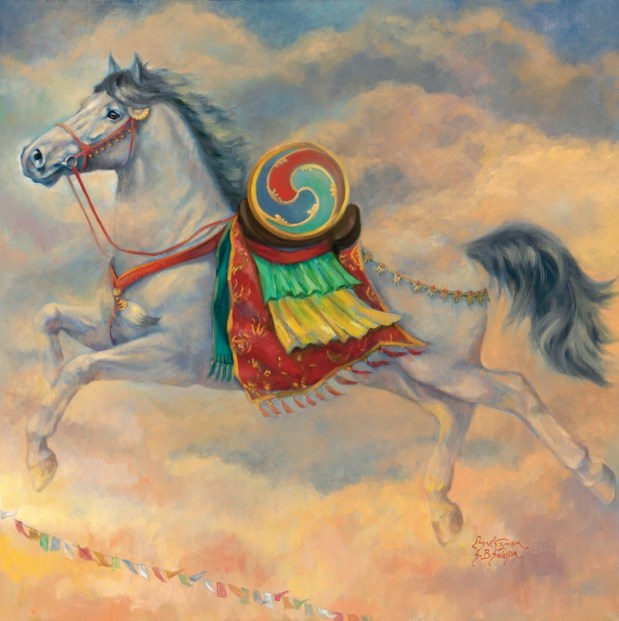
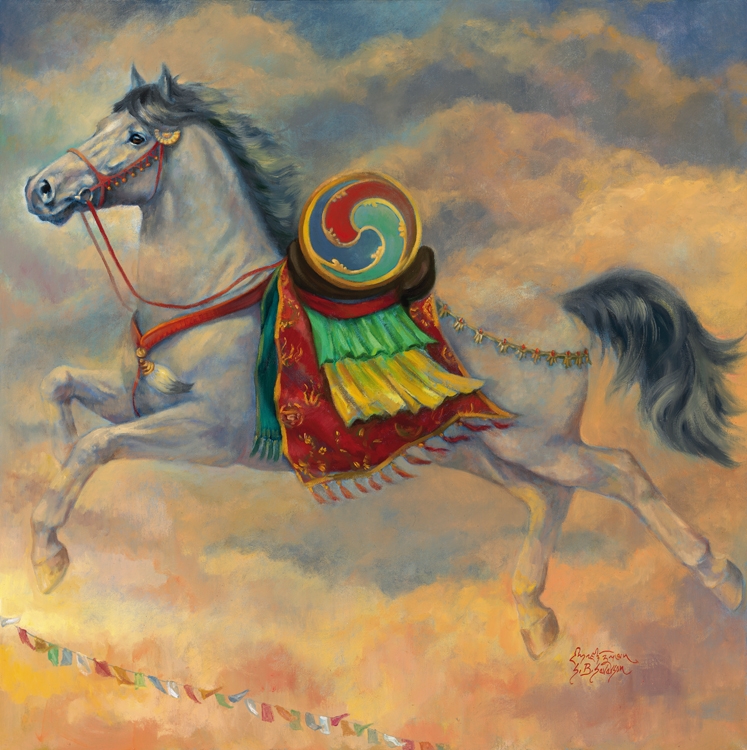
windhorse

(image: http://dungkarling.tripod.com/id7.html)

   Sadly, I have recently learned that one of my former riding students broke her back. I was on a trip to Arizona a few months ago, and while visiting my old barn, this very astute, lovely lady happened to stop by. She was thrilled to see me and excited to tell me about the new horse she had just purchased. The last time I had worked with her, several years ago, she was still on the longe line on a schoolmaster, slowly developing a correct seat. She had very little time to ride and was a long ways from riding independently, much less owning a horse.

   As happens far too many times, the horse she purchased this year was not suitable for her skill level. It was a gaited horse with a lot of forwards energy. In the story that was relayed to me by friends last week, the student had hired a trainer who insisted on using a noseband with spikes in it to control the horse.

   One day, while riding alone, the horse was spooked by a loose horse and the still-novice rider did what most riders would do in that instance, which is to grab at the reins to keep her horse from running off. Unfortunately the horse’s reaction was in response to the pain of the spiked noseband and it flipped over on its rider, causing the severe injury. Luckily, she is not paralyzed from the fall and will recover, but ultimately, such an accident can dramatically change a person’s life.

   It seems like every time I ride, go to a barn, speak with other riders or former clients, I am reminded as to why Dr. Schoen and I have written The Compassionate Equestrian. It seems like it cannot get out to the horse world fast enough.

   As it is, we have tremendous confidence in our wonderful publisher, Trafalgar Square Books, to produce a book we will be extremely pleased with, and one that we can send out on the back of the Windhorse with prayers and blessings for all equines and their people. For this generation, the next, and all to come, we wish for compassion to become the base of all training methods, for the benefit of all beings.

Condensing Time and Space

This is the new world. Nobody has time, and almost everybody is reading things in very small, narrow windows. We have condensed our world. Faster, smaller… better?

I was in an electronics store a short time ago and for the first time took a look at our blog and website on a smartphone screen. I’m a latecomer to the world of these devices, as I haven’t needed one, until now. Since we also have to travel lighter the power of the small screen decidedly trumps the necessity of packing a computer. In the world of condensed everything, even these two paragraphs are too long for most people. If you’ve been able to get this far – good for you!

When you squeeze text into a narrower window, obviously it makes the content appear much longer than it does on a wide-screen. So I’ve decided to try to make these posts shorter and sweeter so that everyone can get back to their busy-ness and other activities in due course.

photo: americashorsedaily.com "Bad Warmup Behavior"

photo: americashorsedaily.com
“Bad Warmup Behavior”

What does this have to do with horses? Compassion?

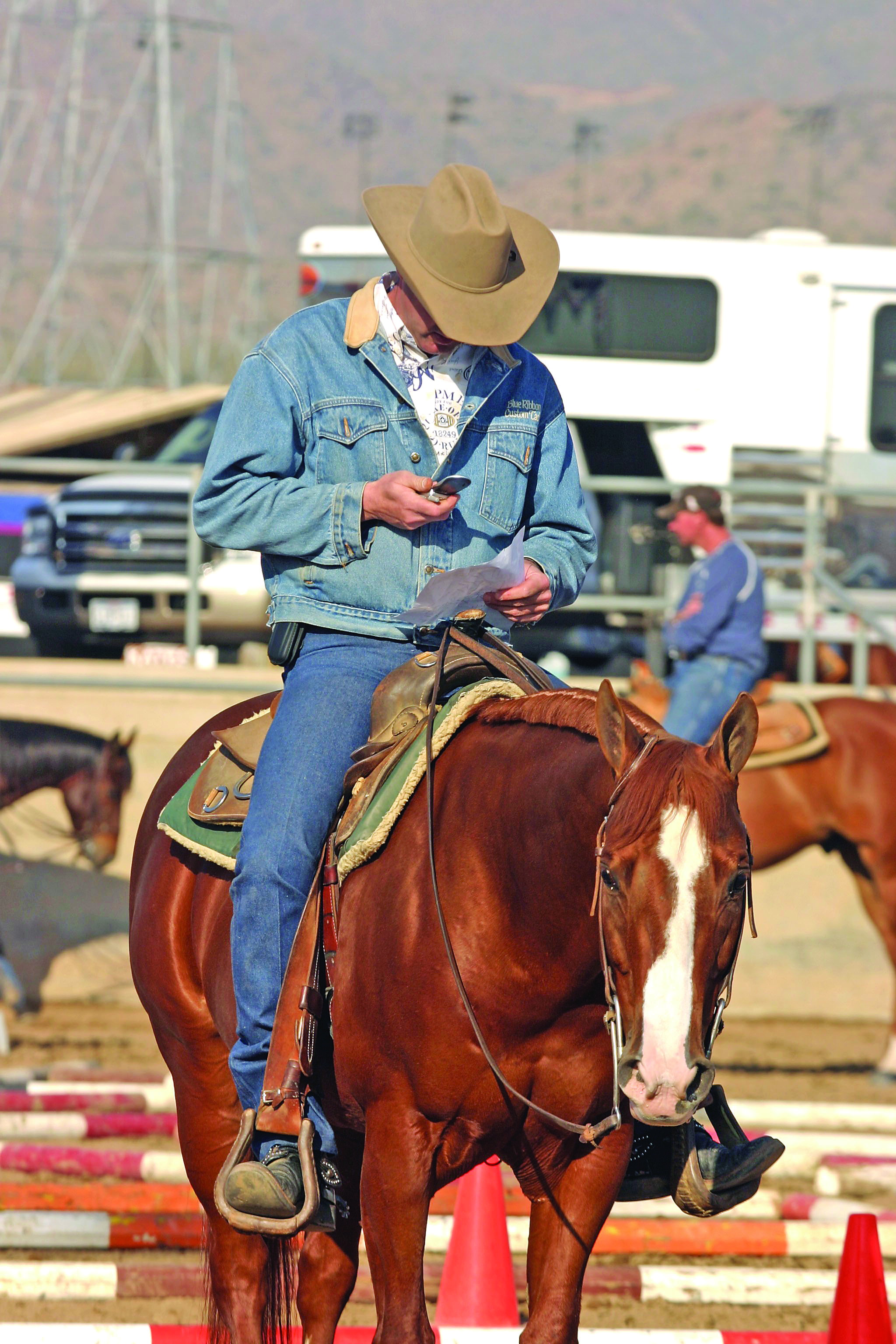
I have seen the tiny electronic devices cause a considerable deflection from the intense focus that’s required to school a horse correctly. I’m old enough to have comparative values of the pre-cellphone and post-cellphone worlds. When my teenage students first started showing up at the barns sporting their new e-toys, I could sense  trouble was brewing. I knew what was coming down the high-tech pipelines too as I actually lived in a computer lab that was full of engineers and programmers developing this stuff. Nobody figured teenagers would be the first demographic addicted to tiny phones.

I will never forget the sight of one of the younger girls who was on her new 17.2 h.h. off-track thoroughbred for the first time. I was waiting in the arena for her to start her lesson and couldn’t figure out why the horse was drifting well away from the in-gate. Then I noticed the reins were on the buckle. No, wait. Not even on the buckle, they were dropped on the big gelding’s neck. The young rider had her head down, both hands on her phone, texting. The horse had no idea where he was supposed to go.

It wasn’t long before the lure of the e-device became far more important than the horse, who soon after began to act out on all the issues that come with an ex-racehorse. He ended up standing in his paddock for the next two years while the girl’s grandmother did her best to care for the high-energy thoroughbred, as none of the other kids had the patience for him either.

Everybody had to get back to their phone calls and texts.

It’s not going to get any better, I’m afraid. Not unless more people decide that it simply isn’t being mindful or compassionate to our horses as distracted humans carry on in this faster, smaller, (better?) world of narrow windows, too much to do, too much traffic, rising costs of everything, complex data plans, endless passwords, typing, typing and more typing (with thumbs, no less), and having to get information across in smaller and smaller chunks. How does anybody learn anything this way? How in the world did we all end up with so much to do and no time to do it? The mind is just too packed with fragmented bits of information to be focused…

…and riding a horse really well requires focus. Otherwise, somebody gets hurt, or somebody (usually the horse) IS hurting, and it goes unnoticed – because the mind is elsewhere – or the rider is in such a rush to get in and out of the barn that something else in the horse’s training goes amiss.

Obviously, I haven’t done a very good job of condensing this post either! So if you’ve also had the time to read this far – good for you again!

The only answer I can see – and Dr. Schoen has spoken about this many times and puts it into practice daily – is that we have to take control of our mind-space and consciously retrain, or re-wire, our thinking to where we can be more mindful. Being mindful means being more compassionate as with that clearer, calmer focus, it’s much easier to notice if somebody, especially our silent horse, is actually suffering in some way.

If you have patiently scrolled all the way through this post, thank you! Apparently I still have a lot to say about things – maybe too much – but in a very condensed conclusion, all I have to say is, when I finally get my first smartphone next week, I hope I’ll remember to put it down when necessary, look up and around and acknowledge everybody and everything that needs some attention and real human contact.

As the Barn Turns

We all have our stories about “barn drama”. No matter what breed, what discipline, or what type of facility you board your horse at, there will be drama.

A recent article in the Wall Street Journal spelled out just how bad things can get:

Horse therapy (photo www.yourhorse.co.uk)

Horse therapy
(photo http://www.yourhorse.co.uk)

‘Barn Drama’ Puts Riders on Their High Horses
People Who Board Horses Know That Misbehavior by Human Owners Is Common Hazard

by Lauren Lipton, April 13, 2014 http://www.wsjonline.com

Scot Gillies has a good idea of the kind of horse people who will fit in at Gryffindor Farm, the small barn he helps manage in Lexington, Ky. So his advertisements for new boarders spell it out in detail: Owners must be “laid-back,” “happy” and above all, “drama-free.”

In an example of ‘barn drama,’ an unknown culprit cut the tail of a prized stallion at a Kentucky horse show. Vicky Castegren
Mr. Gillies, a marketing consultant by day and a horse owner himself, says that during his 14 years in the equestrian world, “I’ve seen the full range of drama that is associated with horse people.”

A few categories of problematic individuals reign: There are overprotective owners who insist their animals be treated like porcelain figurines, and neglectful owners who never show up. There are “back seat riders,” as some call them, who love to criticize other people’s technique. Some freak out over a stray wisp of hay in the barn aisle; others let their animals leave unwanted souvenirs…

I’ve been on both sides of the fence myself, as a boarder and managing a boarding barn. From a small backyard operation of a couple of horses to one of the most famous show-jumping facilities in the world. I could write an entire book on this topic alone.

We all know this kind of “stuff” happens all the time at barns so why does it continue? Can’t we be civilized enough to allow our fellow horse-people to enjoy their mounts and their time at the barn without the concerns of being criticized, harassed, bullied, insulted, or even robbed? Where is the compassion for other humans amongst human horse owners?

Are horse-people just an inherently nasty personality type who can’t resist the chance to flaunt their “superior knowledge” at every chance? Sometimes one has to wonder…

The setup of a boarding barn almost guarantees unstable behavior: Take a group of passionate, opinionated individualists. (Riding, a solo activity, doesn’t attract “team players.”) Give them a consuming hobby centered on a delicate, expensive living creature. Put them in close quarters, often with children and dogs that run amok, spooking the horses, and let the backbiting begin.

Yikes. That doesn’t make us look too good as a subset of society does it?

I wonder if it’s just that horses bring up the deepest part of ourselves, perhaps even mirroring our most repressed fears and long-buried personality traits that we ourselves are surprised to discover when they surface. I can remember many incidents over the years, even going back to my teens, where being around horses made me more reactive and opinionated around people than usual. In fact, I was pretty shy and reclusive around people, even quite nervous, when I didn’t have a horse nearby to “cover” for me. There is definitely new research emerging that confirms a neurobiological basis to our interactions and behaviors between species.

At horse barns I’ve found most people only get to know each other as they relate to their horses and their specific activity at the barn. We don’t get to know each other well and so there may be assumptions made about others causing us to form opinions about them that are untrue or incomplete. This can cause rifts amongst people who might become friendlier if they understood each other a little better. Some riders may form more lasting or bonding friendships and enjoy great camaraderie, but it always seems to split into “cliques”, just like high school. This seems especially true if there’s multiple disciplines involved at the barn:

Some barns attract more drama than others. High-end facilities with riders who compete on the show circuit in events like jumping and dressage can be hotbeds of jealousy; trail-rider barns are said to be easier-going. A mix of disciplines and levels, from serious equestrians to children taking lessons, can make problems worse.

“The minute you start mixing the hunter-jumpers with the dressage people with the Western pleasure people, that is like drama times three,” says Macala Wright, who boards her two horses in a facility that also includes a nonprofit equestrian-therapy group.

“The affluent people look down on the everyday horse owners. The dressage people don’t like the hunters, and every group looks down on the nonprofits,” says Ms. Wright, a Los Angeles branding consultant who has shuttled one of her horses through four barns in two years. At the second, which catered mostly to wealthy riders, “People would comment, ‘Oh, your dressage saddle isn’t very good quality,’ ” recalls Ms. Wright.

Something seems to be missing. Perhaps that would be “compassion,”  – the desire to relieve the suffering of another. Given the scenarios mentioned in this article, it would appear that compassion for others, and even other people’s horses, is sadly absent. I wonder if it’s possible to create a barn with a boarding contract that spells out something more profound than a “no drama” clause…

The best defense against drama may be a no-nonsense management style. “Three strikes and you’re out!” works for Donna Hyde, who juggles 22 horses, 18 boarders and disciplines including therapeutic riding, Western dressage and trail riding at her Norco, Calif., facility.

It’s an unfortunate commentary on the business when a barn manager has to constantly be on the defence for bad behavior. It just makes the barn manager appear to be angry or potentially angry much of the time too. In fact, if they’re dealing with or perpetuating the drama themselves, they may actually be angry! The attitude from the top-down affects everyone at the barn, including the horses.

By the time a boarder has reached the “three strikes and you’re out!” order, they’ve usually already left a trail of destruction ranging from hurt feelings to causing others to leave the barn. You can end up losing a good client because of a disruptive one.

Our answer with The Compassionate Equestrian is to create a new paradigm for horse-people and the equine industry that will allow a barn to follow the program Dr. Schoen and I have been working on. Its principles are designed to encourage the development of self-compassion, compassion for horses, and for all beings. There will eventually be a database of compassionate barns and trainers who will be doing their best to ensure everyone under their care and management is mindful of others and coming from a place of compassionate awareness.

We believe that horse-people are highly influential in their communities, both in and outside of their equestrian activities. If we are known as a “hazard” to each other and noted as “unstable personalities” we are not setting a good example for others, and especially not for young people who need safe, happy environments in which to enjoy their horses. Nobody should ever have to arrive at their barn and be afraid of what negative things will be said or done to them or their horse.

Everyone has the capacity to become more compassionate, and it does take a conscious effort to maintain compassion when situations may become difficult. For the sake of our community, our horses, and peaceful interactions in our barns, it’s our wish that all horse-people consider the benefits of compassion and the extraordinary, broad-reaching impact it can have on our world, well beyond that of the barn.


The Benefits – or Not – of Freedom

Imagine the Earth before there were any countries or borders of any kind. No lines, no names of this or that, no maps, no fences… nothing. The only sounds were the sounds made by Nature. There was no “time” according to human parameters. Just the continuous, ever flowing cycles of life. All creatures were free to wander wherever they would, or could. They were unbound by man-made constraints and the defining qualities brought about by the human tendencies of wants, needs, and ownership.

We couldn’t leave well enough alone, could we? We had to make countries and borders then create weapons of war to protect the countries and make enemies of those from other places. Horses were captured and domesticated to assist humans in their pursuits to “divide and conquer”. Unwitting participants along our path of so-called civilization.

It’s almost like we’ve painted ourselves into a corner after centuries of nation-building and social development. Are we free or not free? We’re surrounded by borders and rules telling us where and when we can and cannot go to visit or live. What of all the animals we’ve domesticated and bred? If we and they have wonderful, fulfilling lives, should there be judgement placed on how such great societies have been created? What about the millions of people and animals who still suffer so greatly on this planet, with no freedom to escape bad situations? If we have compassion for all beings, how can we be at peace until all beings on Earth are at peace?

According to Professor Lori Gruen’s interesting viewpoint, there are serious ethical questions to be asked about keeping animals in cages… or in the case of horses, the reference would be to keeping them in stalls and barns as our “captives”.

http://www.psychologytoday.com/blog/animal-emotions/201404/the-ethics-captivity-new-book-covers-all-the-issues

“Though conditions of captivity vary widely for humans and for other animals, there are common ethical themes that imprisonment raises, including the value of liberty, the nature of autonomy, the meaning of dignity, and the impact of routine confinement on physical and psychological well-being.”

Now, imagine what the implications would be if everybody just quit riding their horses, opened all the stall doors and paddock fences and set them free. It’s likely chaos would ensue. Sure, they might run amok for awhile or stop by the neighbour’s apple trees but most would be right back at the barn doors at feeding time looking for their next meal. Some wouldn’t leave at all. A few might join the wild herds, as in the deserts of the American Southwest where the economic downturn really did lead some people to turn their show and companion horses loose to fend for themselves. Rescue operations bordering desert communities have found themselves with “strays” looking for food and water.  Domestic horses don’t do well on their own.

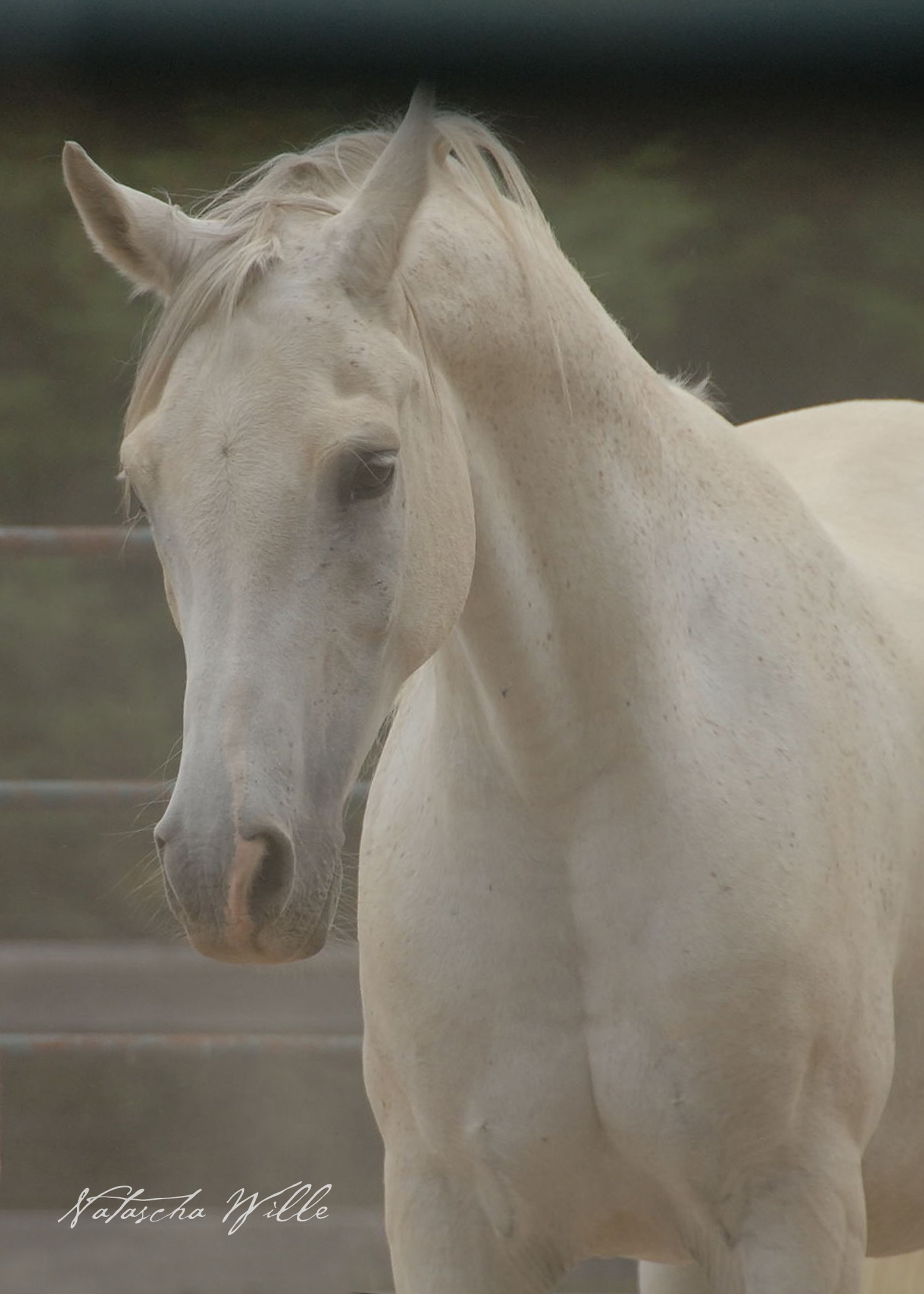
"Nick" - photo by Natascha Wille

“Nick” – photo by Natascha Wille

Let’s face it. Horses are big animals that leave a big hoofprint on the environment. In our “non-ideal” world as Dr. Gruen refers to, we have to “do the very best we can for them while their lives are compromised to various degrees in captive settings”.

Dr. Marc Bekoff, the writer of the article states, ” let’s hope that open discussion of the issues and the questions at hand, including what we know about the cognitive and emotional lives of animals and their capacity to suffer and to empathize with others, will work on behalf of those unfortunate billions of individuals who lives are a mess because of their confinement”.

So somewhere in the middle of “let’s turn all the horses loose” and “let’s keep them confined for our own pleasure and use” is the question “what is the most compassionate way to care for and interact with our horses?”

There is new, emerging research all the time that is telling us what causes distress to horses. We know for sure that ulcers are a man-made condition in equines, caused by stress placed on them due to excessive confinement, travel and showing. In our human rush to conquer and control everything, have we gone too far with horses and committed them to a lifestyle that is so unnatural for them that we’ve changed their genetic makeup? Probably. Is this bad? What have we done to other humans with such a mindset? Even in such things as personal relationships. Are we being compassionate to our partners when we hold them “captive” according to our wants, needs, schedules and whims?

Ah freedom. Look your horse in the eye and ask if he’d rather be turned loose to run and graze wherever he wants. No more grooming, hoof trimming, veterinary care, clean hay and water or forced exercise. Would he tilt his head like a curious puppy and ask “why”? Or would he immediately start nodding his head, pounding on the stall door with the enthusiasm of a football player charging into the opponent’s end zone for a touchdown? What would happen if you told your human partner or spouse they were free to go wherever they choose, whenever, and with whom?

My guess is the equine and human responses would vary, but most would fall somewhere in the middle of the extremes. Having compassion and wishing to alleviate another’s suffering means first of all, to be mindful of the fact that they’re suffering. Is your horse (or human partner) suffering in silence and you’re not seeing it? If you opened the door to set them free, would they go? Would they come back to you after realizing how kind and compassionate you were to them? Do they recognize freedom as being of benefit to them, or are they looking for the security of the home they’ve become so accustomed to and are willing to compromise their freedom to remain “captive” in a potentially less-than-ideal situation? These are the gists of the ethical questions posed by Dr.s Gruen and Bekoff.

Freedom is not about owning and controlling. Perhaps we need to consider that with our “captive” animals and being mindful as to how they are affected by confinement and the tasks we ask of them. Horses have evolved to fit with a domesticated lifestyle, as have humans, and many of the other pets we keep. Turning them all loose would not necessarily be conducive to their health and wellbeing. We all need to depend on each other for care and love, otherwise we lead a lonely and vulnerable life. The kindest approach of all is to acknowledge everyone as a free spirit, accepting who and what they are, with a compassionate heart and mind.