CAUGHT YOU LOOKING!

It is a classic accusation amongst humans in relationships… subtle (or sometimes not so subtle) body language and gestures that make one person jealous of another. For example, women tend to be hyper-vigilant and sensitive to the attention their male partners pay to other women, and immediate judgments are formed about “the other” who is receiving the attention. Even if someone does not want to feel that way, or exhibit the sometimes-embarrassing behavior that arises from those feelings, jealousy seems to happen as a matter of fundamental neurochemistry. Is it an inherent mechanism? If so, what is it for?

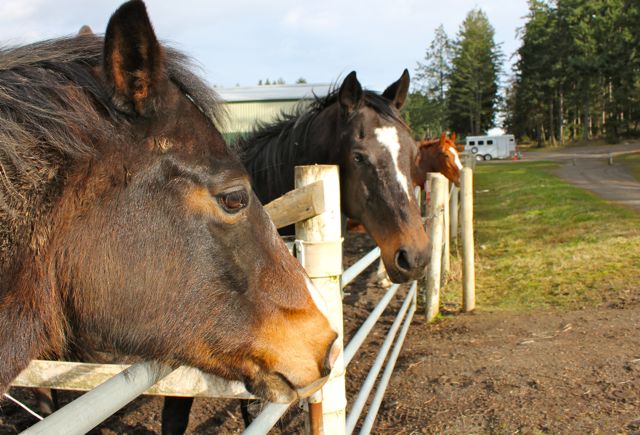
Two brown horses nuzzling each other

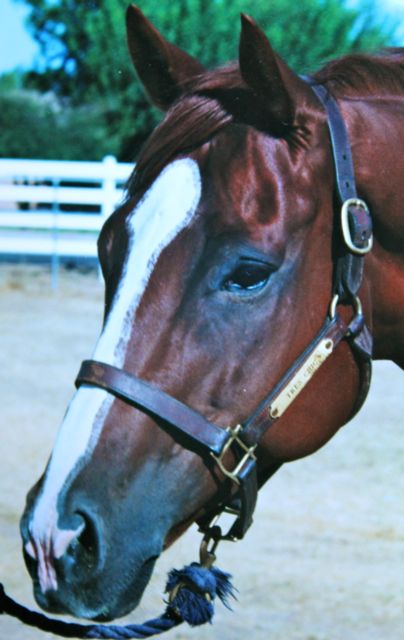
French saddlebred horses. Photo: http://www.horsesoflegend.com

Sometimes the basis for jealousy, which is actually a label for the fear of loss, is well founded. This can be especially true in humans where children or personal security are of concern. The situation that triggers jealousy also evokes thoughts of steps that would need to be taken in the event of losing their partner to the object of their jealousy. It is a defensive mechanism, in short, and should the underlying causes not be dealt with directly, it can lead to anger, depression, and other associated psychological effects.

In adolescents, the negative behaviors associated with jealousy are more common amongst those with low self-esteem. They may perceive their friendships as being easily threatened by others, sometimes leading them to aggressive actions [1]. Jealousy differs from “envy,” which is the desire to have something that someone else has.

Jealousy is an anticipatory emotion and one of the most common, yet unsettling behaviors exhibited by humans… and remarkably, other beings too. I say “other beings,” because it is apparent that animals can also become jealous when their “person” gives attention to another member of that animal’s species, or even another human. If dogs experience such emotions, then horses likely do too, as they also have an amygdala and correlating neurochemistry.

http://news.therawfoodworld.com/animals-can-experience-emotions-like-people-can-jealousy/

My brother and I used to laugh at our dogs when they would immediately get in between our parents as they embraced. The dogs would bark excitedly and turn anxiously from one parent to the other. We could never determine if they thought our parents were trying to hurt each other and the dog was attempting to “save” one or another, or if the dog was actually jealous that one of their “people” was paying too much attention to the other. Apparently, now we know the answer to that.

Fortunately, animals can’t quite go as far as humans in exhibiting abnormal types of jealousy, which can become quite threatening and dangerous to other people. This can enter the realms of extreme insecurity and may move well beyond the typical fighting over emotional infidelity or other common issues encountered in romantic relationships, particularly where “attachment” has been mistaken for love. In fact, there may be a neurochemical basis for jealous reactions that persist when there is no actual threat present and the fears are entirely unfounded. Neurotic jealousy may become associated with a disorder such as schizophrenia, paranoia or chemical imbalance in the brain.

It is sometimes all too easy to anthropomorphize what a horse might be thinking, and sometimes, as with the dogs, their apparent jealous responses when we give attention to another being can be quite amusing. As science continues to produce more confirmation as to the actual biochemical basis for the behaviors of sentient beings however, perhaps it is not such a stretch to be thinking that our horse might be jealous when we pay attention to another.

I have experienced observations of apparent jealousy in horses on many occasions and when Dr. Schoen suggested the article about the dogs as a blog post, reading it brought back many memories.

One such incident was with a big dun Saddlebred gelding I would ride every now and then when his owner was away. He had been rescued from abusive circumstances prior to the owner I was working with, and found himself in a loving, compassionate situation with Katie, his new “person.” During her lessons, it had become very apparent that this horse was quite possessive of his owner, and he would make challenging faces at any horse that got too close to her. As it happened, Katie and I were very similar in appearance and energy, so it was no surprise when her horse took on the same possessive characteristics with me as he did with her.

One day I was grooming him in his pipe-rail stall, preparing to tack up for a ride. Off in the distant paddock, a young horse was playing with a ball, going through some hilarious antics as he was doing so. While still brushing the big dun, my attention was on the colt that was having such a good time entertaining himself. Within a minute or so, the Saddlebred noticed my attention had been distracted to the other horse. He swung his head in the colt’s direction and his ears went back. Knowing how possessive he was of Katie I realized what he was responding to. After glaring in the direction of the playful youngster that was well off in the distance, he swung his head in my direction and gave me a “look that could kill.” Then he promptly re-positioned his body so that his neck, held regally high on his shoulders as is typical of his breed, completely blocked my view of the colt. What else could I do but laugh and return my full attention to the jealous gelding?!

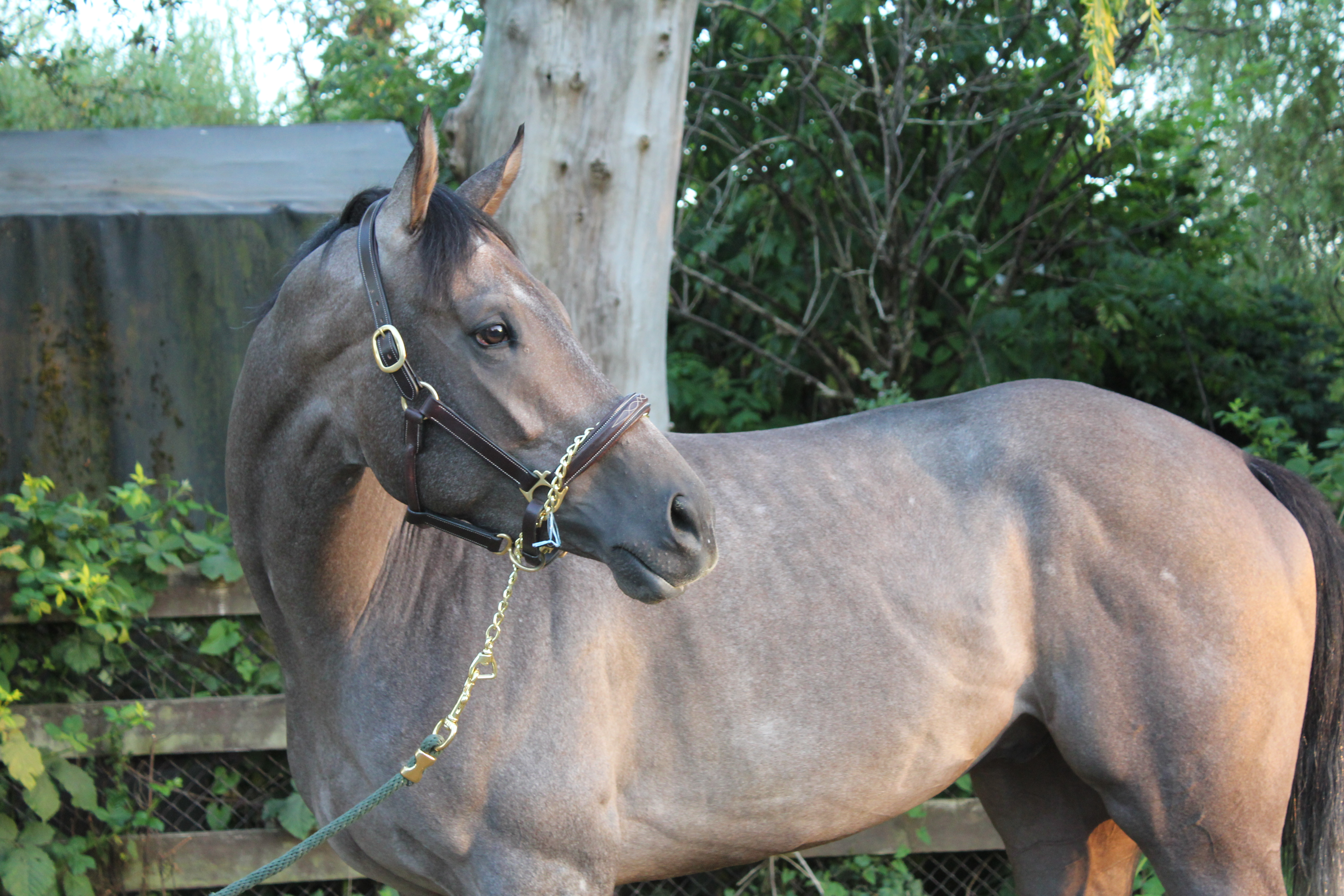
Trakehner stallion

Young, dun Trakehner stallion. Photo: http://www.animalgenetics.us

I think one really has to spend a lot of time around animals to fully realize and appreciate the similarities between our emotions and theirs. As Dr. Schoen and I have cautioned in The Compassionate Equestrian however, there is still the need to recognize that an animal is an animal, and that they are not “us.” Common sense has to dictate the way we handle and train them so they are safe and untraumatized, to the best of our knowledge and abilities. It takes a long time to acquire the sensitivity and skills necessary in determining when an animal’s behavior is related to normal responses and when it may be reactions to fear, pain, or other negative stimuli that can put a less-experienced handler in danger.

Have you recognized jealousy-related behaviors in your own horse? Tell us your story too! We would love to hear from you.

__________

Helping Horses Helping People

I will never forget the day my brother and I came home from school, only to find Dad home early from work and Mom nowhere in sight. He said to us, “I’m afraid your mother has had a bit of a nervous breakdown, and she’s in the hospital.” It was shortly after Christmas, 1973. Mom’s drinking finally had her “hitting bottom” to the point that medical intervention became necessary. To this day, I have no idea what the inciting incident was that had her hospitalized, nor do I have much recall of the months that followed. It was all a blur. I just knew there had been too many times Mom was drunk when we needed her, and I had already altered my young life around her episodes. I had given up on bringing friends home long before this day because it was just too embarrassing. I do not remember who got my brother and I to school after that day, who made our dinners, how we managed to keep the dogs and cats fed, or even if I had a birthday celebration that January. There are family photos of every year of my birthday except my 14th. What I do recall is spending a lot of time talking to my therapist. We communicated at least twice a day, if not more. It was necessary, as nobody else was going to get up before school started and go out there in the pouring rain to feed her. If I looked out the bedroom window, she was usually staring in my direction, her big brown eyes wondering when I was coming out next.

My "therapist"

My “therapist”

Nobody in the family understood my attraction to horses. They all knew I had an affinity for animals, but the horse was an anomaly. Mom came from a traumatized heritage, and scientists have now proven certain traumas carry through to the next generation. Her parents left Poland in 1930, when she was just a week old. The oppression they escaped from with little money or belongings made for a hard life farming on the Canadian prairies before they moved west.  Mom’s most vivid memory of a horse was getting kicked in the chin by one of the farm’s plough horses when she was playing underfoot as a small child. She retained the scar for the rest of her life. So when I first began begging for a horse, it took some convincing. Horses were work animals in her world, as they were for my father’s family, where they had also been a status symbol in the horse and buggy days of a developing western metropolis. They most certainly were not considered “therapists” or co-facilitators for human psychological care, and in fact, the lofty new titles afforded these wonderful animals has not been applied to their species until very recently.

Every behavior a horse does naturally has now been carefully analyzed and their herd dynamic has been extrapolated to human behavior. When I started riding there was basically Western and English and not much deviation from traditional methods. I rode both ways, and as most kids enjoy doing, I also rode bareback with a halter when I was too lazy to tack up. Little did I know, all of those long, quiet hours spent feeding, mucking, grooming, and riding White Cloud, were therapy for the sad days of not having a Mom who was fully present and healthy in my early teenage years. Allegedly, every time the mare followed me, every time she moved in accordance with how I made the request, and every time she responded to my voice, has a meaning in Equine Assisted Guidance and Learning.

According to a recent article Dr. Schoen and I have discussed, horses can help humans in 8 ways:

http://m.huffpost.com/us/entry/5634554?utm_hp_ref=mostpopular  

1. They help us find common ground.

2. They help keep us calm.

3. They help us learn by developing

empathy and social skills.

4. They keep us healthy, physically

and mentally.

5. They relieve Alzheimer’s symptoms.

6. They can be our best therapists.

7. They help us live in the present.

8. They inspire a sense of wonder in

all of us.

These ideas began in the early 1990s after Linda Kohanov released her book, The Tao of Equus. By then, I had continued getting unofficial therapy from horses, long after Mom had been going to AA and managed a full recovery, helping other alcoholics recover from their addictions too. Ala-Teen was the organization that helped my brother and I understand what had happened to our mother, and helped us avoid going down that same path as adults. I really could have used an organization like Horses Healing Hearts for children of alcoholics and addicts, but nothing like it existed at the time:

http://www.chronofhorse.com/article/horses-healing-hearts-adds-equine-assisted-learning-program-through 

The horses and all of their awe-inspiring mystical personalities kept me drawn into their lives until I became a full-time professional trainer instead of the zoologist I wanted to become prior to the experience with Mom’s addiction. Without realizing it, the horses really did mirror everything I was going through. My focus on them was what eventually led to the abilities I acquired insofar as being able to evaluate, calm, and transform the most traumatized and difficult of mounts that found their way into my hands.

As horses have come into their new starring roles in the past few years, fueled by the rise of stories such as Linda’s, the entertaining shows of Cavalia and Odysseo, or popularized in movies like the Horse Whisperer and others, there has also been the emergence of a new type of horse-person. They are drawn to horses by the mystique of equine nature, and not so much by the desire to ride and compete. In the past, as I, and many others in my field either as professionals or competitive amateurs and juniors, took our horses over jumps, we did not think in terms of the jumps being metaphors for obstacles in our lives. I have watched YouTube videos of Equine Assisted Psychotherapy with fascination as a group of people are taken into the horses’ pen and asked what obstacles they need to clear for themselves. Metaphorically, as they coerce a loose horse to hop over a low jump, that is a clearing for their own personal issue. I guess you could say that during my 30+ years of jumping horses that I have cleared a lot of obstacles. Of course, many just seem to keep returning too! Maybe I should still be riding 🙂

While I can see how incredible these new programs are for people, coming from the perspective of a trainer, and for Dr. Schoen as a pioneering holistic, integrative veterinarian, our primary concern is for the welfare of the horses themselves, and their overall wellbeing. The horse-person that is emerging from this new field is one that, as a trainer, we could consider a “beginner” around horses, although some long-time riders are benefitting from the recent revelations too. From my viewpoint, I have noticed several issues that may need to be taken into consideration when relaying equine imagery to public. It appears some safety concerns are not always being addressed, both in and out of the workshop situations, and people are left with the impression that horses can be treated as pets.

When articles such as the one from the Huffington Post show a child mounted on a horse and he is not wearing a helmet or proper footwear, this sends the wrong impression that all horses are safe to ride in this way. Those of us who know horses well also know that it is not a good idea to stand directly in front of them and grab them around the head or give them a kiss either. Not every horse is receptive to such a direct invasion of their space, and people could be hurt if they walk right up to a horse and try to interact in such manner. Having worked at a barn with an active therapeutic riding program, I can say from experience that not all horses are suitable for use in therapy, even if all they have to do is “act like a horse.”

These programs, such as EAGALA are becoming so popular however, that the new-comer to horses is going to need a very warm and compassionate welcome from those of us who have had four-legged therapists to count on for decades, and have also developed the professional skills necessary to help those who wish to explore horses more personally. Some of the newcomers to horses will hopefully want to learn how to ride and handle them correctly for the purposes of keeping the horses as sound, fit, and healthy as possible, as well as enjoying the benefits horses provide to human wellness. We are aware that it takes much more than a few experiences and encounters with horses to gain the ability to work with them independently, or in a boarding-barn situation.

Taking the current research about how horses can help humans with an array of psychological and physical disorders we can see a future for horses that potentially allows for those horses that may not be suitable for traditional riding and showing to lead a life of usefulness and engagement with humans that they would not have been priviledged to in the past. While watching the videos of the therapy sessions on YouTube, I noticed some of the horses were not sound, and hoped they were getting proper veterinary care for their issues.

On the other hand, it seems somewhat ironic that the traditional side of showing and training horses is undergoing its own shift in priorities as the regulating bodies for equestrian sports are having to deal with the enormous problems created around the doping of horses in competition. It is appearing to me that we have conflicting divisions in the equestrian world, and this is where Dr. Schoen and I are optimistic about bringing compassion into every aspect of the equine environment, to benefit all those concerned.

There is a somewhat idealized, romantic version of working with horses gaining in predominance on the social-media networks via the popular clinics and inspirational shows that involve working with horses at liberty and training them with freedom and harmony. Some modes of thought are convincing newer horse-people that all the classical means of working with horses are inhumane and use force, whereas their methods do not. Since everyone has varying filters on what constitutes force and humane or inhumane treatment, there tends to be some confusing techniques presented to eager audiences who genuinely want to learn how to communicate with horses. Some of the “branded” takes on training are not as humane as they are made out to be. In my opinion, pretty much everything we do with a horse is forcing it to do something it would not likely be doing otherwise. On the other hand, sometimes the use of force is legitimately abusive to the horse. It is simply a label, and how we use language. The use of language in the equine industry is what has been causing much of the division, and we would like to see a more nonviolent, compassionate way of communicating with all horse-people become the norm. This includes those who have had the enlightening experience of engaging horses in an EAL workshop, those who are learning some type of popular training method, or those who have been immersed in training and showing in various disciplines for many years. We all need to work together for the sake of horses at large.

As rescues become overwhelmed with the numbers of unwanted horses, and hay prices continue to increase while land for horses decreases in availability, there will be a need to create a new paradigm, and a new life for many more horses.

I am amazed, excited, and cautiously optimistic, as is Dr. Schoen, for this extraordinary rise of former “beasts of burden” to their new roles as helpers of humanity. What we need to ensure as human beings is that we do not judge the “other” kind of rider, or horse-person, or blame them in any way using the labels we have created for them, as it only serves to divide us from the common goals of being of benefit to horses, and our fellow humans. Everyone suffers in some way, from the stressed out executive who walks away from an EAP session with a huge smile and new leadership skills, to the wealthy socialite mounted on her imported dressage stallion. We are human. Our best therapists, apparently, are not. Let us find compassion for all, and move bravely forwards into this beautiful new consciousness. Thank you, horses.


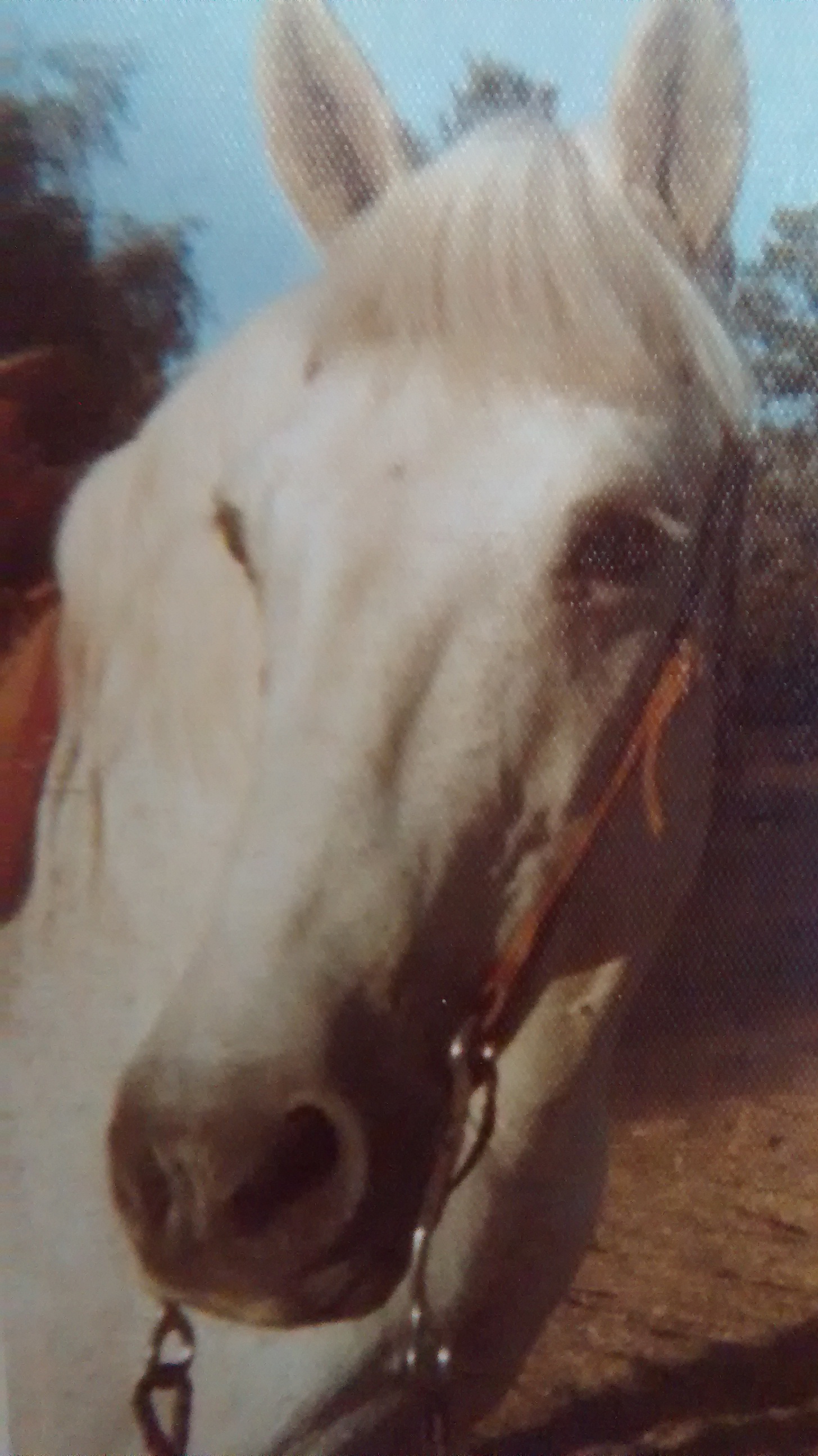
White Cloud and I, 1973 (yes, I used to ride without a helmet and proper footwear...but I advocate strongly for proper safety gear now)

White Cloud and I, 1973 (yes, I used to ride without a helmet and proper footwear…but I advocate strongly for proper safety gear now)

Nobody was able to explain to me in 1974 just how valuable my $150 horse was to my well-being, or why. My Mom was a beautiful, generous, and caring person who probably felt misunderstood, and under-appreciated, and there is some irony in how White Cloud came into my hands. Mom was a volunteer for the Canadian Mental Health Association and taught dance classes to special-needs students. Cloudy had been the faithful ranch horse of one of those students. In some remote way, both Mom and the horse probably knew exactly what they were doing. We just didn’t have the formal definitions 40 years ago, and now we do.

Condensing Time and Space

This is the new world. Nobody has time, and almost everybody is reading things in very small, narrow windows. We have condensed our world. Faster, smaller… better?

I was in an electronics store a short time ago and for the first time took a look at our blog and website on a smartphone screen. I’m a latecomer to the world of these devices, as I haven’t needed one, until now. Since we also have to travel lighter the power of the small screen decidedly trumps the necessity of packing a computer. In the world of condensed everything, even these two paragraphs are too long for most people. If you’ve been able to get this far – good for you!

When you squeeze text into a narrower window, obviously it makes the content appear much longer than it does on a wide-screen. So I’ve decided to try to make these posts shorter and sweeter so that everyone can get back to their busy-ness and other activities in due course.

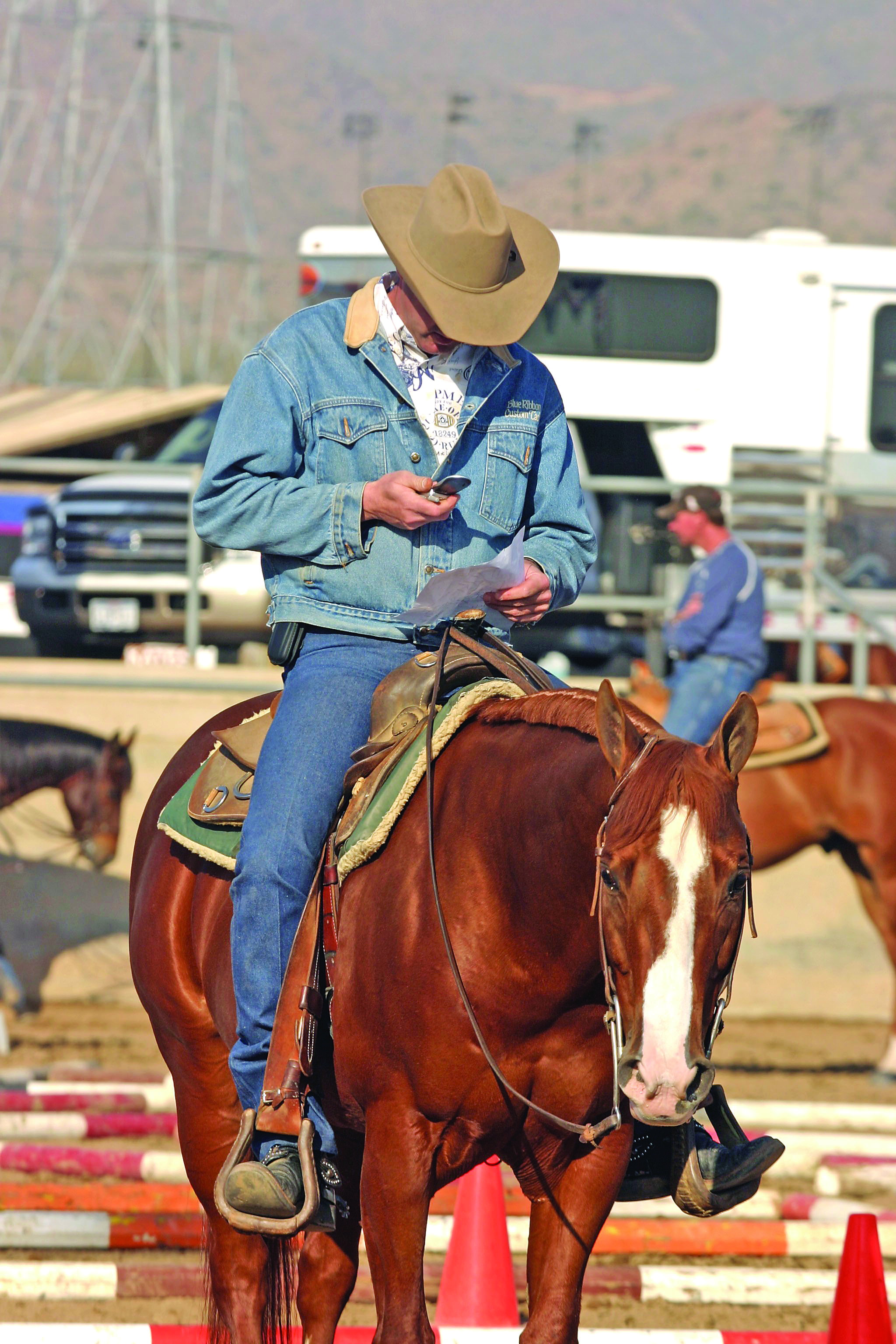
photo: americashorsedaily.com "Bad Warmup Behavior"

photo: americashorsedaily.com
“Bad Warmup Behavior”

What does this have to do with horses? Compassion?

I have seen the tiny electronic devices cause a considerable deflection from the intense focus that’s required to school a horse correctly. I’m old enough to have comparative values of the pre-cellphone and post-cellphone worlds. When my teenage students first started showing up at the barns sporting their new e-toys, I could sense  trouble was brewing. I knew what was coming down the high-tech pipelines too as I actually lived in a computer lab that was full of engineers and programmers developing this stuff. Nobody figured teenagers would be the first demographic addicted to tiny phones.

I will never forget the sight of one of the younger girls who was on her new 17.2 h.h. off-track thoroughbred for the first time. I was waiting in the arena for her to start her lesson and couldn’t figure out why the horse was drifting well away from the in-gate. Then I noticed the reins were on the buckle. No, wait. Not even on the buckle, they were dropped on the big gelding’s neck. The young rider had her head down, both hands on her phone, texting. The horse had no idea where he was supposed to go.

It wasn’t long before the lure of the e-device became far more important than the horse, who soon after began to act out on all the issues that come with an ex-racehorse. He ended up standing in his paddock for the next two years while the girl’s grandmother did her best to care for the high-energy thoroughbred, as none of the other kids had the patience for him either.

Everybody had to get back to their phone calls and texts.

It’s not going to get any better, I’m afraid. Not unless more people decide that it simply isn’t being mindful or compassionate to our horses as distracted humans carry on in this faster, smaller, (better?) world of narrow windows, too much to do, too much traffic, rising costs of everything, complex data plans, endless passwords, typing, typing and more typing (with thumbs, no less), and having to get information across in smaller and smaller chunks. How does anybody learn anything this way? How in the world did we all end up with so much to do and no time to do it? The mind is just too packed with fragmented bits of information to be focused…

…and riding a horse really well requires focus. Otherwise, somebody gets hurt, or somebody (usually the horse) IS hurting, and it goes unnoticed – because the mind is elsewhere – or the rider is in such a rush to get in and out of the barn that something else in the horse’s training goes amiss.

Obviously, I haven’t done a very good job of condensing this post either! So if you’ve also had the time to read this far – good for you again!

The only answer I can see – and Dr. Schoen has spoken about this many times and puts it into practice daily – is that we have to take control of our mind-space and consciously retrain, or re-wire, our thinking to where we can be more mindful. Being mindful means being more compassionate as with that clearer, calmer focus, it’s much easier to notice if somebody, especially our silent horse, is actually suffering in some way.

If you have patiently scrolled all the way through this post, thank you! Apparently I still have a lot to say about things – maybe too much – but in a very condensed conclusion, all I have to say is, when I finally get my first smartphone next week, I hope I’ll remember to put it down when necessary, look up and around and acknowledge everybody and everything that needs some attention and real human contact.

As the Barn Turns

We all have our stories about “barn drama”. No matter what breed, what discipline, or what type of facility you board your horse at, there will be drama.

A recent article in the Wall Street Journal spelled out just how bad things can get:

Horse therapy (photo www.yourhorse.co.uk)

Horse therapy
(photo http://www.yourhorse.co.uk)

‘Barn Drama’ Puts Riders on Their High Horses
People Who Board Horses Know That Misbehavior by Human Owners Is Common Hazard

by Lauren Lipton, April 13, 2014 http://www.wsjonline.com

Scot Gillies has a good idea of the kind of horse people who will fit in at Gryffindor Farm, the small barn he helps manage in Lexington, Ky. So his advertisements for new boarders spell it out in detail: Owners must be “laid-back,” “happy” and above all, “drama-free.”

In an example of ‘barn drama,’ an unknown culprit cut the tail of a prized stallion at a Kentucky horse show. Vicky Castegren
Mr. Gillies, a marketing consultant by day and a horse owner himself, says that during his 14 years in the equestrian world, “I’ve seen the full range of drama that is associated with horse people.”

A few categories of problematic individuals reign: There are overprotective owners who insist their animals be treated like porcelain figurines, and neglectful owners who never show up. There are “back seat riders,” as some call them, who love to criticize other people’s technique. Some freak out over a stray wisp of hay in the barn aisle; others let their animals leave unwanted souvenirs…

I’ve been on both sides of the fence myself, as a boarder and managing a boarding barn. From a small backyard operation of a couple of horses to one of the most famous show-jumping facilities in the world. I could write an entire book on this topic alone.

We all know this kind of “stuff” happens all the time at barns so why does it continue? Can’t we be civilized enough to allow our fellow horse-people to enjoy their mounts and their time at the barn without the concerns of being criticized, harassed, bullied, insulted, or even robbed? Where is the compassion for other humans amongst human horse owners?

Are horse-people just an inherently nasty personality type who can’t resist the chance to flaunt their “superior knowledge” at every chance? Sometimes one has to wonder…

The setup of a boarding barn almost guarantees unstable behavior: Take a group of passionate, opinionated individualists. (Riding, a solo activity, doesn’t attract “team players.”) Give them a consuming hobby centered on a delicate, expensive living creature. Put them in close quarters, often with children and dogs that run amok, spooking the horses, and let the backbiting begin.

Yikes. That doesn’t make us look too good as a subset of society does it?

I wonder if it’s just that horses bring up the deepest part of ourselves, perhaps even mirroring our most repressed fears and long-buried personality traits that we ourselves are surprised to discover when they surface. I can remember many incidents over the years, even going back to my teens, where being around horses made me more reactive and opinionated around people than usual. In fact, I was pretty shy and reclusive around people, even quite nervous, when I didn’t have a horse nearby to “cover” for me. There is definitely new research emerging that confirms a neurobiological basis to our interactions and behaviors between species.

At horse barns I’ve found most people only get to know each other as they relate to their horses and their specific activity at the barn. We don’t get to know each other well and so there may be assumptions made about others causing us to form opinions about them that are untrue or incomplete. This can cause rifts amongst people who might become friendlier if they understood each other a little better. Some riders may form more lasting or bonding friendships and enjoy great camaraderie, but it always seems to split into “cliques”, just like high school. This seems especially true if there’s multiple disciplines involved at the barn:

Some barns attract more drama than others. High-end facilities with riders who compete on the show circuit in events like jumping and dressage can be hotbeds of jealousy; trail-rider barns are said to be easier-going. A mix of disciplines and levels, from serious equestrians to children taking lessons, can make problems worse.

“The minute you start mixing the hunter-jumpers with the dressage people with the Western pleasure people, that is like drama times three,” says Macala Wright, who boards her two horses in a facility that also includes a nonprofit equestrian-therapy group.

“The affluent people look down on the everyday horse owners. The dressage people don’t like the hunters, and every group looks down on the nonprofits,” says Ms. Wright, a Los Angeles branding consultant who has shuttled one of her horses through four barns in two years. At the second, which catered mostly to wealthy riders, “People would comment, ‘Oh, your dressage saddle isn’t very good quality,’ ” recalls Ms. Wright.

Something seems to be missing. Perhaps that would be “compassion,”  – the desire to relieve the suffering of another. Given the scenarios mentioned in this article, it would appear that compassion for others, and even other people’s horses, is sadly absent. I wonder if it’s possible to create a barn with a boarding contract that spells out something more profound than a “no drama” clause…

The best defense against drama may be a no-nonsense management style. “Three strikes and you’re out!” works for Donna Hyde, who juggles 22 horses, 18 boarders and disciplines including therapeutic riding, Western dressage and trail riding at her Norco, Calif., facility.

It’s an unfortunate commentary on the business when a barn manager has to constantly be on the defence for bad behavior. It just makes the barn manager appear to be angry or potentially angry much of the time too. In fact, if they’re dealing with or perpetuating the drama themselves, they may actually be angry! The attitude from the top-down affects everyone at the barn, including the horses.

By the time a boarder has reached the “three strikes and you’re out!” order, they’ve usually already left a trail of destruction ranging from hurt feelings to causing others to leave the barn. You can end up losing a good client because of a disruptive one.

Our answer with The Compassionate Equestrian is to create a new paradigm for horse-people and the equine industry that will allow a barn to follow the program Dr. Schoen and I have been working on. Its principles are designed to encourage the development of self-compassion, compassion for horses, and for all beings. There will eventually be a database of compassionate barns and trainers who will be doing their best to ensure everyone under their care and management is mindful of others and coming from a place of compassionate awareness.

We believe that horse-people are highly influential in their communities, both in and outside of their equestrian activities. If we are known as a “hazard” to each other and noted as “unstable personalities” we are not setting a good example for others, and especially not for young people who need safe, happy environments in which to enjoy their horses. Nobody should ever have to arrive at their barn and be afraid of what negative things will be said or done to them or their horse.

Everyone has the capacity to become more compassionate, and it does take a conscious effort to maintain compassion when situations may become difficult. For the sake of our community, our horses, and peaceful interactions in our barns, it’s our wish that all horse-people consider the benefits of compassion and the extraordinary, broad-reaching impact it can have on our world, well beyond that of the barn.


The Benefits – or Not – of Freedom

Imagine the Earth before there were any countries or borders of any kind. No lines, no names of this or that, no maps, no fences… nothing. The only sounds were the sounds made by Nature. There was no “time” according to human parameters. Just the continuous, ever flowing cycles of life. All creatures were free to wander wherever they would, or could. They were unbound by man-made constraints and the defining qualities brought about by the human tendencies of wants, needs, and ownership.

We couldn’t leave well enough alone, could we? We had to make countries and borders then create weapons of war to protect the countries and make enemies of those from other places. Horses were captured and domesticated to assist humans in their pursuits to “divide and conquer”. Unwitting participants along our path of so-called civilization.

It’s almost like we’ve painted ourselves into a corner after centuries of nation-building and social development. Are we free or not free? We’re surrounded by borders and rules telling us where and when we can and cannot go to visit or live. What of all the animals we’ve domesticated and bred? If we and they have wonderful, fulfilling lives, should there be judgement placed on how such great societies have been created? What about the millions of people and animals who still suffer so greatly on this planet, with no freedom to escape bad situations? If we have compassion for all beings, how can we be at peace until all beings on Earth are at peace?

According to Professor Lori Gruen’s interesting viewpoint, there are serious ethical questions to be asked about keeping animals in cages… or in the case of horses, the reference would be to keeping them in stalls and barns as our “captives”.

http://www.psychologytoday.com/blog/animal-emotions/201404/the-ethics-captivity-new-book-covers-all-the-issues

“Though conditions of captivity vary widely for humans and for other animals, there are common ethical themes that imprisonment raises, including the value of liberty, the nature of autonomy, the meaning of dignity, and the impact of routine confinement on physical and psychological well-being.”

Now, imagine what the implications would be if everybody just quit riding their horses, opened all the stall doors and paddock fences and set them free. It’s likely chaos would ensue. Sure, they might run amok for awhile or stop by the neighbour’s apple trees but most would be right back at the barn doors at feeding time looking for their next meal. Some wouldn’t leave at all. A few might join the wild herds, as in the deserts of the American Southwest where the economic downturn really did lead some people to turn their show and companion horses loose to fend for themselves. Rescue operations bordering desert communities have found themselves with “strays” looking for food and water.  Domestic horses don’t do well on their own.

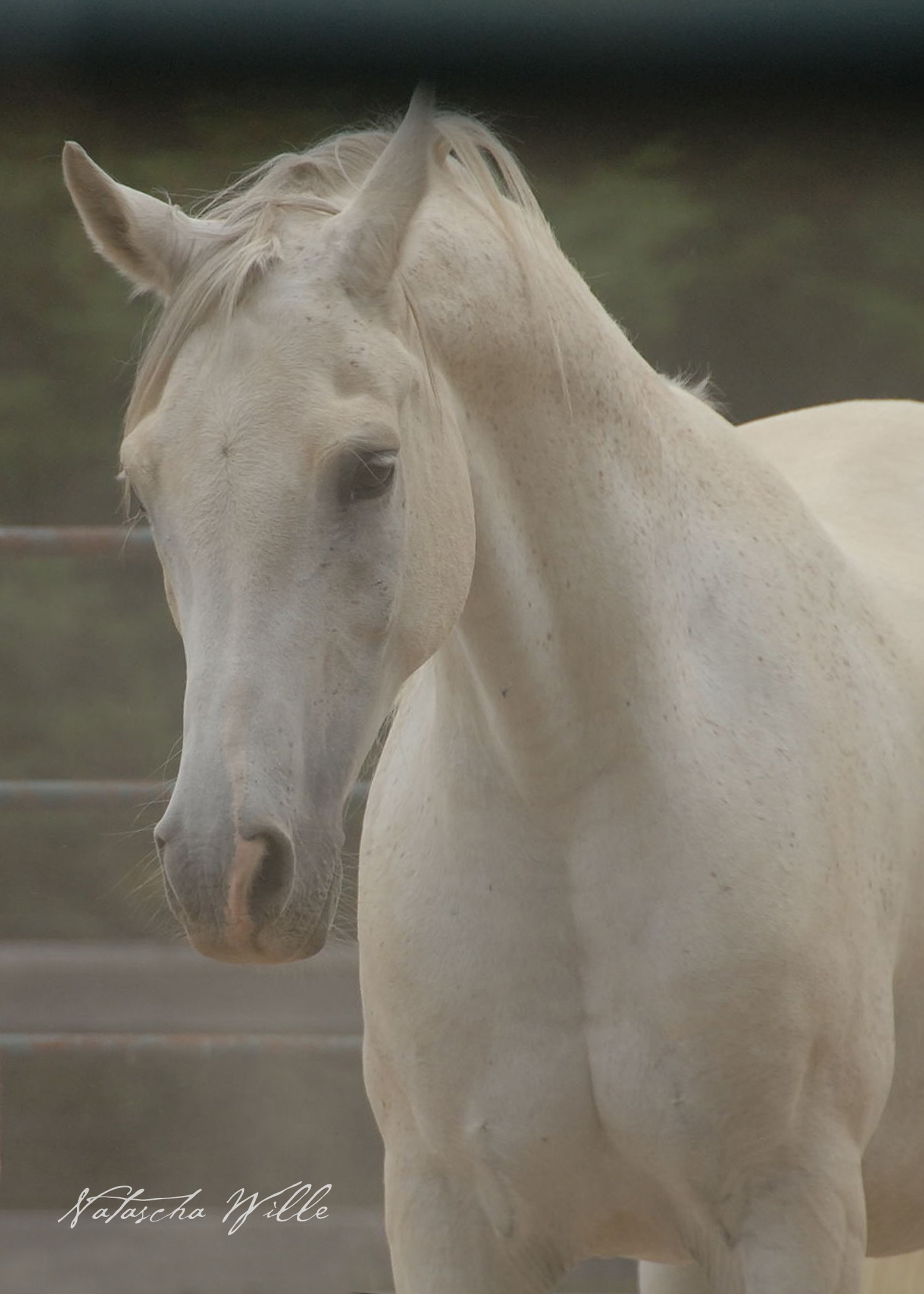
"Nick" - photo by Natascha Wille

“Nick” – photo by Natascha Wille

Let’s face it. Horses are big animals that leave a big hoofprint on the environment. In our “non-ideal” world as Dr. Gruen refers to, we have to “do the very best we can for them while their lives are compromised to various degrees in captive settings”.

Dr. Marc Bekoff, the writer of the article states, ” let’s hope that open discussion of the issues and the questions at hand, including what we know about the cognitive and emotional lives of animals and their capacity to suffer and to empathize with others, will work on behalf of those unfortunate billions of individuals who lives are a mess because of their confinement”.

So somewhere in the middle of “let’s turn all the horses loose” and “let’s keep them confined for our own pleasure and use” is the question “what is the most compassionate way to care for and interact with our horses?”

There is new, emerging research all the time that is telling us what causes distress to horses. We know for sure that ulcers are a man-made condition in equines, caused by stress placed on them due to excessive confinement, travel and showing. In our human rush to conquer and control everything, have we gone too far with horses and committed them to a lifestyle that is so unnatural for them that we’ve changed their genetic makeup? Probably. Is this bad? What have we done to other humans with such a mindset? Even in such things as personal relationships. Are we being compassionate to our partners when we hold them “captive” according to our wants, needs, schedules and whims?

Ah freedom. Look your horse in the eye and ask if he’d rather be turned loose to run and graze wherever he wants. No more grooming, hoof trimming, veterinary care, clean hay and water or forced exercise. Would he tilt his head like a curious puppy and ask “why”? Or would he immediately start nodding his head, pounding on the stall door with the enthusiasm of a football player charging into the opponent’s end zone for a touchdown? What would happen if you told your human partner or spouse they were free to go wherever they choose, whenever, and with whom?

My guess is the equine and human responses would vary, but most would fall somewhere in the middle of the extremes. Having compassion and wishing to alleviate another’s suffering means first of all, to be mindful of the fact that they’re suffering. Is your horse (or human partner) suffering in silence and you’re not seeing it? If you opened the door to set them free, would they go? Would they come back to you after realizing how kind and compassionate you were to them? Do they recognize freedom as being of benefit to them, or are they looking for the security of the home they’ve become so accustomed to and are willing to compromise their freedom to remain “captive” in a potentially less-than-ideal situation? These are the gists of the ethical questions posed by Dr.s Gruen and Bekoff.

Freedom is not about owning and controlling. Perhaps we need to consider that with our “captive” animals and being mindful as to how they are affected by confinement and the tasks we ask of them. Horses have evolved to fit with a domesticated lifestyle, as have humans, and many of the other pets we keep. Turning them all loose would not necessarily be conducive to their health and wellbeing. We all need to depend on each other for care and love, otherwise we lead a lonely and vulnerable life. The kindest approach of all is to acknowledge everyone as a free spirit, accepting who and what they are, with a compassionate heart and mind.


A Happy Horse, of Course!

We do everything else online these days so why not learn how to be happy by taking an online course too!? I had to think about this for a few days, and try to compute what “happy” really means. Especially to a horse. Does a horse think “happy thoughts”? I think with humans, part of the problem is we think too much. Part of being happy is to stop it. “Thinking” too much that is. At least so far as instructions in mind-training go as we are taught to let go of binding attachments to desires and things and just “be”. Yet even when taught to observe the mind as an instrument of desire, we still have wants and needs. It’s part of being human. It depends on what those wants and needs are. Do we want “stuff” or do we want to be of benefit to all beings?

For a horse to be happy, does he have to stop thinking or start thinking? Perhaps with animals, it’s simply a matter of how they respond in the moment as opposed to deciding how they will do everything from selecting a partner to where they will live and work and what they will acquire that will supposedly “make” them happy. They go about their horse-business and seem to be most at peace when they’re turned out in a pasture together and can function as closely to their natural herd behavior as much as possible.

The "herd" waiting to be brought in for dinner.

The “herd” waiting to be brought in for dinner.

What’s interesting about the fundamental ideas behind the “happiness course” is that they sound a lot like the way a herd of horses naturally operates. “Strong social ties”. Check. “A sense of purpose or connection to the greater good”. Check. “Reading people’s emotions”. Oh yes, horses are really good at that too. Do they have compassion? Empathy? I believe many of us who have worked with horses a long time can cite stories of horses displaying all the qualities this course teaches us about being happy. How fascinating!

http://www.huffingtonpost.com/2014/04/23/why-thousands-of-people-a_n_5175603.html?utm_hp_ref=mostpopular

“The [course] starts with the idea that happiness and health are fundamentally about strong social connections and being immersed in a strong social community,” says Keltner, citing research that strong social ties can add years to your life. “We’re going to zero in on things that build strong social ties and communities — things like compassion, empathy, how to read people’s emotions, gratitude, charity, generosity and giving.”

The course emphasizes two main (scientifically-proven) keys to happiness: Strong social ties, and a sense of purpose or connection to the greater good.

Granted, the definition of true happiness can be somewhat broad-based and subjective. A quick online search for the definition provided this description:

hap·pi·ness
ˈhapēnis/
noun
the state of being happy.
“she struggled to find happiness in her life”
synonyms: pleasure, contentment, satisfaction, cheerfulness, merriment, gaiety, joy, joyfulness, joviality, jollity, glee, delight, good spirits, lightheartedness, well-being, enjoyment;

For horses, that could translate to the pleasure of eating a bucket full of tasty grain or taking off across the field, bucking and playing as a delighted free spirit with the rest of the herd. Sounds similar to what humans find satisfying and joyful. Eating, playing… it appears all beings might be looking for the same thing.

Can happiness-seeking take a wrong turn? I can see all the heads nodding now.

This goes back to our desire for self-satisfaction and thinking we’re going to find that either through others, or through the acquisition of material goods. It looks like the online happiness course is scientifically-backed to prove there are definitely errors made in human thinking as to what will make us happy.

I had a landlord once who lived right below my apartment. He and his girlfriend were generous, caring souls, but he was convinced she was supposed to “make him happy”. It’s a fragile way to maintain a human relationship. As soon as he was “unhappy” the arguments would ensue and it became an unpleasant environment not only for them as a couple, but for everyone else in the vicinity who was subjected to their unhappy behaviors. They would eventually make up and the entire cycle would start again.

Horses don’t seem to have these problems.

I’ve watched horses respond to other horses in distress many times. They don’t like it when a herd-member is in trouble or hurting, even if they only know the horse as a stable-mate who lives in another stall in the barn. They will exhibit signs of stress and call out to the distressed horse. Is this not a sign of compassion and empathy? I’ve seen an entire herd of pasture-mates form a procession and circle around one of their own who was dying. Is this not a sign of sentience, intelligence and compassion?

I believe that amongst domesticated horses, we humans are often thought of as part of their herd. Perhaps more so by some horses than others, but I’ve seen signs of acceptance in that regard as well. It’s probably why so many people feel so protective and emotionally attached to their horses. It’s hard not see them as objects of desire and “things” that exist to make us happy, but they are so much more than that.

As the happiness course indicates, the factors that make for true happiness are strong social circles and caring for others. So our real happiness with horses comes from that aspect of being with them, and not so much from the aspect of how much they cost, how much fancy tack we can dress them up with, or how many ribbons we can win in the show ring with them. All that “stuff” simply pales in light of the real reasons horses can bring us true happiness. No wonder they’re so inherently happy 🙂


Attached to That Horse?

Have you ever made a list of the attributes you’re looking for in a horse (or a relationship)?  Have you then gone to all the trouble to seek out exactly the horse or person of your dreams…and found them?  How did things turn out?

I’ve noticed something quite interesting about those “lists” over the years. My experience and observations have led to the conclusion that the more one pursues a relationship according to one’s list of “wants”, the more likely outcome is having chosen the wrong one.  Why is that?

First of all, whenever I went looking for the ideal horse, I ended up with a list of problems that I hadn’t anticipated.  For example, my off-track thoroughbred, Dusty.  I was looking for a suitable hunter-type for the 3′ amateur division.  There were several I tried out, but Dusty was the breed, color, age and temperament I was looking for.  He had been field-hunted after his racing career and presumably that meant he would be bold and safe over show-ring hunter jumps.  I chose him over an older, better-schooled, seasoned warmblood that would have actually been the better horse for me at the time.

Dusty was a problem from the get-go.  We’d only had a basic soundness exam done, which he passed at the time.  I was in a marriage to a horse trainer who was becoming difficult too.  I’d actually sold my horse trailer in order to purchase the perfect horse.  My husband’s mood swings were causing anxiety, and it was making me anxious about getting a new horse.  We were in a new barn and recently married, and a long way from my previous home with my parents.  I had no support system.  I really wanted and thought I needed that horse!

Dusty did not stay sound for long.  He had a crooked spine.  Interestingly, so do I.  He had anxiety attacks and purposely fell down on concrete flooring.  I was in an increasing state of anxiety at the time.  I could probably analyze every detail of my relationship with Dusty and find some way to relate his issues to my own.  He was like a mirror for my own problems.  With horses, as with people, it would probably be a valuable exercise if we realized the mirroring effect at the time, but usually we don’t.

That was over 30 years ago.  I learned to stop looking for horses after that and just let them show up in my life.  The ones that literally  “dropped into my lap” were much better overall.  The key?  I had to let go of the attachment to my list of what I wanted.  I didn’t realize the amount of suffering those attachments would cause.  Looking back, and knowing what I know now, the lessons were obvious.

I’ve had so many clients also make the wrong choice of horse.  Often against my better advice.  I don’t take commissions on sales horses as most trainers do so it’s not like my suggestions were related to money.  My preference was to see the right rider on the right horse, especially given my prior experience.  People still purchased the wrong horse, probably for reasons similar to why I bought Dusty.  You don’t even realize what’s happening or why.

Razzberry Zam.  An off-track thoroughbred who "dropped into my lap" as a sales project.  One of the most wonderful horses I've ever had the opportunity to ride.  So wonderful, in fact, he sold quickly.  His buyer was the perfect owner and a massage therapist to boot.  Love, compassion and no attachment.  I felt it with this horse and although sad to see him go, it seemed like the gratitude with which we approached each other had a most beneficial outcome for us both.

Razzberry Zam. An off-track thoroughbred who “dropped into my lap” as a sales project. One of the most wonderful horses I’ve ever had the opportunity to ride. So wonderful, in fact, he sold quickly. His new rider was the right person for him and a massage therapist to boot. Love, compassion and no attachment. I felt it with this horse and although sad to see him go, it seemed like the gratitude with which we approached each other had a most beneficial outcome for us both.

Then I learned about non-attachment.  Ah ha.  The “list” is all about what we’re attached to, whether it be in a person or a horse.  Buddhism teaches that attachment leads to suffering.  Yes.  I’m proof of that.  I’m sure many of you are too.  Those attributes we want so badly, or think we do, in a horse or in a relationship with another human, are exactly the attributes that will bring us suffering when things don’t turn out as we wish.

The perfect jumper goes lame.  Our perfect spouse sustains a head injury and his personality changes.  The horse ages and can no longer jump.  The husband decides he prefers a younger woman.  Are we still as excited about that horse or that person as we were when they fit our list of “wants”?  Can we have compassion for them when they no longer fulfill our desires, or if they’ve hurt our feelings?

Letting go of the attachments, especially an attachment to any outcomes, is a worthwhile practice.  The other is self-compassion… the desire to alleviate your own suffering, knowing that suffering comes from attachment.  I’ve found that letting go and living with a tremendous love and gratitude for all of life opens the door for loving and grateful relationships to return to you.

The surprise is that those who come into your life may not be anything at all like the list you’ve made.  The thoroughbred of your dreams might manifest as a scruffy little pony who needed to be rescued from somebody’s back-40, but that little pony could just end up being the best jumper you’ve ever had.

According to psychologist Lisa Firestone, Ph.D. “our style of attachment affects everything from our partner selection to how well our relationships progress to, sadly, how they end. That is why recognizing our attachment pattern can help us understand our strengths and vulnerabilities in a relationship. An attachment pattern is established in early childhood attachments and continues to function as a working model for relationships in adulthood.”

http://www.psychologytoday.com/blog/compassion-matters/201307/how-your-attachment-style-impacts-your-relationship

So we can make note of this, and then turn to the practice of compassion and developing non-attachment:

“Most of our troubles are due to our passionate desire for and attachment to things that we misapprehend as enduring entities.” ~Dalai Lama

http://zenhabits.net/zen-attachment/ 

If you do go looking for a new horse (or person), my final thought on the matter is to first,  ask yourself why you want this being to come into your life.  Where are you with your self-compassion?

“When you stop trying to grasp, own, and control the world around you, you give it the freedom to fulfill you without the power to destroy you. That’s why letting go is so important: letting go is letting happiness in.”  Lori Deschene, Tiny Buddha


HEROES for HORSES

As I’m reaching the final chapters on the first-edit of The Compassionate Equestrian, I’ve been thinking a bit more about Chapter 25 – Birth to Completion Life-Cycle Tracking.  This is a new term and a new idea for the equine industry at large.  It is also the key reason why I began writing about compassion and horses.

When I was in film school several years ago I was doing research for my student documentary about rehabilitating off-track thoroughbreds.  I went to the nearby riding club, a long-established community of primarily hunter/jumper and dressage barns, to look for a good story.  I was in luck.

I discovered a trainer  who had just purchased a 3-year old tall, handsome, grey gelding from a stable at Vancouver’s race track, Hastings Park.  He had a slight injury on one tendon, probably sustained in his final race, which he had won.  The short video I produced was only a superficial hint at the legitimately dark side of thoroughbred racing.  I wanted to slant the story to the happier endings of fortunate ex-race horses who find their way to a caring home and a chance at a second career.

http://vimeo.com/14392790  (link to my student film:  Racing Machine –  A Thoroughbred Story)

When the film instructor saw my rough cut, he immediately focused on the more contentious tidbits and told me I had to bring more “conflict” to the short documentary.  “That’s what makes a good doc” he said.  Me, being the non-confrontational, non-argumentative type, cringed at the idea but proceeded with further research anyway.

The thoroughbred racehorse, "Machine"

The thoroughbred racehorse, “Machine”

All I can say is that what I found out about the “deep, dark” side of the horse industry shocked me.  Even as a professional trainer all these years, I had no idea how many horses were ending up in slaughterhouses every year, and why.  I had no idea how horribly  horses were treated once they left the auction houses or race track.  I made myself look at the reports and videos on the Canadian Horse Defence Coalition website.  Most horse-people will not want to see this side of our industry, but I believe they need to.  My eyes were definitely opened.  Not only that, but my heart went out to all of the world’s homeless horses to the point that I felt overwhelmed and somewhat helpless at not being able to help them all, relieving them of a potentially terrifying completion to their lives.  Over 100,000 a year in fact.  Really??!!  Where are all these horses coming from?

http://defendhorsescanada.org/

I’d also found a very knowledgeable researcher who gave me a plentitude of information to mull over and include in the bigger film I was determined to produce.  The more I spoke to her, and the more I learned about homeless equines and their fate, the more I realized I would need a massive legal team to protect both myself and sources from the underworld of cabals that make their living on the acquisition and sales of unwanted horses.

So I shelved the film and looked for other ways I could help educate and enlighten the horse industry.  Then Dr. Schoen and I met in 2012 and through our dialogues, began writing the 25 Principles of Compassionate Equitation, followed by the book, which will be released in the spring of 2015.

While working on  the outline for the documentary I befriended a couple of extraordinary advocates for equine welfare.  They have both been on the “front-lines” of the worst of the worst kind of treatment you can image horses having to endure.  Most of us who love horses couldn’t possibly deal with what they have seen.  They are my heroes.

Brogan Horton is in her twenties and runs Animal Rescue Unit at her home in Maine.  Brogan is the kind of person who will put on a suit and lobby Congress on behalf of the wild burros and mules, or hook up her horse trailer and spend her last few dollars to go pick up a horse in need of rescue.   Animal Rescue Unit is an organization dedicated to revealing the truth about animal suffering, specializing in investigation, rehabilitation, education and legislation for animal welfare.  The following link is one of many heart-warming stories from ARU, and one with a very happy ending.  Further links to ARU information are included in the article, and Brogan can be found on Facebook for anyone interested in following her activities and if possible, helping with donations for the rescued animals.

http://www.pressherald.com/people/cth/donkey-delivers-a-christmas-miracle_2013-01-07.html

The other hero is Brogan’s former partner in another very intense animal welfare investigation organization, Richard Couto of Animal Rescue Mission.  Both Brogan and Richard are well trained and have been on some of the more dangerous missions regarding equine welfare.  Most of us in the horse world have no idea what goes on behind the fences and walls around illegal slaughter farms in Miami.  Nor would most of us want to know.  It’s cruelty to animals beyond our comprehension.

Richard became the exceptional cruelty investigator  he is today after rescuing a thoroughbred ex-racehorse from one of the illegal farms.  The horse, Freedom’s Flight, is a descendant of Secretariat.  Richard found him tied to a tree at the farm, next in line for a terrible demise.

Here’s a link to Richard’s bio:

http://www.animalrecoverymission.org/about-arm/founders-bio/

So in The Compassionate Equestrian, Dr. Schoen and I are doing our best to use language that inspires, unifies, and opens the hearts of equestrians.  We are coming from many years of experience in our collective fields and understand how easily one person’s opinion can immediately send another person into a defensive mode.  Or how upsetting some of these more difficult issues can be.  We also understand that people don’t want to discuss death, so we refer to the “completion” of life.  It’s why Principle 25, which recognizes “the importance of applying the Cradle-to-Cradle model of life-cycle assessment and tracking to the equestrian industry” – has been left to the end of the book.  Chapter 25 is also still largely unwritten as we structure the program and gather further information as to just how it could be applied to help the “global herd” of horses in need.

There isn’t an easy way to convey this information to a  generally loving, compassionate community of horse-people who are active on a day-to-day basis with these beloved animals.  It’s our belief that every human has the opportunity to be compassionate towards all beings, and that compassion just needs to be awakened.  In the hardest times, in the most difficult circumstances, and in facing the darkest side of humanity…that’s when extending compassion may become extremely challenging.

It’s the purpose of The Compassionate Equestrian and The 25 Principles of Compassionate Equitation to assist in the compassionate awakening of horse-people everywhere.  We hope that through their own personal practices, they will be able to see the need for compassion to be extended to all horses, and everyone who’s involved with them.  With such mindfulness, we can come together as a world-wide community and find a way to become heroes for horses ourselves.


When a “Behavioral Problem” Really is Just That

In The Compassionate Equestrian Dr. Schoen and I stress repeatedly that when a horse exhibits behavioral issues, first rule out pain as the root cause.  This is especially true if there’s a change in the horse’s base personality.  Sometimes this takes more than one veterinarian’s opinion.   Diagnosis of subtle lamenesses can be difficult to pinpoint and the first sign of a problem might be the new or increasingly difficult behavior.

However, in my many 30+ years of working with all kinds of horses of varying breeds, ages, backgrounds and temperaments, there are a few quirky personalities in the crowd that are simply, well, weird.  They have legitimate behaviors that are out of the context of “normal” for most horses and sometimes the most compassionate thing to do is let them be exactly as they are.  If you can hang on, or tolerate them that is.

Sometimes you just hang on! (photo Alina Pavlova, 123rf.com)

Sometimes you just hold on!
(photo Alina Pavlova, 123rf.com)

Some of the most interesting have been the off-track thoroughbreds.  The subject of this post is one little, classic, plain bay gelding.  Nothing particularly spectacular to look at, but he had the kind of personality that made everyone look.  Kind of in the way you can’t take your eyes off the cars in a demolition derby.

His name was Earthquake.  As the story went, he was born in California during an actual earthquake.  We never did confirm whether or not this was true.  He was booted off the track in San Diego due to his “bad behavior”.  He ended up in a backyard in Phoenix that housed the other off-track thoroughbred jumpers belonging to his owners.  Besides a string of successful racehorses, they had produced some of the top amateur jumpers on the circuit.

Earthquake’s owner, Tracy, is the sister of the trainer I was working for at the time.  She told us “Quake” was almost impossible to ride on the flat.  Even with all of her experience in showing and winning at the “A” Circuit level, this little bay gelding scared her.  He would scoot out from under her, spin, leap, and generally act like a crazy horse.  She didn’t know what to do with him.

One day he was turned loose in the arena to play.  Tracy watched, somewhat stunned, while ‘Quake galloped over jump after jump all on his own, apparently inspired from watching her other horses school over fences.  So she clung through the flatwork with him and began to train him for jumper classes.

I had the task of helping her with him at his first show.  Lucky me!

I always maintained that somebody had to be the “entertainment of the day” at a horse show and frequently it was our barn.  Tracy’s brother was an excellent, caring horseman and would never consider drugging a horse to calm it down or make it easier to ride.  He just quietly rode whatever was underneath him in the moment, and so did his sister.

Taking thoroughbreds from the track to their first few shows is always a wild card.  ‘Quake was at least consistent with his quirky behavior.  I watched the crowded warm-up arena from the barns and it was easy to spot him.  That would be the horse and rider leaping above all the others, unrelated to where the warmup jumps were placed.

He was so excited to go in the show ring for his rounds, he couldn’t be contained.  He would paw, stretch, almost drop himself to the ground, spin, leap, and spook other horses at the in-gate.   Tracy hung on.  Then he would go in the arena, focus, clear every jump, and won almost every class he was entered in.  He was phenomenal.  Just impossible outside of the jumper ring!

He got better at his routine as he began to get the hang of showing.

I had to tack him up before one of the classes and it was exhausting.  He spun around in the stall.  He couldn’t stay still for a second.  I even tried pressing on an acupressure point on the coronary band, in the center of a front hoof.  It actually seemed to work, much to my relief.  He calmed down and I finished getting him saddled for his class.

Another day, and another class.  We got him tacked up and Tracy left him tied in his stall to go walk the course.  ‘Quake knew where she was going and he was apparently upset that he wasn’t going to the jumper ring with her.  I went in the tack room for a moment when I heard a loud crash from ‘Quake’s stall.  Mortified, I saw that he’d somehow jumped over the stall guard while still tied to the inside of the stall.  I have no idea how he could have maneuvered his body in such a way through a small opening and over the barrier.  Luckily he was unhurt in his desperation to follow his rider to the arena.

All you can do with that kind of enthusiasm is support it and hope the horse connects with the right rider and the right activity to accommodate his energy and ability.  In this case, the stars lined up and what would have been an extremely difficult ride for many equestrians, turned out for the best.  Last I heard ‘Quake was winning Grand Prix classes in the southwest.

Not every horse with behavioral “quirks” is lucky enough to find its way to a compassionate, competent owner that has the patience to simply let him “be” and allow the talent to shine through.  If ‘Quake had been punished for his leaping and spinning who knows what kind of a different horse he may have turned into.  Most likely not such an enthusiastic jumper who seemed completely enamoured with his owner.

If you have been able to rule out pain as the cause of your horse’s “behavior problem” and have determined he’s just of the personality type to be the way he is, then kudos to you for your compassion and understanding.  In my mind, I can see the happy little grins on all those clownish horses out there whose joy for life just can’t be constrained.


____________________

The Compassionate Equestrian is pleased to be affiliated with the International Charter For Compassion’s new Sector on the Environment

For information about the Charter for Compassion, and the upcoming Compassion Relays, click on the following link:

http://compassiongames.org/compassion-relays/


“Just” a Trail Horse


Many times when I’ve asked people about their horses they’ll say, almost apologetically, “oh, he’s just a trail horse”.  It’s as though their horse isn’t important enough for those of us who made a career with show horses to acknowledge as being relevant.  Or that it doesn’t require any special breeding or talent to be a trail horse.

Well, in the Principles of Compassionate Equitation, we see equality in all horses, just as we do all sentient beings.  They were given a life, just as we were, and all are subject to suffering, just as all humans are.  Everyone deserves the same amount of compassion, no matter who or what they are, or what they do.  Including trail horses :).

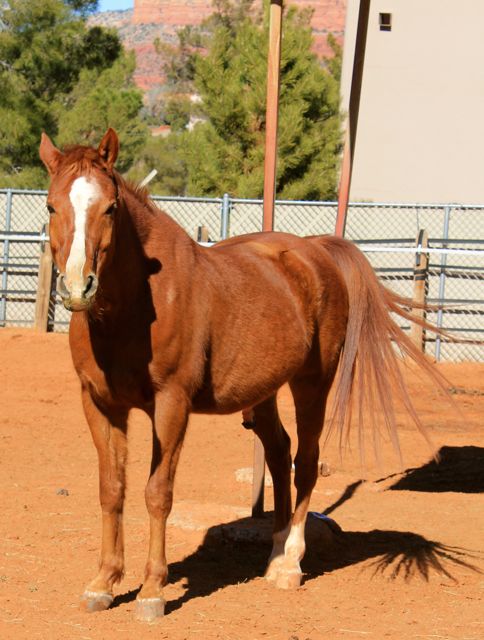
Recently I had the opportunity to spend time in one of my favourite places, Sedona, Arizona, on the back of a sweet, reliable trail horse who is as careful and kind as they come.

Shadow

Shadow

This is significant because my past experience with horses on trails has not always been so favourable.  My first horse, White Cloud, was a ranch horse.  When we moved to the suburbs of a large city, I had to ride along busy roadways to reach the trail system.  I was only twelve at the time and didn’t know better.  I thought that since the stocky white mare was so good on country trails, nothing would bother her on busier roads or trails either.  How wrong I was!

I was lucky we weren’t hit by a car.  We held up traffic a few times while Cloudy panicked at the sound of loud, fast vehicles passing and spooked by throwing herself into reverse.  As the area we lived in was lined with large ditches, her behaviour was quite disconcerting, not to mention dangerous.  Her tension translated into my tension and I was forever nervous about riding horses along busy roads after that.  I’ve never really gotten over it.

When we moved again, Cloudy was sold to a rancher and lived out the remainder of her life in a happy place.

The next horse to come my way was a very young, barely broke (in fact, badly-broke) appaloosa filly.  She was also born and raised on a large ranch and had no concept of behaving on multi-use trails or in traffic.  I really tried to overcome my fears and hers as I still enjoyed a gallop across a hay field or a pleasant trail ride down to the river, which required some riding along roads to get there.

Miss Demeanor, appropriately named, was one “incident” after the other.  I was still in my early teens and learning about training horses.  Determined, I kept taking her on trail rides, hoping for improvement.  One day she managed to thoroughly embarrass me on a group ride by running backwards down a steep hill until she finally backed into a tree, even with the reins thrown at her.  Then she scared herself and scooted forwards, spooking some of the other horses who had gone ahead.  I just seemed destined to not ever have a pleasant trail ride!

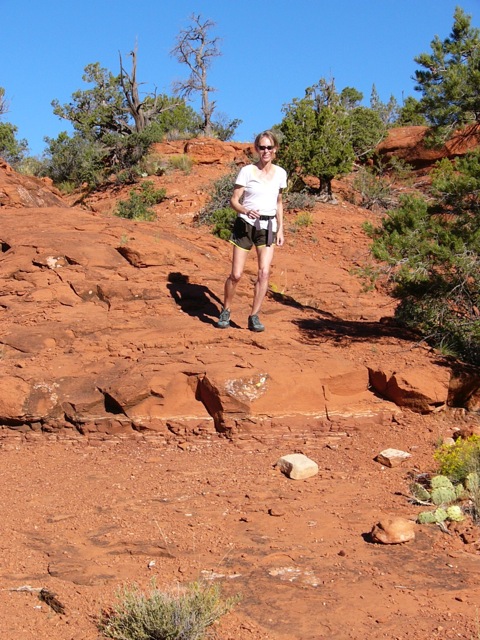
Trail running!

Trail running!

One day I was finally brave enough to ride “Missy” the few miles down to a beautiful spot by the river.  I let her take a drink out of a creek that fed into the river and in the blink of an eye, she was down and rolling in the muddy bank with me still on her.  I had to ride all the way back to the barn with one side of her plastered in mud so thick you couldn’t see her spots any longer.  I never did get all the mud out of the carved leather of my western saddle either.

I was in awe of people who could simply saddle up on a nice day, head out on the trail, and return still smiling with a happy and relaxed horse.  I had no idea why this “trail horse” thing was so elusive!

There was no problem in the show ring.  Even my spooky filly could open gates, walk over teeter-totters and tarps, drag a tire or a cow-hide, and jump a small fence.  Why didn’t that translate to the great outdoors?

Eventually I gave up on the idea of enjoyable trail riding, especially as my next horse was an appaloosa stallion, and confirmed “city boy”.  The first time I led him down a little hill he had no clue how to navigate it and promptly squatted on his hind legs and sat there in a half-rear.  I should have expected such things from my horses by now.

One day I was offered a beautiful big dappled gray warmblood gelding to ride on a charity trail event.  He was a lesson horse at the show barn I was riding at and generally very quiet.  Oh no, not on the trail however.  He spooked at… invisible trolls?  Maybe it was the shrubbery.

Finally I was married to a three-day eventing trainer and we were running a barn that was situated next to a cross-country course and thousands of acres of trails, accessible without riding along any roads.  Surely this was to be trail-riding heaven!

Sigh.  The appaloosa complained about the rocky footing.  The thoroughbred gelding pranced sideways thinking he was still a field-hunter and wouldn’t settle until after a full-out gallop. The off-track mare spooked at the cattle.  The part-Standardbred jumper bolted over the beaver-fall.  Was there anybody out there who wanted to be a nice trail horse??!!

I was starting to resign myself to having to ride in an arena forever, or continue having unusually adventurous trail experiences.  Gee, what was it like to have a safe, relaxing ride where I could drop the reins and enjoy the scenery?

The last barn I taught lessons at was a mix of many types of horses and riders, most of whom went on the rugged, rocky trails of Sedona on a regular basis.  I was still more comfortable jumping fences than going on a trail ride and stayed in the arena.

Finally, having really retired this time (it took a few tries), I thought I’d attempt trail riding again.

I know those trails from having run them on foot.  It’s very easy to twist an ankle or trip and there are many hazards on desert pathways.  Sharp cactus plants await along every edge and the rocks can roll underfoot or be as slick as ice when worn smooth by eons of erosion.  Deer or javelina can appear out of nowhere and in the warmer months there’s always the possibility of a rattlesnake coiling closely enough to do some damage.

Remembering to breathe, at first I guided Shadow, the pretty chestnut Arabian gelding, as I would in the arena, “helping” him negotiate the continually changing angles of the terrain and hoping he wouldn’t slip on any of the slick-rock.  I worked as hard as he did, staying off his back on the uphills and shifting a little rearwards on the downhill, monitoring his balance and speed.  Hoping not to annoy him, I tried to do as little as possible, telling myself he knew what he was doing.

He’d spent many more hours packing riders around these trails than I had spent riding horses on them.

Shadow was also lovely in the arena, and in fact very well bred to be a show horse too.  His gentle disposition and good training seemed to add up to his ability to be an all-around great guy.

At the end of our 3-hour ride, my reins were loose and I was letting him pick his way home, carefully stepping over boulders and not tensing up when his shoes slid on the steep downhills.  Yes, this little horse knew what he was doing alright.

What a happy day.  Now I know what it’s like to have a genuinely pleasant trail ride, with no spooking at wildlife, cars, dogs, cyclists, or loud noises.  What a special horse it takes to provide that kind of experience.  I can’t believe I had to wait so many years to enjoy such a ride.

Happy trails to all!

Happy trails to all!

I can tell you for certain that nobody ever needs to apologetically refer to their horse as “just” a trail horse.  They are a special breed unto themselves, no matter what their breeding or background, and they deserve every accolade that a top-notch show horse receives.  Trail horses also deserve the same kind of mindful care, compassion, and healthy environments as the most expensive, highly bred animals in the show-ring.  After all, horses don’t know how much we paid for them, or how much we pay for their training and board.  All they know is how they are made to feel in our presence, and you really can’t place a dollar sign on that.