IN HORSE, WE TRUST

Whenever we get on a horse, whether it’s the first ride or one of many hundreds of rides, we have to put some degree of faith and trust into the fact that the horse won’t cause us harm.  After all, so many things could go wrong when mounted on a 1000-pound animal that could take a misstep and fall, stop and duck out of a jump, throw a bucking fit, bolt, or any number of potential scenarios that might end with us and/or the horse injured.

So what is it about the brain and mind of a rider that allows us to place our faith in an animal, trust that it will help keep us safe from danger, and in fact, have a truly pleasurable time throughout our interactions with it?
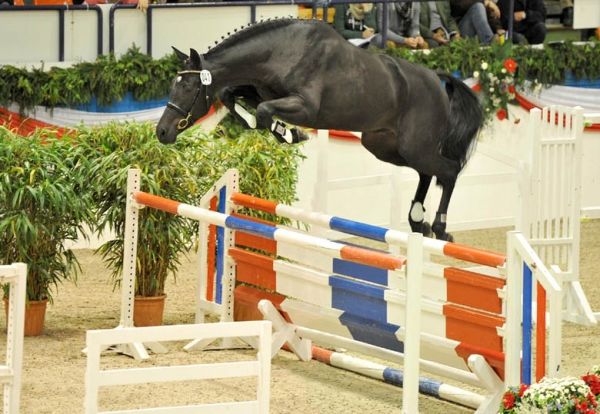
Free-jumping the young stallion, Clarucci C. www.camposstallions.com

Free-jumping the young stallion, Clarucci C.
http://www.camposstallions.com

In the world of show jumpers and three-day eventing horses, the “danger” factor increases exponentially and so many elements have to work together to produce the best performances.  In the beginning of a jumper’s career, the trainer has to have faith that the horse wants to jump, can jump, and will stay sound long enough to make it to the pinnacle of its jumping potential.  It doesn’t take much of a set-back for that faith to be shaken.  One needs a tremendous amount of fortitude, skill, and faith to start with an untrained horse and make it into an athlete willing to go airborne while packing a human on its back.  I suppose the horse has to learn to have a considerable amount of trust in its rider as well.

It’s always been amazing to me that a horse will jump obstacles for a human at all, as I wouldn’t say it’s something they’d “naturally” want to do.  There’s an absolute heart-pounding thrill whenever a jumper takes hold of the reins and actually pulls you to a big fence, as all of the good ones will.  They genuinely want to get there and then get to the next one.  A seasoned show rider will tell you a great jumper feels “bigger” as they enter the arena.  They pump themselves up and are looking for where that first fence is going to be.  It’s certainly easier to place your trust in a horse that is willing and ready to take you around the course than one who isn’t.  Everything else comes down to your faith that the training and preparations have been sufficient to support the horse’s – and the rider’s – desire to complete the jumper or cross-country course without incident.
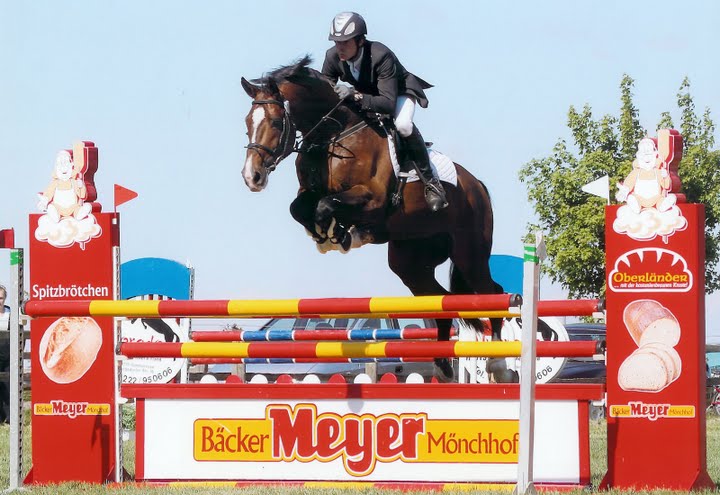
Candillo Jr. at Hamburg

Holsteiner stallion Candillo Jr. at Hamburg

A lot of mental preparation goes into every athlete’s performances, but I believe the uniqueness of competing with a partner who isn’t human adds an extraordinary element and a level of faith and trust that non-horsemen would have difficulty comprehending.  There’s just nothing to compare to sitting on the back of a living being galloping full speed to a large, solid obstacle, and trusting that it will leap cleanly, land safely, and carry on galloping to the next fence.

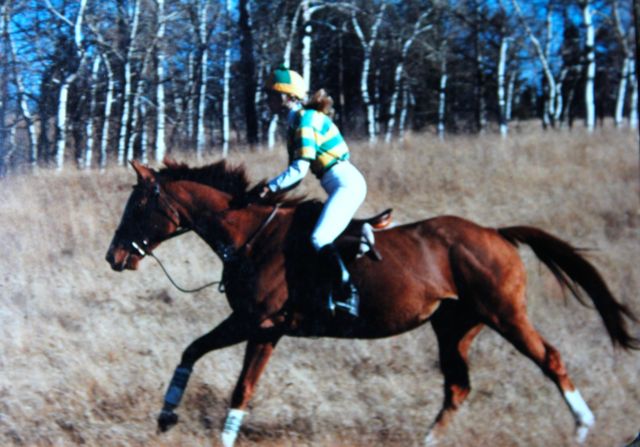
Many years ago when I was riding a lot of horses every day and training for bigger jumping competitions, one of my thoroughbreds tripped and fell over a small 2-foot, 6-inch single-rail vertical fence that we’d trotted into.  Had I not rolled out of the way when he came down he would have fallen right on top of me.  We were both uninjured, but I was definitely shaken.  It took a long time to get over the incident and regain my confidence over low, slow-approach jumps, not just on this horse, but any horse.  I could gallop down to the big fences but remained apprehensive every time I had to begin trotting warm-up jumps.

This is why we believe it’s so critically important to approach the horse and its training from a foundation of compassion, and treating the horse as we would wish to be treated ourselves.  If the horse is stressed, overworked, and resentful of the pressure put on it, how could we not expect a mishap or refusal at some point?  Horses can be pushed both mentally and physically to the point of a complete breakdown and become distrusting of their humans to lead and guide them through a course of dangerous obstacles.  Then what do you do with those horses?  We feel it’s best to be as compassionate as your abilities and skill levels allow and always trust yourself to recognize when your faith in a particular horse may also be misguided.

Not all horses have the training background, conformation, movement, or mental prowess to perform the activity or level of activity the rider and trainer is hoping for.  If they do have all the qualities, and errors are made in the training process or trauma of some type occurs along the way, trust may be lost and the horse may or not allow itself to be re-schooled for the same activity or might not be able to reach the levels originally intended.

The thoroughbred who fell with me, Dusty, was a former racehorse.  His second career was that of a field-hunter, where both his good nature and athleticism were useful, and I thought the combination would also make him a successful show jumper which is what I’d purchased him for.  He could sail over huge fences with ease but there was something I just couldn’t trust about his form and the feeling I got over bigger jumps.  It may have even stemmed from an undisclosed injury or previous accident on the track or hunt field.  The fall took away the remainder of my faith in him to make it as a jumper so we re-evaluated and leased him to a junior rider who was quite successful with him in the 3-foot hunter classes.

There’s always a convergence point in the training of the horse where a compassionate trainer will either say “this horse is done”, “this horse needs a rest”, or “this horse is coming back beautifully from its set-back and we can move forwards”.  Trust is a fragile thing when the minds and hearts of two species must work together to understand each other and find a common language that allows the two to have faith in their abilities to keep one another safe and happy.

Dr. Schoen’s methods for quieting the mind and taking a slow, mindful approach to the care and training of horses is a wonderful practice to make a habit of each time we work with a horse.  If all trainers would also take a few moments of quiet contemplation when working with students and their horses, they might be quite pleasantly surprised at the level of trust those students will then exhibit towards their horses and the instruction they are receiving.  A calm mind and open heart create an atmosphere highly conducive to receptivity and learning, as scientific studies are now proving.

We love the “Just One Thing” newsletter by neuroscientist Rick Hanson.  We can apply his insights to the equestrian world and our horses in so many ways.  Below is his current post with a couple of valuable exercises you can do as suggested or alter a few words to reflect having faith in your horse, your ability as a rider and trainer.  Consider the most positive qualities of your heart and how having faith in yourself can translate to wonderful experiences with your horse and your riding as well as everybody you encounter and inspire as you go about your daily activities outside of the world of your horses.

_________________________

In what do you trust?

Have faith.

Why?

Try a little experiment: in your mind or out loud, complete this sentence a few times: “I have faith in _________.” Then complete another sentence a few times: “I have no faith in ________.” What do faith – and no faith – feel like?

In your experience of faith, there’s probably a sense of trusting in something – which makes sense since the word comes from the Latin root, “to trust.” (“Faith” can also mean a religion, but my meaning here is more general.) Faith feels good. To have confidence is to have faith; “con+fide” means “with+faith.”

Faith comes from direct experience, reason, trusted sources, and sometimes from something that just feels deeply right and that’s all you can say about it. You could have faith in both biological evolution and heaven. Sometimes faith seems obvious, like expecting water to yield each time you prepare to dive in; other times, faith is more of a conscious choice – an act of faith – such as choosing to believe that your child will be all right as he or she leaves home for college.

What do you have faith in – out there in the world or inside yourself?

For example, I have faith in the sun coming up tomorrow, my partner while rock climbing, science and scholarship, the kindness of strangers, the deliciousness of peaches, the love of my wife, God, and the desire of most people to live in peace. And faith in my determination, coffee-making skills, and generally good intentions.

In your brain, faith (broadly defined to include assumptions and expectations) is an efficient way to conserve neural resources by not figuring things out each time from scratch. The visceral sense of conviction in faith integrates prefrontal logic, limbic emotion, and brainstem arousal.

Without faith in the world and in yourself, life feels shaky and scary. Faith grounds you in what’s reliable and supportive; it’s the antidote to doubt and fear. It strengthens you and supports you in weathering hard times. It helps you stay on your chosen paths, with confidence they will lead to good places. Faith fuels the hope and optimism that encourage the actions that lead to the results that confirm your faith, in a lovely positive cycle. Faith lifts your eyes to the far horizons, toward what’s sacred, even Divine.

How?

Sure, some skepticism is good. But going overboard with it leads to an endless loop of mistrusting the world and doubting yourself. You need to have faith that you’ll make good choices about where to have faith! Which means avoiding two pitfalls:

Putting too much trust in the wrong places, such as in people who won’t come through for you, in a business or job that’s unlikely to turn out well, in dogmas and prejudices, or in a habit of mind that harms you – like a guardedness with others that may have worked okay when you were young but is now like walking around in a suit of armor that’s three sizes too small.

Putting too little trust in the right places, such as in the willingness of most people to hear what you really have to say, in the results that will come if you keep plugging away, or in the goodness inside your own heart.

So, first make a list of what you do have faith in – both in the world and in yourself. You can do this in your mind, on paper, or by talking with someone.

Next, ask yourself where your faith might be misplaced – in dry wells or in dogs that won’t hunt. Be sure to consider too much faith in certain aspects of your own mind, such as in beliefs that you are weak or tainted, that others don’t care about you, or that somehow you’re going to get different results by doing pretty much the same old things.

Then pick one instance of misguided faith, and consciously step away from it: reflect on how you came to develop it and what it has cost you; imagine the benefits of a life without it; and develop a different resource to replace it. Repeat these steps for other cases of misplaced faith.

Second, make another list, this one of what you could reasonably have faith in – in the world and in yourself. These are missed opportunities for confidence – such as in people who could be trusted more (including children), in the basic safety of most days for most people, and in your own strengths and virtues.

Then pick one and see if you can have more faith in it. Remember the good reasons for relying upon it. Imagine how more trust in it will help you and others. Consciously choose to believe in it.

Third, consider some of the good qualities and aspirations in your innermost heart. Give yourself over to them for a moment – or longer. What’s that like

Try to have more faith in the best parts of yourself. They’ve always been faithful to you.

Just One Thing (JOT) is the free newsletter that suggests a simple practice each week for more joy, more fulfilling relationships, and more peace of mind.A small thing repeated routinely adds up over time to produce big results.

Just one thing that could change your life.

(© Rick Hanson, 2014)

Us Watching Them Watching Us

We’re all interacting,  we’re all interconnected.  It’s a very integral web of interactions from everyone’s mind.  We can joke and say that every person on the planet is their own human universe.  So each horse-person is seeing that same horse barn through their unique filters based on their own life’s experiences.  The good, the bad and the ugly!  So they bring all of that to their perception of the barn.  Every person in the barn brings their own perception of the world, and their activity with the horses, and the horses are bearing the brunt of the good, the bad and the ugly.  All the other horses are bringing their own experiences.  So whatever number of horses there are on the planet, that’s how many equine universes there are based on each one’s experiences.

One of the things I’ve found with all animals that interact with people is they’ve actually evolved to a different level of awareness in consciousness.  I chuckle and say “when a horse is in a herd, it’s just horsing around.  It’s just being a horse”.  When the horse is interacting with people, they’re such great students of human behaviour.  They’re watching us in their predator-prey form so they’re still feeling like prey and they’re interacting from that fearful and cautious mind, but they can also evolve into the most compassionate, loving being, or the most dangerous, frightening 1200 pounds on earth.

Dr. A. Schoen, Introduction to The Compassionate Equestrian

There are many moments in my 30+ years with horses that stand out, and some of the most profound are when I simply stood by and watched the horses interacting with each other.

I recall one cold morning in particular, at a forested, mountainside property that was the backyard of my then-husband’s parents.  We were between commercial barns at the time and he had built a small barn for our 5 horses.  They were quite a herd.  Two off-track thoroughbreds, one nervous part-Standardbred jumper, my appaloosa gelding and a semi-wild buckskin filly.

We opened the stalls to let the horses out for the day and the chestnut thoroughbred mare that was turning into my primary jumper mount bolted out of her stall and raced to the knoll above the roofline of the cramped barn.  She then stood on her hind legs and pawed at the air as though the Lone Ranger were on her back shouting “Hi-Ho Silver awaaaay!”

The other horses did not participate in her exuberant display of wanton freedom and wild-stallion emulating antics.  I’d never seen her act this way before and I don’t think they had either.  We all stood watching below the hillside, marvelling at the rearing mare.  I was in awe of her athletic prowess and ability to balance on her hind legs on such a steep slope.  My first thought was “Huh!  I have to ride this horse!”.

The image of Ali’s ability to rear never quite left my conscious mind and it was a good thing I’d seen her do it on her own, even though she only pulled off the acrobatics twice under saddle.  One of the times I should have known better.  We were riding at the walk in a large field after she’d been on stall rest for a couple of weeks for a minor injury.  She seemed quiet enough so I thought it was safe to hack out.  Wrong.  All of a sudden and without warning, there was a repeat performance of her “hi-ho” movie- horse act and luckily enough I was able to ride it out.

The fact was, as Dr. Schoen noted, this hot chestnut mare was bringing her experiences from the race track, her experiences from the cowboys who tried to make a cutting horse out of her at the barn we were managing, her first lessons over jumps, and her subsequent development into a champion show jumper.  Her abilities to react quickly, snap the front legs up and push off her hind end over large jumps were evident during her “play” time and correlated with the observations I’d made watching her interact with the other horses.

So what made the different between thinking this is a compassionate, loving horse, or this might be a really dangerous horse that could seriously hurt me?  I believe we were both good students of each other.

Susan and Ali

Susan and Ali

For me, the difference came from all the times I’d just sat in silence and observed the horses in their own environments.  What they’re like when they eat by themselves, or with others.  Who’s the bully?  Who’s the clown?  Which one was the first to pick up a stick and try to get the others to play “tug of war” with him?  Who’s the first one to nicker when the back door opens and the human appears?  They’re like a class of kindergarten children who never grow up.  They’re very good at watching how the “adults” behave too and emulating their behaviour.

There’s lots of programs now that encourage bonding with horses and developing a relationship with them, and this is wonderful.  It takes many years of riding a lot of horses to really know them well though, and to be able to use the powers of observation to determine the best “niche” for each horse, plus how to keep them happy and sound under saddle.  Many times they are happiest doing what they’re bred to do, but circumstances might alter their future, such as the former race-horses. New activities have to be managed within their scope of willingness and ability.  In many cases, suitable bonding on the ground might still leave the horse difficult to ride and manage under saddle and this is where the skills and experiences of the rider need to match up with the personality, experiences, and abilities of the horse.

My other horses at the time would never have thought to rear and strike out as the mare did, but neither were they as sharp or talented over jumps as she was.  They had their own “stuff” going on however and each one is a story unto themselves.  All different, and much safer for the average rider to get on and have a pleasant ride.  I had a special bond with all of them, but the hot red-head mare and I could communicate with each other in a way that other people couldn’t.  She was too sensitive for my ex-husband and they would both get angry with each other.  Very angry.  She was terribly spooked by the cowboys who thought she might make a cutting horse – about the furthest thing from her background or abilities – and she was tense as a steel guy-wire when I first rode her.

Was this a compassionate horse?  She jumped everything for me and tried her guts out every single time.  I think we even went beyond her actual physical capabilities sometimes.  I knew this horse wouldn’t intentionally hurt me and the fact that she could be explosive didn’t bother me.  I wasn’t intimidated by her and I believe she knew that.  I had to learn how to breathe with her breaths, think with the quickness of her mind, and coordinate my rhythm with hers.  Yes, she could be dangerous if she wanted to be, but there was a lot more depth to our relationship than the physical one.  We knew each other on a whole different level.  Science is beginning to come up with some explanations about that kind of relationship with animals and the heart-to-mind connection we can have with them.

SG

What it boils down to so much is not just our mind, but our hearts and mind and the heart and mind of everyone in the barn.  To me, ultimate healing is bringing that awareness to all animal lovers and to all horse lovers everywhere.  For everyone who’s interacting with horses there’s an opportunity that has arisen now as neuroscience has advanced and continues to develop.  It’s documenting all the ancient traditions about the benefits of lovingkindness and compassion for all beings.  As these two areas converge into a new field, sometimes called neurospirituality, or the neuroscience of behaviour, we can better understand the positive, or negative impact we have on the animals we interact with.

That’s what this book is about.  It’s from the horse trainer/instructor who has over 30 years of experience with the mindfulness of decades of meditation practice, along with the veterinarian who has been trained in conventional western medicine and surgery and acknowledges the value and benefits of it, but in addition has undertaken a personal, professional and spiritual journey realizing all the different options for healing animals and people and that the healing is a full circle.  The more we become aware of how we can be of benefit through developing lovingkindness and compassion in ourselves for all beings, then we can help the animals that way, and subsequently they become all they can be, and they will then support us in becoming all we can be.

The more one understands neuroscience and neurobiology the more we realize we share similar brain patterns and brain programs with animals, rather than differences.  One of the paradigm shifts I’d like to see is to change from having to prove what’s the same to having to prove what is different in the way our thoughts and moods function from those of animals.”

Dr. A. Schoen


Secondhand Stress… Really?

http://www.huffingtonpost.com/2014/01/09/secondhand-stress_n_4556964.html?utm_hp_ref=healthy-living

We all know how secondhand smoke can affect a non-smoker, but how about secondhand stress and its effect on the wellbeing of others?

Yesterday morning as I was waking up to my radio-alarm clock a program came on featuring several people whose lives were made very stressful by working for minimum wage and struggling to make ends meet.

There were a couple of young mothers working two or three part-time jobs. One lamented that she couldn’t afford to buy good food as even a bag of her favourite apples would alone cost $10 for her and each of her kids to have just one.

I felt so sad for her and could relate to the stories I was hearing, as I too, have been “horse poor” most of my life as I built a reputation for training and teaching while struggling to pay expenses on my own horses. It’s not unlike having children to feed and care for as you don’t ever want them to know why their favourite food isn’t forthcoming or that you may have given up on a new pair of shoes for yourself in order for your dependents to have a new pair themselves.

It’s a situation most professional riders can relate to, as can students who have massive amounts of debt to pay off by the time they can even get started in their chosen careers.

The longer I listened to the interviewees on the radio show the more stressed I found myself becoming… and this was before getting out of bed! I started to worry about my own future and how expensive food is becoming and on and on. Not really how I like to start my day since it usually begins with a good raw breakfast, meditation and yogic stretches. I finally had to turn off the radio and try to shake off the effects of the “secondhand stress” I was experiencing.

Stressed?

Stressed?

I’ve learned over the years how to reduce the effects of both mental and physical stress and it doesn’t just happen by accident. It takes study, practice, and more practice, especially if your environment at home and at work is not as supportive as it could be to your peace and wellness.

When Dr. Schoen and I have a conversation about The Compassionate Equestrian and the Principles of Compassionate Equitation, we frequently find the mere act of having a good dialogue about our respective backgrounds and stories to be soothing and therapeutic. Dr. Schoen is not only an advocate for meditation, he practices it with a deep conviction and thoroughly understands the transformative power of regular contemplation, even before entering a barn where he’s about to see his veterinary clientele.  He knows from experience how it affects not only the horses, who then watch him intently and actually want to be his patients, but also their owners and everyone in the barn who can sense the positive shift in energy when he’s in attendance.

Imagine being in his shoes for a moment, or that of any veterinary practitioner working with your horse or other animals, as he must take on responsibility for the diagnosis and treatment protocol for that animal. Not only that, but he has to explain his findings and treatment to the horse’s owner, the trainer, and perhaps the groom and barn manager, and then also deal with the horse itself.

The emotional stress is potentially enormous, given how horses react when they’re in pain, and also how they may respond to a veterinarian if they’ve been treated roughly by one in the past.

Our Principle #13 states:

“The Principles recommend that one takes a few moments of silence to become heart-centered, allowing for the release of any destructive emotions, prior to working with any horse in any way.”

#14 continues with:

“This allows both the individual and the horse to interact from a place of inner calm, peace, awareness and mindfulness, thereby allowing for the most positive, constructive outcome from all interactions between humans and horses.”

Over the years of working many horses a day, and dealing with all the different personality types that come with the horses at the show barns, I also discovered the value of maintaining that centred calmness and noticed the actual physiological changes that take place in both the heart and mind when one maintains a regular practice of compassion and meditation. That’s not to say I haven’t had many moments where I “lose it” and the ego wants to override thoughts and judgement, but now I know how to come “home”, and am getting better at staying there.  In fact, I think it’s possible to spread “secondhand peace” too.

Not stressed

Not stressed

Dr. Schoen says:

“Differentiating self from other promotes suffering, and the trainings in which you see that everyone is suffering and that you’re here to be of benefit to others then those areas in the brain responding to joy and bliss light up. The Buddhists talk about altruism being of benefit to others and that may be a more positive, higher evolutionary form of thinking beyond survival mode.

What this means regarding The Compassionate Equestrian’s perspective is that if we can bring compassion – the awareness of the intelligence – the personalities and awareness of the neurochemistry and neuroscience that horses and all other species have the same mind-traffic and all the same fears and survival mechanisms that we do, then theoretically being more intelligent we have the ability to go beyond that base-level mode of survival instincts and train ourselves to be more compassionate. By spreading that mind-stream in a horse barn, show, or any place where humans and animals interact we set a whole new bar for compassion and it can evolve person-to-person, person-to-horse, barn-by-barn, and so on.”

While the effects of secondhand smoking have been highly documented, it seems like we’re just beginning to understand how secondhand stress can affect us too. By becoming aware of this fact, and how it will also affect our horses when we show up at the barn, it presents us with the opportunity to determine how we will change ourselves to be more conscious of the effects we have on others, and how we can make the world a more compassionate, less stressful place for everyone we encounter.

123rf.com stock photo

Secondhand peace 🙂

A Symbiosis of Two

In another life I would have been a scientist.  “Zoologist” was my choice, in fact.  I love the research and putting together original ideas to formulate new theories or prove existing ones.  Back in the 1970s though, when I was in high school, there was little thought given to directing girls towards fields of science.  I fell behind in math after a change in school systems and nobody seemed to notice or care much, and I was too shy to ask for help.  Meanwhile, I found myself with a four-year-old appaloosa filly and a yearling appaloosa colt that turned my analytical mind to that of wonder at how I, a slight teenage girl, could develop such a close relationship with horses as to be able to manage these two young training projects and not get hurt in the process.

I studied the works of great classical master trainers and was always excited to try out their techniques on my horses, then go back and study more.  The colt wasn’t even rideable until he was two so I “played” with him for a year and a half while he grew into a full stallion.  By the time I had started him under saddle we could practically read each other’s minds, and he seemed to clearly understand what I was saying to him in the way that a small child would act and respond to body language, facial expressions, tone of voice, and actual words.  Sometimes his responses were startling and very unexpected.  I believe we developed what the researchers in the story at the subject of this blog post from TheHorse.Com have termed “co-being”.

This young horse, in my opinion, actually evolved in his intelligence above and beyond what he would have had he been left in the wild or simply turned out with other horses and not interacting so much with a human in his formative years.  I believe I also developed what I refer to as a “sixth sense” of reaction-time and horse-like responses to visual and auditory stimuli as a result of handling not only such a young horse, but one with the developing hormones and behaviours respective of a typical stud colt.

The 2 year-old Top Canadian & Susan

The 2 year-old Top Canadian & Susan

I am grateful that researchers are now identifying the drivers behind such evolutionary development, and am extremely thankful that a veterinarian such as Dr. Allen Schoen emerged as an early pioneer in the field of integrative, holistic veterinary medicine, and has never stopped exploring the ways animals can be healed and communicated with beyond conventional approaches.

His theories regarding the energetic fields that develop between a horse and rider support the possible reasons that my young horses and I were able to merge together and feel as though we could respond to each other’s thoughts and emotions with split-second timing and clear understanding.

* * * *

Please enjoy Dr. Schoen’s commentary on the article:  Some Horses, Riders Have “Co-Being” Relationship:

I am pleased to see these universities undertaking these studies on what they term “co-being theory”.

In my book “Kindred Spirits, How the Remarkable Bond Between Humans and Animals Can Change the Way We Live” that I wrote in 2001, I proposed what I call “co-species healing”, how we both can heal each other.  I also began to describe what I feel more and more confident actually exists, is actually, a new level of conscious evolution in all animals when they are in the presence and continued interaction with humans.  Recently, I have termed and copyrighted the terms “Trans-species Field Theory”©  and the “Compassionate Field Theory” © proposing that new energetic fields actually develop between humans and animals when we are interacting regularly together.  My theories are based on a combination of the research documented by HeartMath between humans, the latest in neuroscience and the latest in research in mind body medicine and compassion.  I extrapolate all this research to interactions between humans and animals when they interact with each other.

In my blog, Kindred Spirits Project, I have collated videos and articles that document the interactions between different species that transcend our current beliefs and knowledge about how they “should” interact with each other.

I believe we are co-creating an entirely new field based on an expanded level of awareness of human animal interactions.  I believe that animals that interact regularly with humans are developing areas in their brains that create new firing of neural nets and then new wiring of their neural nets to encompass a new level of awareness and consciousness in regards to interacting with humans. They are evolving beyond just “horsing around” or being in a herd and acting out of herd behavior, even beyond mirroring or mimicking humans. I believe they are developing new levels of communication with humans, based on their observations of human behavior and new levels of trans-species communication at many levels.  We then co-create a “trans-species” field, transcending the individual field.  Rupert Sheldrake has coined the term “morphic fields” between animals, like fish swimming together or birds flying together  Sheldrake; Morphic Resonance Introduction.  I feel that there are actually these “trans-species” fields of interactions that develop.  When we take responsibility for our part in creating those fields, and then focus our intention on compassion for all beings and have that intention as part of our energetic field, then we can create the “compassionate field” that I observe clinically in my practice and call the “Compassionate Field Theory”©.

I am excited to see that there are variations on this theme evolving elsewhere, especially at universities.  I used to be a Clinical Assistant Professor at both Colorado State University College of Veterinary Medicine as well as at Tufts University School of Veterinary Medicine, but now focus more on how these theories may be demonstrated and manifesting in clinical practice in horse barns as well as anywhere where humans and animals interact.

 Dr. Allen Schoen, DVM, MS, PhD (Hon)
Dr. Schoen with a client's horse

Dr. Schoen with a client’s horse