CAUGHT YOU LOOKING!

It is a classic accusation amongst humans in relationships… subtle (or sometimes not so subtle) body language and gestures that make one person jealous of another. For example, women tend to be hyper-vigilant and sensitive to the attention their male partners pay to other women, and immediate judgments are formed about “the other” who is receiving the attention. Even if someone does not want to feel that way, or exhibit the sometimes-embarrassing behavior that arises from those feelings, jealousy seems to happen as a matter of fundamental neurochemistry. Is it an inherent mechanism? If so, what is it for?

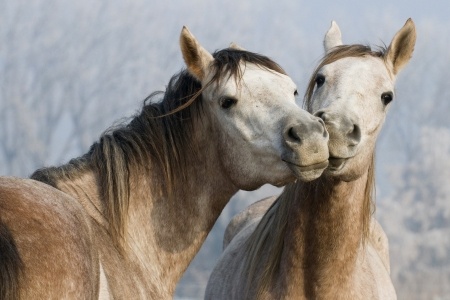
Two brown horses nuzzling each other

French saddlebred horses. Photo: http://www.horsesoflegend.com

Sometimes the basis for jealousy, which is actually a label for the fear of loss, is well founded. This can be especially true in humans where children or personal security are of concern. The situation that triggers jealousy also evokes thoughts of steps that would need to be taken in the event of losing their partner to the object of their jealousy. It is a defensive mechanism, in short, and should the underlying causes not be dealt with directly, it can lead to anger, depression, and other associated psychological effects.

In adolescents, the negative behaviors associated with jealousy are more common amongst those with low self-esteem. They may perceive their friendships as being easily threatened by others, sometimes leading them to aggressive actions [1]. Jealousy differs from “envy,” which is the desire to have something that someone else has.

Jealousy is an anticipatory emotion and one of the most common, yet unsettling behaviors exhibited by humans… and remarkably, other beings too. I say “other beings,” because it is apparent that animals can also become jealous when their “person” gives attention to another member of that animal’s species, or even another human. If dogs experience such emotions, then horses likely do too, as they also have an amygdala and correlating neurochemistry.

http://news.therawfoodworld.com/animals-can-experience-emotions-like-people-can-jealousy/

My brother and I used to laugh at our dogs when they would immediately get in between our parents as they embraced. The dogs would bark excitedly and turn anxiously from one parent to the other. We could never determine if they thought our parents were trying to hurt each other and the dog was attempting to “save” one or another, or if the dog was actually jealous that one of their “people” was paying too much attention to the other. Apparently, now we know the answer to that.

Fortunately, animals can’t quite go as far as humans in exhibiting abnormal types of jealousy, which can become quite threatening and dangerous to other people. This can enter the realms of extreme insecurity and may move well beyond the typical fighting over emotional infidelity or other common issues encountered in romantic relationships, particularly where “attachment” has been mistaken for love. In fact, there may be a neurochemical basis for jealous reactions that persist when there is no actual threat present and the fears are entirely unfounded. Neurotic jealousy may become associated with a disorder such as schizophrenia, paranoia or chemical imbalance in the brain.

It is sometimes all too easy to anthropomorphize what a horse might be thinking, and sometimes, as with the dogs, their apparent jealous responses when we give attention to another being can be quite amusing. As science continues to produce more confirmation as to the actual biochemical basis for the behaviors of sentient beings however, perhaps it is not such a stretch to be thinking that our horse might be jealous when we pay attention to another.

I have experienced observations of apparent jealousy in horses on many occasions and when Dr. Schoen suggested the article about the dogs as a blog post, reading it brought back many memories.

One such incident was with a big dun Saddlebred gelding I would ride every now and then when his owner was away. He had been rescued from abusive circumstances prior to the owner I was working with, and found himself in a loving, compassionate situation with Katie, his new “person.” During her lessons, it had become very apparent that this horse was quite possessive of his owner, and he would make challenging faces at any horse that got too close to her. As it happened, Katie and I were very similar in appearance and energy, so it was no surprise when her horse took on the same possessive characteristics with me as he did with her.

One day I was grooming him in his pipe-rail stall, preparing to tack up for a ride. Off in the distant paddock, a young horse was playing with a ball, going through some hilarious antics as he was doing so. While still brushing the big dun, my attention was on the colt that was having such a good time entertaining himself. Within a minute or so, the Saddlebred noticed my attention had been distracted to the other horse. He swung his head in the colt’s direction and his ears went back. Knowing how possessive he was of Katie I realized what he was responding to. After glaring in the direction of the playful youngster that was well off in the distance, he swung his head in my direction and gave me a “look that could kill.” Then he promptly re-positioned his body so that his neck, held regally high on his shoulders as is typical of his breed, completely blocked my view of the colt. What else could I do but laugh and return my full attention to the jealous gelding?!

Trakehner stallion

Young, dun Trakehner stallion. Photo: http://www.animalgenetics.us

I think one really has to spend a lot of time around animals to fully realize and appreciate the similarities between our emotions and theirs. As Dr. Schoen and I have cautioned in The Compassionate Equestrian however, there is still the need to recognize that an animal is an animal, and that they are not “us.” Common sense has to dictate the way we handle and train them so they are safe and untraumatized, to the best of our knowledge and abilities. It takes a long time to acquire the sensitivity and skills necessary in determining when an animal’s behavior is related to normal responses and when it may be reactions to fear, pain, or other negative stimuli that can put a less-experienced handler in danger.

Have you recognized jealousy-related behaviors in your own horse? Tell us your story too! We would love to hear from you.

__________

Judge Not – Or A Lot… It’s Your Choice

Compassion is about “the other.” It means that we recognize the suffering of another, and have a desire to alleviate their suffering. Still, we find that many people understand compassion through their own filters and experiences, and may find it difficult to have compassion for others who exhibit behaviors that they deem to be non-compassionate. This is why compassion requires study and practice. It tends to challenge us the most in situations where our compassionate nature may become somewhat compromised.


One of the key barriers to compassion is our human tendency to gravitate to negativity, judgment and blame. It seems to be the “default” mechanism in our base-line nature. In the horse world, we can find many examples of divisive, inflammatory language in that regard. We even go to horse shows and pay a lot of money to be judged!

photo: irishtimes.com

photo: irishtimes.com


Dr. Schoen and I have just finished writing a very lengthy manuscript and we could have written more. We realized that The Compassionate Equestrian is not only a teaching journey for others, but it became a progressive journey for ourselves in writing the book and putting together the beginnings of the program. I have personally changed the way I use language and have become more acutely aware of my tendency to place judgment on others, even after years of contemplative study and telling myself I should know better.


And telling myself “I should know better” is an example of self-judgment, which requires an exploration of my own self-compassion, then self-forgiveness.


In 1977 I took riding lessons from one of Canada’s most respected hunter/jumper and dressage judges and Technical Delegate for the 3-Day Eventing discipline. She took me to horse shows as her assistant and taught me the finer points of determining who would be placed in what order according to the highest standards of the sport. It is not an easy job! In the end, somebody is very happy and somebody is ultimately very disappointed and blaming their loss on the judging.


For some reason, we are not as good at relaying the positive, more caring side of our observations, especially when it comes to photographs on social media sites. Not being present to voice an opinion in person seems to have sparked a modern-day phenomenon amongst not just horse-people, but people in general who tend to make a habit out of posting negative, sometimes extremely inflammatory comments, at the sight of a photograph of something as innocent as a moment caught in time, where something does not agree with their perception of “all that is right and good with the world.”


Some people blame social media technology itself, while others have declared it is simply humans displaying their innate feelings without having to actually confront the objects of their judgments.


http://blogs.vancouversun.com/2013/10/21/f-bombs-or-friendly-words-is-social-media-making-us-rude/

 “Technology and social media can certainly make negativity more visible,” he said. And social media amplifies messages instantly, giving no time for second thoughts.


Either way, I found it difficult to not take critical judgments personally when I was a professional trainer, and I still get a familiar little twinge in my stomach if someone posts a potentially inflammatory, negative remark about a photo I have put on our Facebook page. This is where I have a conversation with myself about meeting the needs that are behind one’s feelings about those comments. What compelled that person to find fault with something in the photograph? Why do I think that I must take responsibility for how that person feels about the photo?


The dialogue is very interesting. Some people can relate to what is positive in the photo and mention what they like, while others immediately gravitate to faults that relay visual information contrary to the observer’s perception of “what is compassionate about this photo?”


For the most part, the riders in the photos probably love their horses. They most likely feel as though they are compassionate equestrians and are doing everything right with their horses. Today’s picture was a lineup at a show, with riders anxiously waiting for the class results to be called. They may all feel like winners. They aren’t thinking what some people may have judged as “that horse is over-bent”, or “that’s a terrible bit to put in a horse’s mouth”, or “horses should never be forced into the show ring like that.” The list could go on.


Even if there is truth in the judgments, why are we compelled to make them? Why can’t we look at the same photo and say, “those horses have beautiful, shiny coats and are obviously very well cared-for”, or “the riders are so well turned out, they must have worked hard for this moment”, or perhaps something like, “this style of riding doesn’t agree with my version of compassionate training, but even so, I feel compassion for these people, as they believe they are doing the right things for their horses.”


If we judge them with divisive language, they will put their energy into becoming defensive, as this is what happens when people feel criticized instead of engaged with empathy.


This is the enigma we find with introducing compassion across the broad expanses of breeds, disciplines, training methods, and human nature within the collective of horses, and well beyond. It is part of the challenge in building a new paradigm for a compassionate community of horse-people that transcends our personal needs and wants, in consideration of horses at large. If we can accomplish this in the equine world, we can accomplish it for humanity in general.


I found this wonderful article on Speaking of the Faults of Others and will continue to share excerpts on The Compassionate Equestrian’s Facebook site. You are invited to join the dialogue, and choose how you will judge the pictures, or not.


http://www.thubtenchodron.org/DailyLifeDharma/speaking_of_the_faults_of_others.html

“I vow not to talk about the faults of others.” In the Zen tradition, this is one of the bodhisattva vows. For fully ordained monastics the same principle is expressed in the payattika vow to abandon slander. It is also contained in the Buddha’s recommendation to all of us to avoid the ten destructive actions, the fifth of which is using our speech to create disharmony.


Countdown!

Countdown!

   It has actually happened. In the weeks since acquiring a so-called “smart” phone, time does seem to have condensed and almost a month has gone by since my last post. Truly a phenomenon of the modern world. Perhaps I have just been so fully immersed in the final phases of writing The Compassionate Equestrian with Dr. Schoen, that the early days of summer have already slipped by in a blink. I haven’t even been to a horse show yet this season, but I do plan on heading to Spruce Meadows sometime soon to catch up on the activities of some of my favorite jumpers.

   I also made a quick weekend trip to the extraordinary, famous retreat center in Big Sur, California, Esalen. This is a place where life-transforming “incidents” occur and one can release past traumas, move forward, and awaken to a world of self-advancement with renewed energy and purpose. I am learning to speak with the power and intent that drives The Compassionate Equestrian on its path to making the earth a better place for horses and their humans.

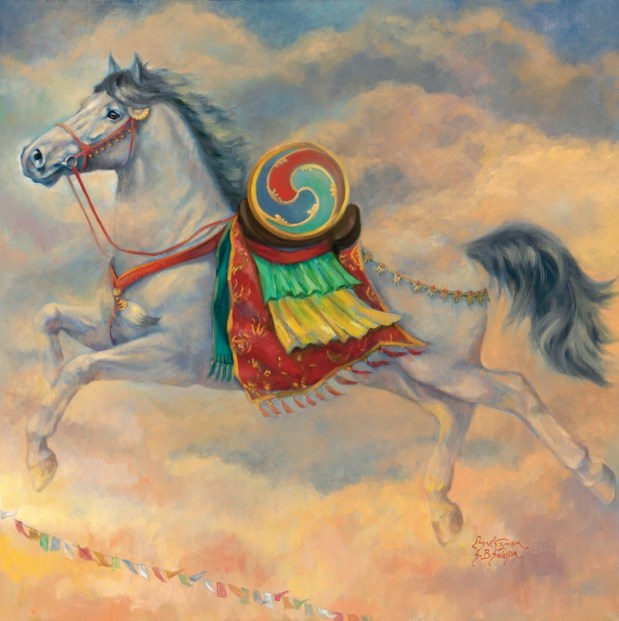
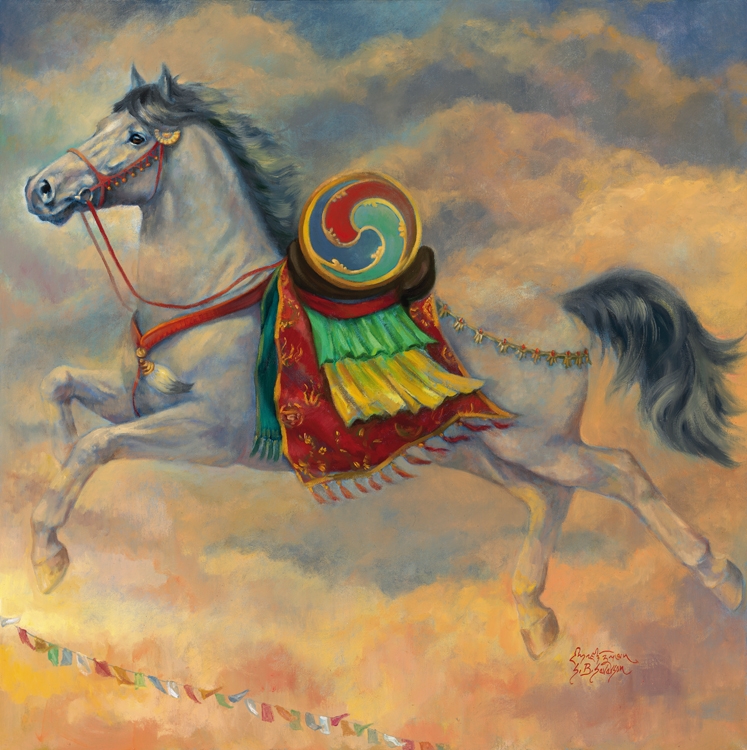
windhorse

(image: http://dungkarling.tripod.com/id7.html)

   Sadly, I have recently learned that one of my former riding students broke her back. I was on a trip to Arizona a few months ago, and while visiting my old barn, this very astute, lovely lady happened to stop by. She was thrilled to see me and excited to tell me about the new horse she had just purchased. The last time I had worked with her, several years ago, she was still on the longe line on a schoolmaster, slowly developing a correct seat. She had very little time to ride and was a long ways from riding independently, much less owning a horse.

   As happens far too many times, the horse she purchased this year was not suitable for her skill level. It was a gaited horse with a lot of forwards energy. In the story that was relayed to me by friends last week, the student had hired a trainer who insisted on using a noseband with spikes in it to control the horse.

   One day, while riding alone, the horse was spooked by a loose horse and the still-novice rider did what most riders would do in that instance, which is to grab at the reins to keep her horse from running off. Unfortunately the horse’s reaction was in response to the pain of the spiked noseband and it flipped over on its rider, causing the severe injury. Luckily, she is not paralyzed from the fall and will recover, but ultimately, such an accident can dramatically change a person’s life.

   It seems like every time I ride, go to a barn, speak with other riders or former clients, I am reminded as to why Dr. Schoen and I have written The Compassionate Equestrian. It seems like it cannot get out to the horse world fast enough.

   As it is, we have tremendous confidence in our wonderful publisher, Trafalgar Square Books, to produce a book we will be extremely pleased with, and one that we can send out on the back of the Windhorse with prayers and blessings for all equines and their people. For this generation, the next, and all to come, we wish for compassion to become the base of all training methods, for the benefit of all beings.

Attached to That Horse?

Have you ever made a list of the attributes you’re looking for in a horse (or a relationship)?  Have you then gone to all the trouble to seek out exactly the horse or person of your dreams…and found them?  How did things turn out?

I’ve noticed something quite interesting about those “lists” over the years. My experience and observations have led to the conclusion that the more one pursues a relationship according to one’s list of “wants”, the more likely outcome is having chosen the wrong one.  Why is that?

First of all, whenever I went looking for the ideal horse, I ended up with a list of problems that I hadn’t anticipated.  For example, my off-track thoroughbred, Dusty.  I was looking for a suitable hunter-type for the 3′ amateur division.  There were several I tried out, but Dusty was the breed, color, age and temperament I was looking for.  He had been field-hunted after his racing career and presumably that meant he would be bold and safe over show-ring hunter jumps.  I chose him over an older, better-schooled, seasoned warmblood that would have actually been the better horse for me at the time.

Dusty was a problem from the get-go.  We’d only had a basic soundness exam done, which he passed at the time.  I was in a marriage to a horse trainer who was becoming difficult too.  I’d actually sold my horse trailer in order to purchase the perfect horse.  My husband’s mood swings were causing anxiety, and it was making me anxious about getting a new horse.  We were in a new barn and recently married, and a long way from my previous home with my parents.  I had no support system.  I really wanted and thought I needed that horse!

Dusty did not stay sound for long.  He had a crooked spine.  Interestingly, so do I.  He had anxiety attacks and purposely fell down on concrete flooring.  I was in an increasing state of anxiety at the time.  I could probably analyze every detail of my relationship with Dusty and find some way to relate his issues to my own.  He was like a mirror for my own problems.  With horses, as with people, it would probably be a valuable exercise if we realized the mirroring effect at the time, but usually we don’t.

That was over 30 years ago.  I learned to stop looking for horses after that and just let them show up in my life.  The ones that literally  “dropped into my lap” were much better overall.  The key?  I had to let go of the attachment to my list of what I wanted.  I didn’t realize the amount of suffering those attachments would cause.  Looking back, and knowing what I know now, the lessons were obvious.

I’ve had so many clients also make the wrong choice of horse.  Often against my better advice.  I don’t take commissions on sales horses as most trainers do so it’s not like my suggestions were related to money.  My preference was to see the right rider on the right horse, especially given my prior experience.  People still purchased the wrong horse, probably for reasons similar to why I bought Dusty.  You don’t even realize what’s happening or why.

Razzberry Zam.  An off-track thoroughbred who "dropped into my lap" as a sales project.  One of the most wonderful horses I've ever had the opportunity to ride.  So wonderful, in fact, he sold quickly.  His buyer was the perfect owner and a massage therapist to boot.  Love, compassion and no attachment.  I felt it with this horse and although sad to see him go, it seemed like the gratitude with which we approached each other had a most beneficial outcome for us both.

Razzberry Zam. An off-track thoroughbred who “dropped into my lap” as a sales project. One of the most wonderful horses I’ve ever had the opportunity to ride. So wonderful, in fact, he sold quickly. His new rider was the right person for him and a massage therapist to boot. Love, compassion and no attachment. I felt it with this horse and although sad to see him go, it seemed like the gratitude with which we approached each other had a most beneficial outcome for us both.

Then I learned about non-attachment.  Ah ha.  The “list” is all about what we’re attached to, whether it be in a person or a horse.  Buddhism teaches that attachment leads to suffering.  Yes.  I’m proof of that.  I’m sure many of you are too.  Those attributes we want so badly, or think we do, in a horse or in a relationship with another human, are exactly the attributes that will bring us suffering when things don’t turn out as we wish.

The perfect jumper goes lame.  Our perfect spouse sustains a head injury and his personality changes.  The horse ages and can no longer jump.  The husband decides he prefers a younger woman.  Are we still as excited about that horse or that person as we were when they fit our list of “wants”?  Can we have compassion for them when they no longer fulfill our desires, or if they’ve hurt our feelings?

Letting go of the attachments, especially an attachment to any outcomes, is a worthwhile practice.  The other is self-compassion… the desire to alleviate your own suffering, knowing that suffering comes from attachment.  I’ve found that letting go and living with a tremendous love and gratitude for all of life opens the door for loving and grateful relationships to return to you.

The surprise is that those who come into your life may not be anything at all like the list you’ve made.  The thoroughbred of your dreams might manifest as a scruffy little pony who needed to be rescued from somebody’s back-40, but that little pony could just end up being the best jumper you’ve ever had.

According to psychologist Lisa Firestone, Ph.D. “our style of attachment affects everything from our partner selection to how well our relationships progress to, sadly, how they end. That is why recognizing our attachment pattern can help us understand our strengths and vulnerabilities in a relationship. An attachment pattern is established in early childhood attachments and continues to function as a working model for relationships in adulthood.”

http://www.psychologytoday.com/blog/compassion-matters/201307/how-your-attachment-style-impacts-your-relationship

So we can make note of this, and then turn to the practice of compassion and developing non-attachment:

“Most of our troubles are due to our passionate desire for and attachment to things that we misapprehend as enduring entities.” ~Dalai Lama

http://zenhabits.net/zen-attachment/ 

If you do go looking for a new horse (or person), my final thought on the matter is to first,  ask yourself why you want this being to come into your life.  Where are you with your self-compassion?

“When you stop trying to grasp, own, and control the world around you, you give it the freedom to fulfill you without the power to destroy you. That’s why letting go is so important: letting go is letting happiness in.”  Lori Deschene, Tiny Buddha


When a “Behavioral Problem” Really is Just That

In The Compassionate Equestrian Dr. Schoen and I stress repeatedly that when a horse exhibits behavioral issues, first rule out pain as the root cause.  This is especially true if there’s a change in the horse’s base personality.  Sometimes this takes more than one veterinarian’s opinion.   Diagnosis of subtle lamenesses can be difficult to pinpoint and the first sign of a problem might be the new or increasingly difficult behavior.

However, in my many 30+ years of working with all kinds of horses of varying breeds, ages, backgrounds and temperaments, there are a few quirky personalities in the crowd that are simply, well, weird.  They have legitimate behaviors that are out of the context of “normal” for most horses and sometimes the most compassionate thing to do is let them be exactly as they are.  If you can hang on, or tolerate them that is.

Sometimes you just hang on! (photo Alina Pavlova, 123rf.com)

Sometimes you just hold on!
(photo Alina Pavlova, 123rf.com)

Some of the most interesting have been the off-track thoroughbreds.  The subject of this post is one little, classic, plain bay gelding.  Nothing particularly spectacular to look at, but he had the kind of personality that made everyone look.  Kind of in the way you can’t take your eyes off the cars in a demolition derby.

His name was Earthquake.  As the story went, he was born in California during an actual earthquake.  We never did confirm whether or not this was true.  He was booted off the track in San Diego due to his “bad behavior”.  He ended up in a backyard in Phoenix that housed the other off-track thoroughbred jumpers belonging to his owners.  Besides a string of successful racehorses, they had produced some of the top amateur jumpers on the circuit.

Earthquake’s owner, Tracy, is the sister of the trainer I was working for at the time.  She told us “Quake” was almost impossible to ride on the flat.  Even with all of her experience in showing and winning at the “A” Circuit level, this little bay gelding scared her.  He would scoot out from under her, spin, leap, and generally act like a crazy horse.  She didn’t know what to do with him.

One day he was turned loose in the arena to play.  Tracy watched, somewhat stunned, while ‘Quake galloped over jump after jump all on his own, apparently inspired from watching her other horses school over fences.  So she clung through the flatwork with him and began to train him for jumper classes.

I had the task of helping her with him at his first show.  Lucky me!

I always maintained that somebody had to be the “entertainment of the day” at a horse show and frequently it was our barn.  Tracy’s brother was an excellent, caring horseman and would never consider drugging a horse to calm it down or make it easier to ride.  He just quietly rode whatever was underneath him in the moment, and so did his sister.

Taking thoroughbreds from the track to their first few shows is always a wild card.  ‘Quake was at least consistent with his quirky behavior.  I watched the crowded warm-up arena from the barns and it was easy to spot him.  That would be the horse and rider leaping above all the others, unrelated to where the warmup jumps were placed.

He was so excited to go in the show ring for his rounds, he couldn’t be contained.  He would paw, stretch, almost drop himself to the ground, spin, leap, and spook other horses at the in-gate.   Tracy hung on.  Then he would go in the arena, focus, clear every jump, and won almost every class he was entered in.  He was phenomenal.  Just impossible outside of the jumper ring!

He got better at his routine as he began to get the hang of showing.

I had to tack him up before one of the classes and it was exhausting.  He spun around in the stall.  He couldn’t stay still for a second.  I even tried pressing on an acupressure point on the coronary band, in the center of a front hoof.  It actually seemed to work, much to my relief.  He calmed down and I finished getting him saddled for his class.

Another day, and another class.  We got him tacked up and Tracy left him tied in his stall to go walk the course.  ‘Quake knew where she was going and he was apparently upset that he wasn’t going to the jumper ring with her.  I went in the tack room for a moment when I heard a loud crash from ‘Quake’s stall.  Mortified, I saw that he’d somehow jumped over the stall guard while still tied to the inside of the stall.  I have no idea how he could have maneuvered his body in such a way through a small opening and over the barrier.  Luckily he was unhurt in his desperation to follow his rider to the arena.

All you can do with that kind of enthusiasm is support it and hope the horse connects with the right rider and the right activity to accommodate his energy and ability.  In this case, the stars lined up and what would have been an extremely difficult ride for many equestrians, turned out for the best.  Last I heard ‘Quake was winning Grand Prix classes in the southwest.

Not every horse with behavioral “quirks” is lucky enough to find its way to a compassionate, competent owner that has the patience to simply let him “be” and allow the talent to shine through.  If ‘Quake had been punished for his leaping and spinning who knows what kind of a different horse he may have turned into.  Most likely not such an enthusiastic jumper who seemed completely enamoured with his owner.

If you have been able to rule out pain as the cause of your horse’s “behavior problem” and have determined he’s just of the personality type to be the way he is, then kudos to you for your compassion and understanding.  In my mind, I can see the happy little grins on all those clownish horses out there whose joy for life just can’t be constrained.


____________________

The Compassionate Equestrian is pleased to be affiliated with the International Charter For Compassion’s new Sector on the Environment

For information about the Charter for Compassion, and the upcoming Compassion Relays, click on the following link:

http://compassiongames.org/compassion-relays/


“Just” a Trail Horse


Many times when I’ve asked people about their horses they’ll say, almost apologetically, “oh, he’s just a trail horse”.  It’s as though their horse isn’t important enough for those of us who made a career with show horses to acknowledge as being relevant.  Or that it doesn’t require any special breeding or talent to be a trail horse.

Well, in the Principles of Compassionate Equitation, we see equality in all horses, just as we do all sentient beings.  They were given a life, just as we were, and all are subject to suffering, just as all humans are.  Everyone deserves the same amount of compassion, no matter who or what they are, or what they do.  Including trail horses :).

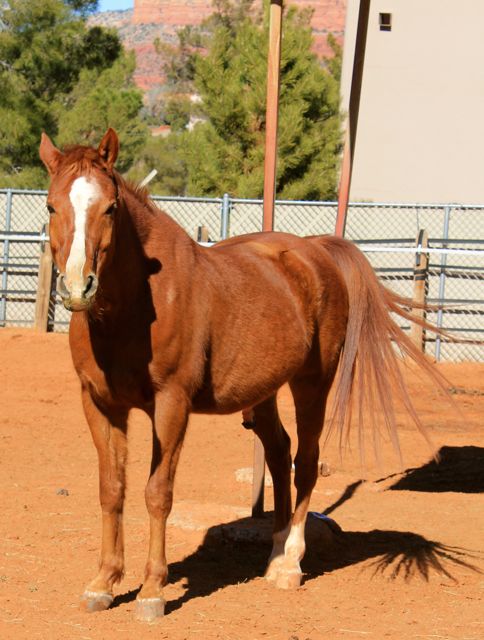
Recently I had the opportunity to spend time in one of my favourite places, Sedona, Arizona, on the back of a sweet, reliable trail horse who is as careful and kind as they come.

Shadow

Shadow

This is significant because my past experience with horses on trails has not always been so favourable.  My first horse, White Cloud, was a ranch horse.  When we moved to the suburbs of a large city, I had to ride along busy roadways to reach the trail system.  I was only twelve at the time and didn’t know better.  I thought that since the stocky white mare was so good on country trails, nothing would bother her on busier roads or trails either.  How wrong I was!

I was lucky we weren’t hit by a car.  We held up traffic a few times while Cloudy panicked at the sound of loud, fast vehicles passing and spooked by throwing herself into reverse.  As the area we lived in was lined with large ditches, her behaviour was quite disconcerting, not to mention dangerous.  Her tension translated into my tension and I was forever nervous about riding horses along busy roads after that.  I’ve never really gotten over it.

When we moved again, Cloudy was sold to a rancher and lived out the remainder of her life in a happy place.

The next horse to come my way was a very young, barely broke (in fact, badly-broke) appaloosa filly.  She was also born and raised on a large ranch and had no concept of behaving on multi-use trails or in traffic.  I really tried to overcome my fears and hers as I still enjoyed a gallop across a hay field or a pleasant trail ride down to the river, which required some riding along roads to get there.

Miss Demeanor, appropriately named, was one “incident” after the other.  I was still in my early teens and learning about training horses.  Determined, I kept taking her on trail rides, hoping for improvement.  One day she managed to thoroughly embarrass me on a group ride by running backwards down a steep hill until she finally backed into a tree, even with the reins thrown at her.  Then she scared herself and scooted forwards, spooking some of the other horses who had gone ahead.  I just seemed destined to not ever have a pleasant trail ride!

Trail running!

Trail running!

One day I was finally brave enough to ride “Missy” the few miles down to a beautiful spot by the river.  I let her take a drink out of a creek that fed into the river and in the blink of an eye, she was down and rolling in the muddy bank with me still on her.  I had to ride all the way back to the barn with one side of her plastered in mud so thick you couldn’t see her spots any longer.  I never did get all the mud out of the carved leather of my western saddle either.

I was in awe of people who could simply saddle up on a nice day, head out on the trail, and return still smiling with a happy and relaxed horse.  I had no idea why this “trail horse” thing was so elusive!

There was no problem in the show ring.  Even my spooky filly could open gates, walk over teeter-totters and tarps, drag a tire or a cow-hide, and jump a small fence.  Why didn’t that translate to the great outdoors?

Eventually I gave up on the idea of enjoyable trail riding, especially as my next horse was an appaloosa stallion, and confirmed “city boy”.  The first time I led him down a little hill he had no clue how to navigate it and promptly squatted on his hind legs and sat there in a half-rear.  I should have expected such things from my horses by now.

One day I was offered a beautiful big dappled gray warmblood gelding to ride on a charity trail event.  He was a lesson horse at the show barn I was riding at and generally very quiet.  Oh no, not on the trail however.  He spooked at… invisible trolls?  Maybe it was the shrubbery.

Finally I was married to a three-day eventing trainer and we were running a barn that was situated next to a cross-country course and thousands of acres of trails, accessible without riding along any roads.  Surely this was to be trail-riding heaven!

Sigh.  The appaloosa complained about the rocky footing.  The thoroughbred gelding pranced sideways thinking he was still a field-hunter and wouldn’t settle until after a full-out gallop. The off-track mare spooked at the cattle.  The part-Standardbred jumper bolted over the beaver-fall.  Was there anybody out there who wanted to be a nice trail horse??!!

I was starting to resign myself to having to ride in an arena forever, or continue having unusually adventurous trail experiences.  Gee, what was it like to have a safe, relaxing ride where I could drop the reins and enjoy the scenery?

The last barn I taught lessons at was a mix of many types of horses and riders, most of whom went on the rugged, rocky trails of Sedona on a regular basis.  I was still more comfortable jumping fences than going on a trail ride and stayed in the arena.

Finally, having really retired this time (it took a few tries), I thought I’d attempt trail riding again.

I know those trails from having run them on foot.  It’s very easy to twist an ankle or trip and there are many hazards on desert pathways.  Sharp cactus plants await along every edge and the rocks can roll underfoot or be as slick as ice when worn smooth by eons of erosion.  Deer or javelina can appear out of nowhere and in the warmer months there’s always the possibility of a rattlesnake coiling closely enough to do some damage.

Remembering to breathe, at first I guided Shadow, the pretty chestnut Arabian gelding, as I would in the arena, “helping” him negotiate the continually changing angles of the terrain and hoping he wouldn’t slip on any of the slick-rock.  I worked as hard as he did, staying off his back on the uphills and shifting a little rearwards on the downhill, monitoring his balance and speed.  Hoping not to annoy him, I tried to do as little as possible, telling myself he knew what he was doing.

He’d spent many more hours packing riders around these trails than I had spent riding horses on them.

Shadow was also lovely in the arena, and in fact very well bred to be a show horse too.  His gentle disposition and good training seemed to add up to his ability to be an all-around great guy.

At the end of our 3-hour ride, my reins were loose and I was letting him pick his way home, carefully stepping over boulders and not tensing up when his shoes slid on the steep downhills.  Yes, this little horse knew what he was doing alright.

What a happy day.  Now I know what it’s like to have a genuinely pleasant trail ride, with no spooking at wildlife, cars, dogs, cyclists, or loud noises.  What a special horse it takes to provide that kind of experience.  I can’t believe I had to wait so many years to enjoy such a ride.

Happy trails to all!

Happy trails to all!

I can tell you for certain that nobody ever needs to apologetically refer to their horse as “just” a trail horse.  They are a special breed unto themselves, no matter what their breeding or background, and they deserve every accolade that a top-notch show horse receives.  Trail horses also deserve the same kind of mindful care, compassion, and healthy environments as the most expensive, highly bred animals in the show-ring.  After all, horses don’t know how much we paid for them, or how much we pay for their training and board.  All they know is how they are made to feel in our presence, and you really can’t place a dollar sign on that.


RIDE IN BEAUTY

We all love and understand the beauty of horses, but what about the importance of the aesthetics of the places we ride and keep our horses at?  Do you think our surroundings have an effect on our own mental states as well as that of the horses?

My personal experience has included everything from keeping horses in my backyard to boarding at less-than-ideal establishments to one of the most beautiful, peaceful equestrian centers you could ever imagine, and running several training barns.  Speaking from such broad experience, I can share with you the insights I’ve gained about the effect of beauty, and ugliness, on both horses and riders.

The beautiful Spanish Riding School of Vienna

When I was 13 and still learning about having my own horse, my dad was transferred to another city.  The former ranch horse that was now my “beginner mount” had to learn to live in a box stall for the first time in her life while her shed and paddock were being built at our new home.  The closest barn was a dark, damp, wood-frame building with muddy paddocks and unscrupulous, horse-dealing managers.

I don’t remember all the things that were said to me there, but I sure remember how I felt, and how spooky my normally-quiet horse was at this place.  Not knowing too much made me vulnerable and the “helpful” suggestions were more like insults.  All of the people seemed to be “up to something” and none of the horses, in my memory, were very happy.  They were dirty, smelly, and the entire place was just unpleasant.  I couldn’t wait to bring my horse home and luckily, we didn’t have to stay there for more than a couple of months.

When we were transferred again a couple of years later and I needed to find another boarding barn, I found a home on a ranch for my mare, White Cloud, where she lived out her life in great comfort and truly in her element.

At 17 I had moved to the now-famous show jumping facility, Spruce Meadows, with my appaloosa colt.  What a contrast to the stable White Cloud had experienced. I’d had an appaloosa filly at another barn in the new city and was not pleased with the environment there either.  The horses were chased by the owner’s dog from the pasture into their stalls each night and my horse had been seriously injured as a result.  The staff were unapologetic and I later found out they had not been giving the filly her pain medication for the hock injury she’d sustained.  She also became terrified of men in cowboy hats.

I don’t like having to go to a barn with the feeling that I’m likely to find something wrong with my horse, the place is a mess, the staff are angry, or the stress levels are so high that riding isn’t the joyful experience it should be.

Walking into the barns and arenas at Spruce Meadows was like being in a cathedral.  It even smelled different than any other barn I’d been in.  The horses were bedded knee-deep in straw, and everything was spotless.  Soft music played in the indoor arena and the temperature was kept constant, even in Alberta’s cold winter weather.

http://sprucemeadows.com/

I’d never been at an equestrian facility where the first words coming to mind were “elegant”, “beautiful”, “peaceful”, “grace”, and “calm”.

We were required to keep our tack clean and hung a specific way and we followed a protocol that wasn’t so much rigid as it was to the benefit of everyone’s peace and wellbeing. The grounds  were lined with gorgeous flowers and trees and it was always easy to let out a big breath and sigh of relief every time I drove through the gates.  At this place, I found myself wanting to spend time there not just to enjoy my beautiful horse, but to rise to the level of elegance and old-world classiness – not an “elitist” attitude by any means – more like a kind of simplicity that allows you to settle into a calm, clear state of thinking and focus on what you are there for.

When my colt turned two I started him under saddle myself, having observed the German riding master’s guidance of the stunning Hanoverian horses that had been imported and bred on site.  Unless there was a show on, the peace and quiet could be counted on consistently and the horses also seemed to thrive both mentally and physically from the reliability of their environment.

http://www.horseandhound.co.uk/news/what-music-do-horses-like/#

I never had to worry about being insulted, anything irresponsible happening to my horse, angry staff, or bad management that affected the entire chain of events down to the boarders and guests.  It is no surprise to me that this establishment has won the accolades it has.

Dr. Schoen has been the veterinarian to many major show barns and we have written about the importance of a healthy, holistic environment with the best quality of care and food provided for the horses.  With the Principles of Compassionate Equitation, the kind of equestrian environment that supports the wellbeing of both horses and riders begins with caring, compassionate management and permeates the entire chain of day-to-day events at a barn.

While it may sound difficult to get an entire barn of human personalities to become compassionate, we believe that not only is it possible, but a necessary step for the sustainability of our industry and our beloved horses.  In today’s fast-paced, expensive, stressed out world, how could we not want to be in a “sanctuary” that supports our joyful interactions with horses, and helps us learn to extend that joy and compassion to all beings?

It is our wish that all horses and horse-people have the opportunity to live in health, happiness, and beauty.

Willy’s Light-headedness

I’m not sure if my last post made it to followers.  It certainly didn’t get to my e-mail box so this is an extension to the story of how light, or photonic therapy, saved my horse’s life.

The week after his series of three BioScan Light treatments was a happy week for Willy, and for me.  He was able to roll again, his gaits were good, and he seemed happy.  While of course the photonic therapy couldn’t eliminate all the lumps, bumps and turn the clock back to his youth, there was a spring in his step again and we were back in the saddle.  I went from making a decision about whether or not to euthanize him to deciding how to celebrate his 25th birthday.

Unfortunately as I led him through the barn one afternoon an aggressive mare lunged at him over the top door of her stall, surprising us both and catching Willy across his forehead with her incisors.  She left a deep gash above his left eye that began bleeding profusely.  Given his expression it obviously hurt quite a bit and I made a quick call to the vet.  I thought this would need stitches given the width and depth of the injury.

Willy

Willy – always letting you know how he feels!

Describing the nasty wound, our old-fashioned country vet said he’d prefer not to put stitches in a horse’s head due to the risk of infection and the difficulty in bandaging the area and keeping it clean given the equine tendency to rub on such things.  Like they do with show braids.  He suggested keeping an eye on it and making a “fresh wound” after it scabbed over, repeating the process until it was healing cleanly.

I put Willy in an empty box stall instead of returning him to the pasture with a rapidly-swelling, bleeding forehead and thought of the studies I’d read about the ability of red light to increase wound healing and tissue regeneration, to relieve pain and inflammation, and to prevent tissue death.

http://www.ncbi.nlm.nih.gov/pmc/articles/PMC2933784/  (Effect of Pulsing in Low Level Laser Therapy)

The only problem was I didn’t have a device that could deliver the specific frequencies of light and I needed it right away.  Willy was not going to let me anywhere near his head.  Any attempts to clean the wound were met with pinned ears and a “don’t you dare” expression.  Remembering I had a red bicycle light in the house, I thought I’d have nothing to lose by giving it a try.  It was so low-level as to be well out of the infrared range, and it certainly didn’t pulse, but it was LED-based nevertheless so it was worth a shot, even if the effect was minor.

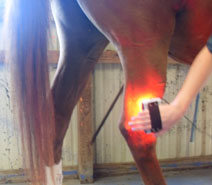
I returned to the barn with the bicycle light in hand.  Willy was still in distress and not wanting me near his head.  That is, until he saw the red light in my hand.  I held it up to him and his expression changed immediately.  He literally dropped his head into my hand and allowed the light to be placed over the open wound.  Obviously the memory of what he felt during the BioScan treatment was still fresh in his mind.

I continued to treat the injury daily for a few days with nothing more than the bicycle light and was amazed at how quickly and cleanly it healed over.  I pretty much left it alone after that and within 10 days the hair was growing back.  The horrible looking wound needed no further treatment as it healed so well there was no scar, and no white hair as frequently occurs in horses at the site of a traumatic injury.

After I had a device made with the correct frequencies, I’d offer it to Willy who would turn his body into the light pad and point with his nose, indicating where he wanted the diodes placed, or he would ignore it altogether, which I took to mean he felt just fine that day.

How LIGHT Saved My Horse’s Life

In the late 1990s my aged Hanoverian gelding who had once been an upper-levels eventing horse and show jumper was retired to the job of a lesson horse.  Old injuries he’d sustained in his younger years as a competitive athlete were catching up with him and his level of discomfort increasing.  He had a large amount of scar tissue on the underside of his neck, bad hocks, spinal deformity and arthritic joints.  By the time he was essentially bracing himself on two legs and not wanting to roll any longer, my options for his care and comfort were diminishing.  I’d already rescued him from a trip to the slaughterhouse when he was 18, and was glad to have given him a good “second chance” in life and a far better ending than the one he’d been threatened with.  I thought maybe he’d reached “the end” for sure this time and was considering euthanasia.

Willy & I

Willy & I

Given the results I’d seen with light therapy in humans and other animals however, I decided to give it a chance as a new company had emerged at the time with a system designed specifically for horses.

For some who may not have been introduced to Low Level Laser Therapy*, this might sound like it’s straight off the Holodeck of the Starship Enterprise.  I can assure you of the science behind it however, and will present both anecdotal accounts from my own experience with this remarkable healing modality as well as scientific references.  Oh yes, and if you search for the opinions that say it isn’t effective or that there isn’t supportive research, you’ll find them, and generally they stem from sources who don’t actually quote the lengthy list of well-funded studies that do prove the known mechanisms and successful case studies, in particular the currently FDA-approved monochromatic red wavelengths.  Everyone comes through their own belief systems, even scientists.  However, I’ve now used the technology for over 20 years and still use it to speed up the healing of sports injuries, wounds, and dental surgery.  Results are consistent with both humans and animals in my experience.

Some of the contemporary history leading to the FDA-approved research came through NASA and the University of Wisconsin’s Dr. Harry Whelan, M.D.:

http://spinoff.nasa.gov/Spinoff2005/hm_1.html

Dr. Harry Whelan, M.D., has been inducted into the NASA Space Technology Hall of Fame for his research into the use of near-infrared LEDs for wound healing and the treatment of brain tumors and neurofibromatosis:

http://www.mcw.edu/neurology/facult/HarryWhelan.htm

I was personally introduced to photo-therapy, or the application of colored light, via Dr. Jacob Liberman O.D., Ph.D, D.Sc. (hon), (author of Light; Medicine of the Future  http://www.jacobliberman.org/jacob/bio/).  He invited me to attend the annual conference and professional training session of the College of Syntonic Optometry in 1991.  I then experimented with the specific frequencies of visible light on myself, on waterfowl that were rescued from various states of illness and injury and brought to our ranch, as well as dogs, cats, horses and anyone who wanted to try it for themselves.  Over and over again the results were nothing short of miraculous.

The originator of syntonic phototherapy was Dr. Harry Riley Spitler, D.O.S., M.D., M.S. Ph.D who first published the Syntonic Principle in 1941.  Scientific research that began in the 1920s speculated that the power of light was primarily transmitted to the core of the human organism via the organ of sight – the eyes.  Dr. Spitler theorized in great detail the role of the eyes in phototransduction, as well as the role of light and color in total organismic function and development.  Most of his work has been scientifically validated, and that of the work of many others in the field.  Their collective bodies of work have formed the foundation for today’s most advanced approaches to light therapy.

Glowing LEDs

Glowing LEDs

The issues up until the 1990s were conflicts between the FDA, DEA, and classifying both the devices and frequencies of light into their respective categories of drugs and medical devices.  It was NASA’s work in developing the technology with the Marshall Space Science Centre and Dr. Whelan that brought at least a portion of photonics research into the mainstream.

After I was trained in the application of colored light through the eyes, I made a set of filters and worked with those and a light source.  The technology that emerged at the time my Hanoverian, Wilhem, was literally on “his last legs” was that of BioScan Light, then out of New Mexico.  The application was quite different than what I had been taught, but understanding the mechanism of light on the cells of the body made me call a local woman who occasionally rode at our barn and had been through the BioScan training.  Desperate, I called her and had her come out to treat Willy.

http://youtu.be/mfueJv3OK9c

I found the scanning unit took quite a long time and when Sandra was finished the initial session, Willy had dots of grease pencil all over his body.  Then she treated each dot with a cluster-head set of red LED lights.  I noticed he immediately began taking deep breaths and almost fell asleep in the cross ties.  His whole body relaxed so much by the end of the session he looked like a different horse.  I was anxious to see how he moved.  His tail was up for the first time in quite awhile.  It had been clamped in chronic discomfort as his soundness deteriorated.  As it turned out, the old scar tissue under his neck had been causing him more pain than I’d originally thought too.

Conventional veterinary medicine had done all it could for this horse, saving his life when he was injured after flipping over a cross-country fence and splitting his neck near the jugular vein.  His hocks had been x-rayed, determining the condition they were in and finding a bone spur, and the farrier did everything he could to put a good, supportive foot under the big gelding’s aging body.  Everything else Willy needed, he got, but life had caught up with him and it was time to find an alternative and compassionate way to make him comfortable, or else let him end his life in peace.

Applying red light with the Respond System.  www.emersonww.com

Applying red light with the Respond System. http://www.emersonww.com

After Willy’s first light treatment I put him back out to the pasture with the other old horses and he proudly marched to the middle of the field, stood up square like a statue, then took off in an elevated trot towards the horses.  I was amazed to say the least.  The other horses saw him coming and they all took off running too!

Sandra came back two more times and each time the number of grease-pencil dots from the Bio-Find unit decreased.  I noticed the old scar tissue softening under Willy’s neck.  The real test would come when I put him into one of the outdoor pens that he loved to roll in, but hadn’t done so in months.  I believe he thought he might not be able to get back up from the deep, soft dirt, once he got down into it for a roll.

Sure enough, after the final treatment I put Willy in the turnout and he immediately tossed a big hoof-full of dirt into the air.  That was the signal he was going to drop and roll.  He pretty much had a big grin on his face, as much as a horse can actually smile, then collapsed into the dirt and rolled, and rolled and rolled!  I knew from that point on he was going to be alright.

He stayed serviceably sound and remained bright and happy.  The other horses seemed to enjoy hanging around him more as well.  He even managed to commandeer two of them to swat flies from his face out in the pasture and his gentle nature made him a favourite for babysitting youngsters, sick horses and horses that needed to calm down.

I had an LED pad custom made and began to experiment on other horses, some with horrendous spinal deformities, dropped hips and sacroiliac displacement.  The results were consistent and every horse improved, some dramatically, even just using this very basic, simple version of light therapy.  It is a completely non-invasive, gentle method of remediation for injuries involving soft tissue and seems to help with joint stiffness as well as reducing the effects of old scar tissue.  I noticed the spine and hips realign, most likely due to the release of tightness and muscle damage that was pulling the musculoskeletal system out of alignment, allowing the bony structures to move back into a more normal state.  The horses all showed a marked increase in their ROM (range-of-motion).

In recent years, many new companies have emerged and new research and information continues to support the use of LLLT.  Dr. Schoen and I are looking forward to following the progress of the latest devices to enter the market for advanced and professional delivery of red light for the healing of horses.

The MR4 Super Pulsed Laser

The MR4 Super Pulsed Laser

Dr. Schoen and myself both recommend a thorough veterinary workup if your horse exhibits signs of pain or lameness or is otherwise in apparent distress as there could be many causes.  A good lameness veterinarian is invaluable to every horse owner and sometimes they may recommend a second or third opinion also.  It isn’t unusual to find several causes of lameness in a horse and some are very difficult to diagnose.  As each practitioner comes from their own areas of expertise, you may find putting a good diagnostic team together the most compassionate thing to do for your horse’s wellbeing.  This includes a neurologic workup and checking for Lyme Disease if your horse’s behaviour has changed and he seems to have chronic, yet indeterminate symptoms of discomfort.

LLLT works wonderfully in conjunction with conventional medicine and is highly applicable as a supportive mechanism for speeding up healing along with standard protocols for treating sport-related injuries, wounds and post-surgical conditions.

_________________________________

*Laser Therapy is a form of phototherapy which involves the application of monochromatic light over biological tissue to elicit a biomodulative effect within that tissue.

Low-level Laser Therapy (LLLT) – the most widely-used name given to this form of photobiomodulation – can have both a photobiostimulative effect and a photobioinhibitive effect within the irradiated tissue – each of which can be used in a number of therapeutic applications.

source:  http://www.spectra-medics.com/llltinfo.html

OH HORSE, HOW DO WE LOVE THEE?

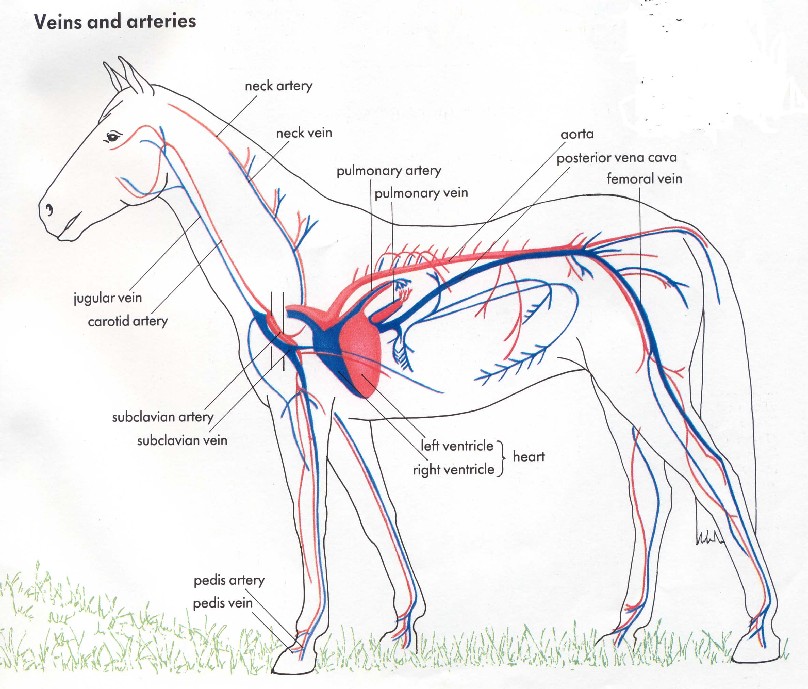
Have you ever wondered how a hollow, blood-pumping muscular organ could be connected to the emotion called “love”?  Every animal that has a circulatory system has a heart.  Does this mean all animals as well as humans are capable of love?  While the structure of the heart may vary among different species, it’s fundamental job is the same, and that is to pump blood throughout the body’s blood vessels by repeated, rhythmic contractions.

Circulatory system of the horse from www.serendipityrancher.com

Circulatory system of the horse from http://www.serendipityrancher.com

It goes without saying that horses have big hearts.  An average of 8.5 pounds in fact.  They have similar structures to that of the human heart, with the same four chambers and heart valves.  However, our heart electrical conduction systems differ due to the inherent stalking predator (that’s us) versus flight-driven prey (the horse) animal.  We stalk, while horses take flight in extraordinary bursts of speed thanks to a heart physiology that allows them to go from resting to almost 300 beats per minute in the blink of an eye.  Every human athlete would love to be privy to that kind of heart performance!  In fact, the flight response in horses is so ingrained that even after centuries of domestication, the horse is a species that has to keep moving.  While humans can be recumbent for days or months when ill or injured, the horse only has 72-96 hours of “being down” before life-threatening complications arise.

So in spite of our anatomical heart similarities, yet functional differences and opposing survival mechanisms, we still seem to be able to note measurable bonding and emotions coherent in both species.  Science can reduce love to several chemical responses that work between the heart and the brain.  For some reason, the predator can fall in love with the prey and vice versa.  What is it about the horse…?

Fundamentally, the “love chemistry” exists for reproduction and evolutionary capabilities of a species.  It’s not exactly what we would term “romantic” unless we find horses writing romance novels behind our backs somewhere.  The initial physiologic response when two attracted beings meet is an increase in heart rate due to a rush of adrenalin.  Yes, just like a sporting event.

In addition to the adrenalin, the brain is sending signals to the adrenal gland which is secreting other hormones such as epinephrine and norepinephrine.  When the heart rate goes up, it’s using more oxygen.  Another part of the brain that becomes active in the presence of the loved one is the area that produces dopamine, a neurotransmitter.  Norepinephrine and dopamine are closely related and in a performance situation, they provide both the “weak in the knees” feeling and that of focus, euphoria and motivation.  Any runner pushing through pain at the most intense part of a race can tell you exactly how it feels to have every performance-related neurohormone affecting various body parts.

In romantic love, there are three brain systems involved and they are often connected, but can also operate separately.  They involve sex drive, love and attachment.  The primal sex drive is there to encourage the seeking of many partners, while the “love” part focuses on putting mating energy into one specific person at a time, and attachment is allowing you to tolerate the partner long enough to have children with him or her.  Even the excitement of a “one night stand” produces a flood of the hormones oxytocin and vasopressin, making you feel deeply attached, and possibly even in love with someone.  It sounds a little cold, but this is the chemical basis for our emotional responses to others, including horses.

photo credit:  123rf.com stock photo - kislovas

photo credit: 123rf.com stock photo – kislovas

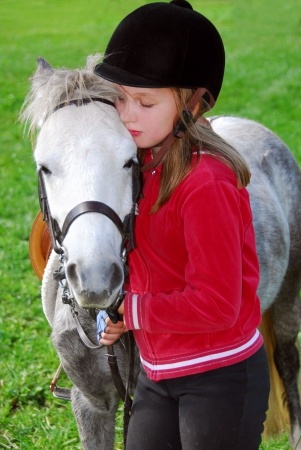
When you’re a small child in love with animals, you learn a lot about the excitement of new relationships, loss, disinterest, grief, and renewal.  They hypothesize children as young as 4 practice at love and are able to learn more about themselves before being in love actually becomes important to them.

So when a little girl says she loves horses, she really does.

The release of “love chemicals” in the body are beneficial throughout the lifetime of a human as they are found to contribute to the person’s wellbeing and longevity.  Studies on compassion and meditation are conclusive in their positive influence on brain chemistry, the cardiovascular system and subsequent health effects overall.

What’s so fascinating, is that given the primitive, inherent responses to stimuli, is the ability to train ourselves to control the release of emotion-production chemicals that affect our heart rate, and somehow, horses are acutely aware of our various states.  Without being able to monitor the horse’s brain during activity, studies have turned to Heart Rate Variable data (the beat-to-beat changes in heart rate) to determine how and why horses bond with humans.  Perhaps even exhibiting what we know to be “love” responses in return for us loving them.

It’s been almost a decade since the pilot studies were conducted by the Institute of HeartMath using HRV to measure the emotional bond between humans and horses.  It will be extraordinary to see what kind of information will emerge in this field in the coming years.

You can read the full study here:

http://www.horseconnection.com/site/archive/story-aug07.html

I was one of those little girls in love with horses.  I am also a competitive runner, and a retired professional rider.  I know exactly what it feels like to push the heart, brain, and body to the point of implosion, and because I’ve practiced meditation for so long, I also know what intense focus and concentration feels like.

Many years ago while riding very green and off-track horses, I learned the importance of focus and breathing correctly to maintain a calm state.  It gave me the ability to take a very excited, fresh horse and bring it into the state I, or the client, needed it to be in for training or showing.  Biochemically, the horses were in fact so sensitive to my respiratory rate and mind-set that they “got it” very quickly and would come into sync.

Working in a busy show barn presented huge challenges due to the broad range of personalities and emotions exhibited by horse owners and their horses, obviously “feeding” off each other.  While I can talk up a storm any other time, people eventually learned not to interrupt me or try to talk while I was riding a horse until I indicated we were “off” work and ready to re-engage with the outside world. I learned over the years to shut out everything but the bond I was creating with the horse I was on.

Was this “love” between two species?  Hard to say.  It was certainly a synchronous relationship of some sort.  Perhaps it was a classic “heart to heart” discussion using an unspoken language (heart-to-heart – openly straightforward and direct without reserve or secretiveness – FreeDictionary).

There was one particular bay gelding that I had a more unusual connection with than all the other horses though.

He was an off-track thoroughbred that we’d named Kevin.  The trainer I worked for purchased Kevin from a broker as a 5-year-old that didn’t run too well on the track.  I was assigned to re-school him on the flat and the trainer started him over fences.  He was a klutz over jumps in the beginning too.  It wasn’t until he learned balance and some degree of gracefulness through many months of dressage and gymnastics that he began winning in the show ring.

I enjoyed riding Kevin as he was a willing student albeit one who would have the occasional mini-explosion while he leapt about and kicked the kinks out of his body.  He also had a habit of digging in his stall and subsequently developed allergies to dust, in particular dusty hay.  I started watering down his hay and if I forgot, I’d find him standing forlornly over the automatic waterer as a subtle hint.

Kevin with student Mira Word

Kevin with student Mira Word

For all the dozens of horses I’d ridden, none was a “hugger” like Kevin.  Occasionally when I’d enter his stall to toss a can of water on his hay or fill in the hole he’d been digging, I’d wrap my arms around his neck and he would respond in kind by wrapping his head and neck around my body and pulling me closer to his chest.  I felt a genuine emotion, call it “love” if you will, flooding my body when we would embrace this way.

I don’t think anybody saw me doing this.  After all, this was a serious FEI dressage show barn and trainers weren’t going around hugging their horses in public displays.  Lots of praise and petting, yes, but this hugging thing was different.  Really different in Kevin’s case.  I had been riding professionally for more than 16 years at this point and while I could develop a relationship with all the horses, this was a deeper-than-usual bond.  Unfortunately he wasn’t my horse and I had to maintain the typical level of detachment I’d also learned while being in the horse business.  The horses provided rather masterful lessons in compassion themselves and Kevin was one of the best.  I loved them but I couldn’t keep them or control their lives.

I can’t tell you what kind of emotion Kevin was feeling since no researchers were there to monitor his heart rate or pull blood to see what chemicals were present at the time.

However, those hugs from the lovely bay gelding felt so genuine they always comforted me on a really tough day.  The neurohormones triggered in my body were real, and perhaps Kevin felt better too.  In any case, I would guess that when a little girl, or a grown woman says they love a horse, it really is “love” and the benefits we receive from that inter-species love is just as authentic as that with our fellow human beings.

SG

…and from Dr. Schoen:

This video shares the images of the wish of Happy Valentines Day to All Kindred Spirits:

https://www.youtube.com/watch?v=5iUhZvsuNp8&feature=youtu.be

Wishing all Kindred Spirits a Happy Valentine’s Day!  May all beings feel the deepest, profound love that permeates all of life, all dimensions!  This love is within each and every one of us.  It is not getting love from food, treats, distractions, etc.  It is giving and receiving love from the deepest truth of who we really are.  This love radiates from our hearts in every moment.  Love is the bridge between all of us, between the form and the formless, between all hearts.  Love is a key to my Trans-species Field Theory© and global coherence.  It is our old programmings, thoughts, belief systems etc. that prevent us from realizing this.  From this deep love, I wish you all the love that the Kindred Spirits Project and The Compassionate Equestrian wishes to radiate out to all our wonderful followers!

Blessings and Happy Valentine’s Day to you all!

Girl with Pony