A Happy Horse, of Course!

We do everything else online these days so why not learn how to be happy by taking an online course too!? I had to think about this for a few days, and try to compute what “happy” really means. Especially to a horse. Does a horse think “happy thoughts”? I think with humans, part of the problem is we think too much. Part of being happy is to stop it. “Thinking” too much that is. At least so far as instructions in mind-training go as we are taught to let go of binding attachments to desires and things and just “be”. Yet even when taught to observe the mind as an instrument of desire, we still have wants and needs. It’s part of being human. It depends on what those wants and needs are. Do we want “stuff” or do we want to be of benefit to all beings?

For a horse to be happy, does he have to stop thinking or start thinking? Perhaps with animals, it’s simply a matter of how they respond in the moment as opposed to deciding how they will do everything from selecting a partner to where they will live and work and what they will acquire that will supposedly “make” them happy. They go about their horse-business and seem to be most at peace when they’re turned out in a pasture together and can function as closely to their natural herd behavior as much as possible.
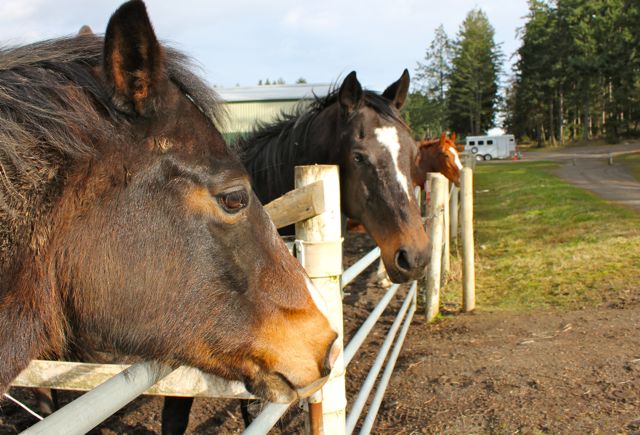
The "herd" waiting to be brought in for dinner.

The “herd” waiting to be brought in for dinner.

What’s interesting about the fundamental ideas behind the “happiness course” is that they sound a lot like the way a herd of horses naturally operates. “Strong social ties”. Check. “A sense of purpose or connection to the greater good”. Check. “Reading people’s emotions”. Oh yes, horses are really good at that too. Do they have compassion? Empathy? I believe many of us who have worked with horses a long time can cite stories of horses displaying all the qualities this course teaches us about being happy. How fascinating!

http://www.huffingtonpost.com/2014/04/23/why-thousands-of-people-a_n_5175603.html?utm_hp_ref=mostpopular

“The [course] starts with the idea that happiness and health are fundamentally about strong social connections and being immersed in a strong social community,” says Keltner, citing research that strong social ties can add years to your life. “We’re going to zero in on things that build strong social ties and communities — things like compassion, empathy, how to read people’s emotions, gratitude, charity, generosity and giving.”

The course emphasizes two main (scientifically-proven) keys to happiness: Strong social ties, and a sense of purpose or connection to the greater good.

Granted, the definition of true happiness can be somewhat broad-based and subjective. A quick online search for the definition provided this description:

hap·pi·ness
ˈhapēnis/
noun
the state of being happy.
“she struggled to find happiness in her life”
synonyms: pleasure, contentment, satisfaction, cheerfulness, merriment, gaiety, joy, joyfulness, joviality, jollity, glee, delight, good spirits, lightheartedness, well-being, enjoyment;

For horses, that could translate to the pleasure of eating a bucket full of tasty grain or taking off across the field, bucking and playing as a delighted free spirit with the rest of the herd. Sounds similar to what humans find satisfying and joyful. Eating, playing… it appears all beings might be looking for the same thing.

Can happiness-seeking take a wrong turn? I can see all the heads nodding now.

This goes back to our desire for self-satisfaction and thinking we’re going to find that either through others, or through the acquisition of material goods. It looks like the online happiness course is scientifically-backed to prove there are definitely errors made in human thinking as to what will make us happy.

I had a landlord once who lived right below my apartment. He and his girlfriend were generous, caring souls, but he was convinced she was supposed to “make him happy”. It’s a fragile way to maintain a human relationship. As soon as he was “unhappy” the arguments would ensue and it became an unpleasant environment not only for them as a couple, but for everyone else in the vicinity who was subjected to their unhappy behaviors. They would eventually make up and the entire cycle would start again.

Horses don’t seem to have these problems.

I’ve watched horses respond to other horses in distress many times. They don’t like it when a herd-member is in trouble or hurting, even if they only know the horse as a stable-mate who lives in another stall in the barn. They will exhibit signs of stress and call out to the distressed horse. Is this not a sign of compassion and empathy? I’ve seen an entire herd of pasture-mates form a procession and circle around one of their own who was dying. Is this not a sign of sentience, intelligence and compassion?

I believe that amongst domesticated horses, we humans are often thought of as part of their herd. Perhaps more so by some horses than others, but I’ve seen signs of acceptance in that regard as well. It’s probably why so many people feel so protective and emotionally attached to their horses. It’s hard not see them as objects of desire and “things” that exist to make us happy, but they are so much more than that.

As the happiness course indicates, the factors that make for true happiness are strong social circles and caring for others. So our real happiness with horses comes from that aspect of being with them, and not so much from the aspect of how much they cost, how much fancy tack we can dress them up with, or how many ribbons we can win in the show ring with them. All that “stuff” simply pales in light of the real reasons horses can bring us true happiness. No wonder they’re so inherently happy 🙂


Where Have All the Kids Gone?

I know there are still a lot of horse-crazy girls, and probably a few boys, out there in the world. According to statistics however, their numbers are declining considerably, and the demographic of horse owners is narrowing:

Looking at the overall picture, the typical horse owner is a married female, 45 or older, who is employed full time and has a household income of more than $50,000.

Further, the proportion of horse owners ages 18 to 34 has declined from 24 percent in 2006 to 15 percent in 2009 to 11 percent in 2013, according to Brakke. So overall, Brakke has observed a gradual decline in the proportion of young horse owners. The same goes for the rate of participation in equine competitions, particularly at the local level.

Since 2009, the percentage of horse owners who participate in competitions has declined from 36 to 30 percent. Competition participation at regional, national, and international levels has remained about constant; however, the proportion of these horse owners who also compete at the local level has declined by nearly 10 percent, from 84 percent in 2009 to 77 percent in 2013. And the mean amount of time horse owners spend on equine activities has declined from 20-plus hours a week to 17-plus.

https://www.avma.org/news/javmanews/pages/140415g.aspx?utm_content=javma-news&utm_medium=email&utm_campaign=gen

The big question is, why? Have more kids lost interest in horses, or animals and nature in general, because of their obsession with electronic devices? Have smart-phones and social media begun to replace the desire for activities that require them to put down the phones and pay attention to another living being? Perhaps the economy has made horse-ownership too expensive for the average family and accessibility has waned as agricultural land is converted to higher densities. Possibly all of the above.

I think often of the last group of students I had. All but a couple have grown up and gone off to college, world travels, and careers. If they have access to horses they’ll ride, but otherwise it’s an activity that’s fallen by the wayside. One of the reasons I stopped teaching is because there were so few kids coming up behind them. Only one or two enthusiastic, bright eyed little girls wanting to play with the minis. Nobody wanting to put the time or money into showing. Nobody looking for a new horse. No need to look for a new horse anyway as there are plenty standing around whose owners don’t have enough time to spend with them. Too many of those in fact.

I also think of all the horses who have been “sadly outgrown”, neglected, abandoned, or sent to auctions. If only they could all be matched up with the kids who still want to ride, especially for those of whom it’s an economic or accessibility issue. I don’t know what the answers are but if we want to keep the industry sustainable we need to find a way to re-engage youth and connect them back to horses. Perhaps breed associations and lesson programs will have to alter their methods for engaging a younger set of riders, finding new ways to synchronize today’s tech-oriented kids with an equestrian lifestyle.


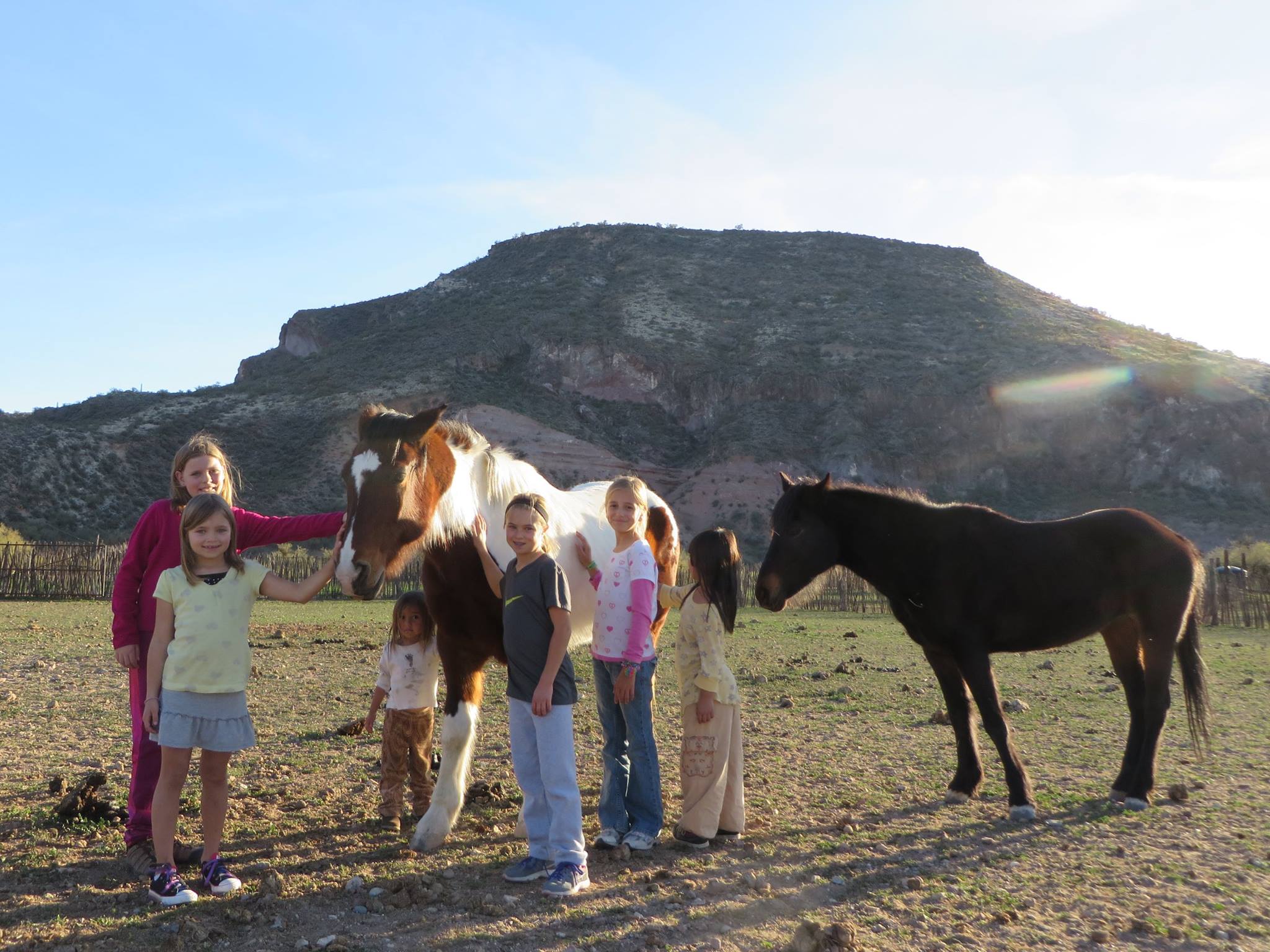
Photo courtesy Matthew Bonnstetter, TT Ranch, Arizona

Photo courtesy Matthew Bonnstetter, TT Ranch, Arizona

We know what kind of positive influence horses have on people. In The Compassionate Equestrian, Dr. Schoen and I have proposed new, more compassionate methods for training and handling horses that come from a base of compassion. The program begins by teaching self-compassion and mindfulness and applying compassion to one’s own life as well as to all living beings. Horses are extraordinary biofeedback units. They are so valuable in teaching people, especially young people, the benefits of becoming aware of the emotions and feelings of another being.

One of the key issues amongst teenagers is bullying each other on social media networks. It happens at the barns too and the trickle-down effect from the abuser, to the victims, and to the horses, is unfair to everyone involved. We desperately need a new paradigm that will work for the horses who need compassion, attention and care as much as youth who need the same. We know how much horses can help:

A kind of magic happens when a desperately unhappy child is brought to the country to interact with horses. A change of environment, especially from an urban area to open, natural surroundings, filled with fresh air and flooded with sunshine, can have an uplifting and calming effect, and with time, a troubled teen can begin to let go of a lot of pent-up, negative emotions.

When teenagers first arrive at an equine program, they are often withdrawn and angry. Their relationships have been negative – but the relationship they will experience with a horse will be completely different from any other. Horses and other animals are completely honest in their encounters, and for many teens this will be the first interaction they have ever had in which they can honestly be themselves.

http://aspeneducation.crchealth.com/articles/article-equine-therapy/

It seems like gone are the days when we would see 80 or 90 kids in a junior hunter class. There’s still a handful that can compete at the big, “A” rated shows, or go to the Nationals for their breed organizations, but those numbers are dwindling too. Breeders are still breeding, and more racetracks are shutting down as thoroughbred racing continues to fall out of favor. People are more over-extended than ever in just trying to survive and manage everything. It’s no wonder horse ownership for kids is waning. Where are all the ponies, pleasure horses and thoroughbreds going to go? What will become of a young horse today that will still be around 10, or perhaps even 20 years from now?

If we don’t find a way to bring a new generation of compassionate young riders and trainers to the industry, I’m very concerned as to what will happen to our domesticated horses in this rapidly changing world. I’m sure they’ll still be here, patiently waiting for their people to show up. Hoping to be taken out of their stalls for some exercise. Looking forward to having somebody to teach. I just hope we can provide them with an endless supply of new students who are willing to learn.


Attached to That Horse?

Have you ever made a list of the attributes you’re looking for in a horse (or a relationship)?  Have you then gone to all the trouble to seek out exactly the horse or person of your dreams…and found them?  How did things turn out?

I’ve noticed something quite interesting about those “lists” over the years. My experience and observations have led to the conclusion that the more one pursues a relationship according to one’s list of “wants”, the more likely outcome is having chosen the wrong one.  Why is that?

First of all, whenever I went looking for the ideal horse, I ended up with a list of problems that I hadn’t anticipated.  For example, my off-track thoroughbred, Dusty.  I was looking for a suitable hunter-type for the 3′ amateur division.  There were several I tried out, but Dusty was the breed, color, age and temperament I was looking for.  He had been field-hunted after his racing career and presumably that meant he would be bold and safe over show-ring hunter jumps.  I chose him over an older, better-schooled, seasoned warmblood that would have actually been the better horse for me at the time.

Dusty was a problem from the get-go.  We’d only had a basic soundness exam done, which he passed at the time.  I was in a marriage to a horse trainer who was becoming difficult too.  I’d actually sold my horse trailer in order to purchase the perfect horse.  My husband’s mood swings were causing anxiety, and it was making me anxious about getting a new horse.  We were in a new barn and recently married, and a long way from my previous home with my parents.  I had no support system.  I really wanted and thought I needed that horse!

Dusty did not stay sound for long.  He had a crooked spine.  Interestingly, so do I.  He had anxiety attacks and purposely fell down on concrete flooring.  I was in an increasing state of anxiety at the time.  I could probably analyze every detail of my relationship with Dusty and find some way to relate his issues to my own.  He was like a mirror for my own problems.  With horses, as with people, it would probably be a valuable exercise if we realized the mirroring effect at the time, but usually we don’t.

That was over 30 years ago.  I learned to stop looking for horses after that and just let them show up in my life.  The ones that literally  “dropped into my lap” were much better overall.  The key?  I had to let go of the attachment to my list of what I wanted.  I didn’t realize the amount of suffering those attachments would cause.  Looking back, and knowing what I know now, the lessons were obvious.

I’ve had so many clients also make the wrong choice of horse.  Often against my better advice.  I don’t take commissions on sales horses as most trainers do so it’s not like my suggestions were related to money.  My preference was to see the right rider on the right horse, especially given my prior experience.  People still purchased the wrong horse, probably for reasons similar to why I bought Dusty.  You don’t even realize what’s happening or why.

Razzberry Zam.  An off-track thoroughbred who "dropped into my lap" as a sales project.  One of the most wonderful horses I've ever had the opportunity to ride.  So wonderful, in fact, he sold quickly.  His buyer was the perfect owner and a massage therapist to boot.  Love, compassion and no attachment.  I felt it with this horse and although sad to see him go, it seemed like the gratitude with which we approached each other had a most beneficial outcome for us both.

Razzberry Zam. An off-track thoroughbred who “dropped into my lap” as a sales project. One of the most wonderful horses I’ve ever had the opportunity to ride. So wonderful, in fact, he sold quickly. His new rider was the right person for him and a massage therapist to boot. Love, compassion and no attachment. I felt it with this horse and although sad to see him go, it seemed like the gratitude with which we approached each other had a most beneficial outcome for us both.

Then I learned about non-attachment.  Ah ha.  The “list” is all about what we’re attached to, whether it be in a person or a horse.  Buddhism teaches that attachment leads to suffering.  Yes.  I’m proof of that.  I’m sure many of you are too.  Those attributes we want so badly, or think we do, in a horse or in a relationship with another human, are exactly the attributes that will bring us suffering when things don’t turn out as we wish.

The perfect jumper goes lame.  Our perfect spouse sustains a head injury and his personality changes.  The horse ages and can no longer jump.  The husband decides he prefers a younger woman.  Are we still as excited about that horse or that person as we were when they fit our list of “wants”?  Can we have compassion for them when they no longer fulfill our desires, or if they’ve hurt our feelings?

Letting go of the attachments, especially an attachment to any outcomes, is a worthwhile practice.  The other is self-compassion… the desire to alleviate your own suffering, knowing that suffering comes from attachment.  I’ve found that letting go and living with a tremendous love and gratitude for all of life opens the door for loving and grateful relationships to return to you.

The surprise is that those who come into your life may not be anything at all like the list you’ve made.  The thoroughbred of your dreams might manifest as a scruffy little pony who needed to be rescued from somebody’s back-40, but that little pony could just end up being the best jumper you’ve ever had.

According to psychologist Lisa Firestone, Ph.D. “our style of attachment affects everything from our partner selection to how well our relationships progress to, sadly, how they end. That is why recognizing our attachment pattern can help us understand our strengths and vulnerabilities in a relationship. An attachment pattern is established in early childhood attachments and continues to function as a working model for relationships in adulthood.”

http://www.psychologytoday.com/blog/compassion-matters/201307/how-your-attachment-style-impacts-your-relationship

So we can make note of this, and then turn to the practice of compassion and developing non-attachment:

“Most of our troubles are due to our passionate desire for and attachment to things that we misapprehend as enduring entities.” ~Dalai Lama

http://zenhabits.net/zen-attachment/ 

If you do go looking for a new horse (or person), my final thought on the matter is to first,  ask yourself why you want this being to come into your life.  Where are you with your self-compassion?

“When you stop trying to grasp, own, and control the world around you, you give it the freedom to fulfill you without the power to destroy you. That’s why letting go is so important: letting go is letting happiness in.”  Lori Deschene, Tiny Buddha


HEROES for HORSES

As I’m reaching the final chapters on the first-edit of The Compassionate Equestrian, I’ve been thinking a bit more about Chapter 25 – Birth to Completion Life-Cycle Tracking.  This is a new term and a new idea for the equine industry at large.  It is also the key reason why I began writing about compassion and horses.

When I was in film school several years ago I was doing research for my student documentary about rehabilitating off-track thoroughbreds.  I went to the nearby riding club, a long-established community of primarily hunter/jumper and dressage barns, to look for a good story.  I was in luck.

I discovered a trainer  who had just purchased a 3-year old tall, handsome, grey gelding from a stable at Vancouver’s race track, Hastings Park.  He had a slight injury on one tendon, probably sustained in his final race, which he had won.  The short video I produced was only a superficial hint at the legitimately dark side of thoroughbred racing.  I wanted to slant the story to the happier endings of fortunate ex-race horses who find their way to a caring home and a chance at a second career.

http://vimeo.com/14392790  (link to my student film:  Racing Machine –  A Thoroughbred Story)

When the film instructor saw my rough cut, he immediately focused on the more contentious tidbits and told me I had to bring more “conflict” to the short documentary.  “That’s what makes a good doc” he said.  Me, being the non-confrontational, non-argumentative type, cringed at the idea but proceeded with further research anyway.

The thoroughbred racehorse, "Machine"

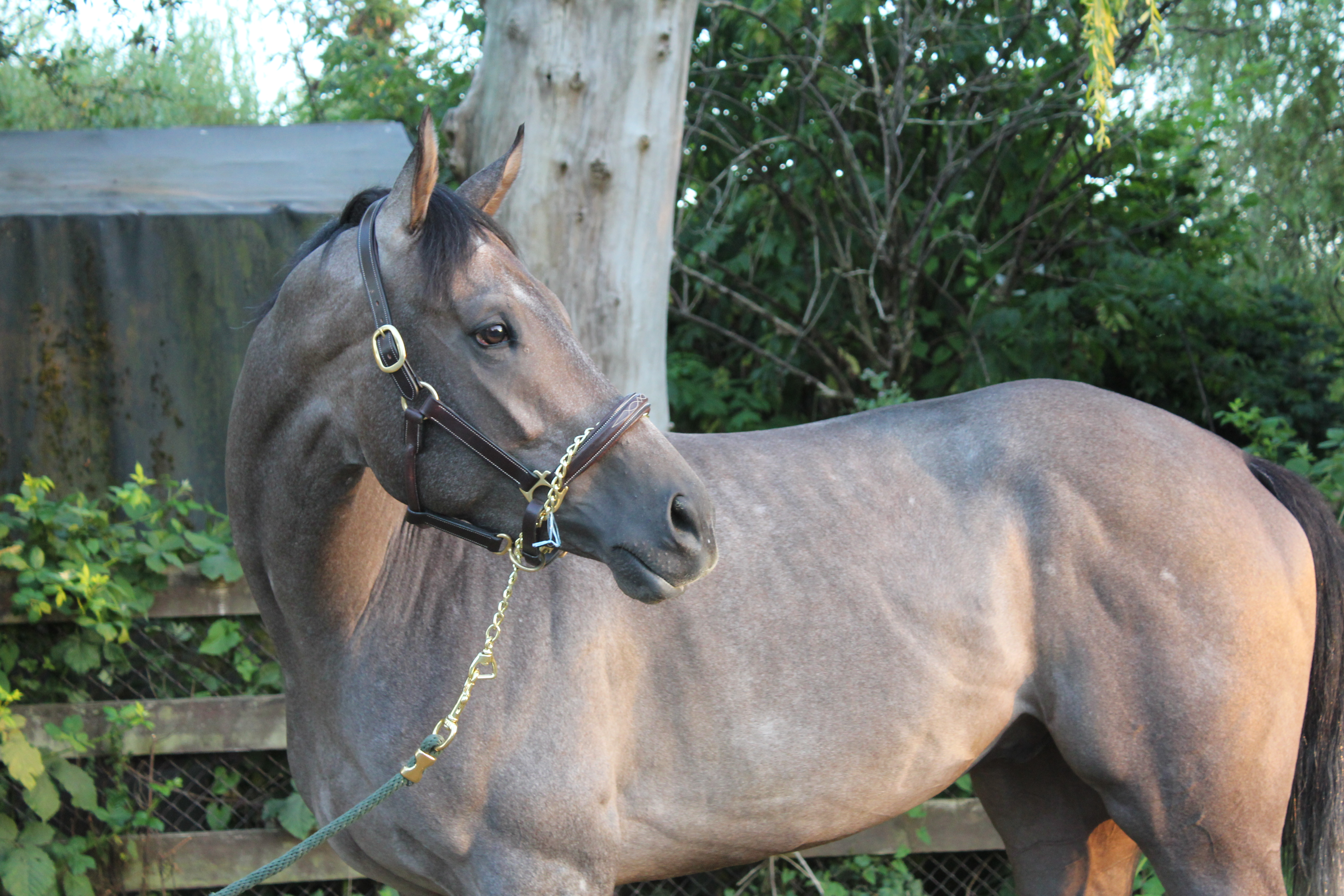
The thoroughbred racehorse, “Machine”

All I can say is that what I found out about the “deep, dark” side of the horse industry shocked me.  Even as a professional trainer all these years, I had no idea how many horses were ending up in slaughterhouses every year, and why.  I had no idea how horribly  horses were treated once they left the auction houses or race track.  I made myself look at the reports and videos on the Canadian Horse Defence Coalition website.  Most horse-people will not want to see this side of our industry, but I believe they need to.  My eyes were definitely opened.  Not only that, but my heart went out to all of the world’s homeless horses to the point that I felt overwhelmed and somewhat helpless at not being able to help them all, relieving them of a potentially terrifying completion to their lives.  Over 100,000 a year in fact.  Really??!!  Where are all these horses coming from?

http://defendhorsescanada.org/

I’d also found a very knowledgeable researcher who gave me a plentitude of information to mull over and include in the bigger film I was determined to produce.  The more I spoke to her, and the more I learned about homeless equines and their fate, the more I realized I would need a massive legal team to protect both myself and sources from the underworld of cabals that make their living on the acquisition and sales of unwanted horses.

So I shelved the film and looked for other ways I could help educate and enlighten the horse industry.  Then Dr. Schoen and I met in 2012 and through our dialogues, began writing the 25 Principles of Compassionate Equitation, followed by the book, which will be released in the spring of 2015.

While working on  the outline for the documentary I befriended a couple of extraordinary advocates for equine welfare.  They have both been on the “front-lines” of the worst of the worst kind of treatment you can image horses having to endure.  Most of us who love horses couldn’t possibly deal with what they have seen.  They are my heroes.

Brogan Horton is in her twenties and runs Animal Rescue Unit at her home in Maine.  Brogan is the kind of person who will put on a suit and lobby Congress on behalf of the wild burros and mules, or hook up her horse trailer and spend her last few dollars to go pick up a horse in need of rescue.   Animal Rescue Unit is an organization dedicated to revealing the truth about animal suffering, specializing in investigation, rehabilitation, education and legislation for animal welfare.  The following link is one of many heart-warming stories from ARU, and one with a very happy ending.  Further links to ARU information are included in the article, and Brogan can be found on Facebook for anyone interested in following her activities and if possible, helping with donations for the rescued animals.

http://www.pressherald.com/people/cth/donkey-delivers-a-christmas-miracle_2013-01-07.html

The other hero is Brogan’s former partner in another very intense animal welfare investigation organization, Richard Couto of Animal Rescue Mission.  Both Brogan and Richard are well trained and have been on some of the more dangerous missions regarding equine welfare.  Most of us in the horse world have no idea what goes on behind the fences and walls around illegal slaughter farms in Miami.  Nor would most of us want to know.  It’s cruelty to animals beyond our comprehension.

Richard became the exceptional cruelty investigator  he is today after rescuing a thoroughbred ex-racehorse from one of the illegal farms.  The horse, Freedom’s Flight, is a descendant of Secretariat.  Richard found him tied to a tree at the farm, next in line for a terrible demise.

Here’s a link to Richard’s bio:

http://www.animalrecoverymission.org/about-arm/founders-bio/

So in The Compassionate Equestrian, Dr. Schoen and I are doing our best to use language that inspires, unifies, and opens the hearts of equestrians.  We are coming from many years of experience in our collective fields and understand how easily one person’s opinion can immediately send another person into a defensive mode.  Or how upsetting some of these more difficult issues can be.  We also understand that people don’t want to discuss death, so we refer to the “completion” of life.  It’s why Principle 25, which recognizes “the importance of applying the Cradle-to-Cradle model of life-cycle assessment and tracking to the equestrian industry” – has been left to the end of the book.  Chapter 25 is also still largely unwritten as we structure the program and gather further information as to just how it could be applied to help the “global herd” of horses in need.

There isn’t an easy way to convey this information to a  generally loving, compassionate community of horse-people who are active on a day-to-day basis with these beloved animals.  It’s our belief that every human has the opportunity to be compassionate towards all beings, and that compassion just needs to be awakened.  In the hardest times, in the most difficult circumstances, and in facing the darkest side of humanity…that’s when extending compassion may become extremely challenging.

It’s the purpose of The Compassionate Equestrian and The 25 Principles of Compassionate Equitation to assist in the compassionate awakening of horse-people everywhere.  We hope that through their own personal practices, they will be able to see the need for compassion to be extended to all horses, and everyone who’s involved with them.  With such mindfulness, we can come together as a world-wide community and find a way to become heroes for horses ourselves.


When a “Behavioral Problem” Really is Just That

In The Compassionate Equestrian Dr. Schoen and I stress repeatedly that when a horse exhibits behavioral issues, first rule out pain as the root cause.  This is especially true if there’s a change in the horse’s base personality.  Sometimes this takes more than one veterinarian’s opinion.   Diagnosis of subtle lamenesses can be difficult to pinpoint and the first sign of a problem might be the new or increasingly difficult behavior.

However, in my many 30+ years of working with all kinds of horses of varying breeds, ages, backgrounds and temperaments, there are a few quirky personalities in the crowd that are simply, well, weird.  They have legitimate behaviors that are out of the context of “normal” for most horses and sometimes the most compassionate thing to do is let them be exactly as they are.  If you can hang on, or tolerate them that is.

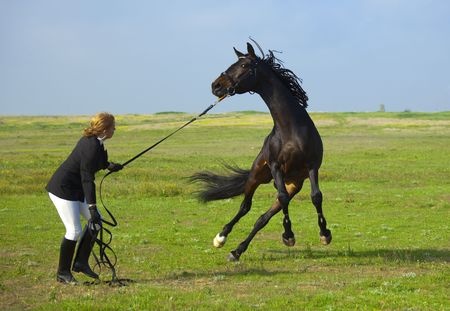
Sometimes you just hang on! (photo Alina Pavlova, 123rf.com)

Sometimes you just hold on!
(photo Alina Pavlova, 123rf.com)

Some of the most interesting have been the off-track thoroughbreds.  The subject of this post is one little, classic, plain bay gelding.  Nothing particularly spectacular to look at, but he had the kind of personality that made everyone look.  Kind of in the way you can’t take your eyes off the cars in a demolition derby.

His name was Earthquake.  As the story went, he was born in California during an actual earthquake.  We never did confirm whether or not this was true.  He was booted off the track in San Diego due to his “bad behavior”.  He ended up in a backyard in Phoenix that housed the other off-track thoroughbred jumpers belonging to his owners.  Besides a string of successful racehorses, they had produced some of the top amateur jumpers on the circuit.

Earthquake’s owner, Tracy, is the sister of the trainer I was working for at the time.  She told us “Quake” was almost impossible to ride on the flat.  Even with all of her experience in showing and winning at the “A” Circuit level, this little bay gelding scared her.  He would scoot out from under her, spin, leap, and generally act like a crazy horse.  She didn’t know what to do with him.

One day he was turned loose in the arena to play.  Tracy watched, somewhat stunned, while ‘Quake galloped over jump after jump all on his own, apparently inspired from watching her other horses school over fences.  So she clung through the flatwork with him and began to train him for jumper classes.

I had the task of helping her with him at his first show.  Lucky me!

I always maintained that somebody had to be the “entertainment of the day” at a horse show and frequently it was our barn.  Tracy’s brother was an excellent, caring horseman and would never consider drugging a horse to calm it down or make it easier to ride.  He just quietly rode whatever was underneath him in the moment, and so did his sister.

Taking thoroughbreds from the track to their first few shows is always a wild card.  ‘Quake was at least consistent with his quirky behavior.  I watched the crowded warm-up arena from the barns and it was easy to spot him.  That would be the horse and rider leaping above all the others, unrelated to where the warmup jumps were placed.

He was so excited to go in the show ring for his rounds, he couldn’t be contained.  He would paw, stretch, almost drop himself to the ground, spin, leap, and spook other horses at the in-gate.   Tracy hung on.  Then he would go in the arena, focus, clear every jump, and won almost every class he was entered in.  He was phenomenal.  Just impossible outside of the jumper ring!

He got better at his routine as he began to get the hang of showing.

I had to tack him up before one of the classes and it was exhausting.  He spun around in the stall.  He couldn’t stay still for a second.  I even tried pressing on an acupressure point on the coronary band, in the center of a front hoof.  It actually seemed to work, much to my relief.  He calmed down and I finished getting him saddled for his class.

Another day, and another class.  We got him tacked up and Tracy left him tied in his stall to go walk the course.  ‘Quake knew where she was going and he was apparently upset that he wasn’t going to the jumper ring with her.  I went in the tack room for a moment when I heard a loud crash from ‘Quake’s stall.  Mortified, I saw that he’d somehow jumped over the stall guard while still tied to the inside of the stall.  I have no idea how he could have maneuvered his body in such a way through a small opening and over the barrier.  Luckily he was unhurt in his desperation to follow his rider to the arena.

All you can do with that kind of enthusiasm is support it and hope the horse connects with the right rider and the right activity to accommodate his energy and ability.  In this case, the stars lined up and what would have been an extremely difficult ride for many equestrians, turned out for the best.  Last I heard ‘Quake was winning Grand Prix classes in the southwest.

Not every horse with behavioral “quirks” is lucky enough to find its way to a compassionate, competent owner that has the patience to simply let him “be” and allow the talent to shine through.  If ‘Quake had been punished for his leaping and spinning who knows what kind of a different horse he may have turned into.  Most likely not such an enthusiastic jumper who seemed completely enamoured with his owner.

If you have been able to rule out pain as the cause of your horse’s “behavior problem” and have determined he’s just of the personality type to be the way he is, then kudos to you for your compassion and understanding.  In my mind, I can see the happy little grins on all those clownish horses out there whose joy for life just can’t be constrained.


____________________

The Compassionate Equestrian is pleased to be affiliated with the International Charter For Compassion’s new Sector on the Environment

For information about the Charter for Compassion, and the upcoming Compassion Relays, click on the following link:

http://compassiongames.org/compassion-relays/


“Just” a Trail Horse


Many times when I’ve asked people about their horses they’ll say, almost apologetically, “oh, he’s just a trail horse”.  It’s as though their horse isn’t important enough for those of us who made a career with show horses to acknowledge as being relevant.  Or that it doesn’t require any special breeding or talent to be a trail horse.

Well, in the Principles of Compassionate Equitation, we see equality in all horses, just as we do all sentient beings.  They were given a life, just as we were, and all are subject to suffering, just as all humans are.  Everyone deserves the same amount of compassion, no matter who or what they are, or what they do.  Including trail horses :).

Recently I had the opportunity to spend time in one of my favourite places, Sedona, Arizona, on the back of a sweet, reliable trail horse who is as careful and kind as they come.

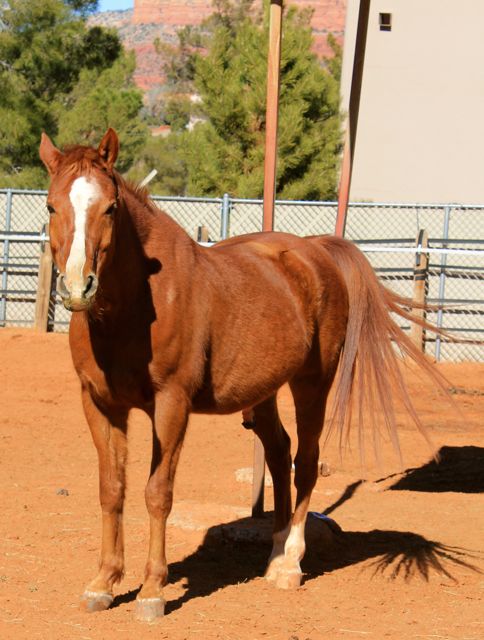
Shadow

Shadow

This is significant because my past experience with horses on trails has not always been so favourable.  My first horse, White Cloud, was a ranch horse.  When we moved to the suburbs of a large city, I had to ride along busy roadways to reach the trail system.  I was only twelve at the time and didn’t know better.  I thought that since the stocky white mare was so good on country trails, nothing would bother her on busier roads or trails either.  How wrong I was!

I was lucky we weren’t hit by a car.  We held up traffic a few times while Cloudy panicked at the sound of loud, fast vehicles passing and spooked by throwing herself into reverse.  As the area we lived in was lined with large ditches, her behaviour was quite disconcerting, not to mention dangerous.  Her tension translated into my tension and I was forever nervous about riding horses along busy roads after that.  I’ve never really gotten over it.

When we moved again, Cloudy was sold to a rancher and lived out the remainder of her life in a happy place.

The next horse to come my way was a very young, barely broke (in fact, badly-broke) appaloosa filly.  She was also born and raised on a large ranch and had no concept of behaving on multi-use trails or in traffic.  I really tried to overcome my fears and hers as I still enjoyed a gallop across a hay field or a pleasant trail ride down to the river, which required some riding along roads to get there.

Miss Demeanor, appropriately named, was one “incident” after the other.  I was still in my early teens and learning about training horses.  Determined, I kept taking her on trail rides, hoping for improvement.  One day she managed to thoroughly embarrass me on a group ride by running backwards down a steep hill until she finally backed into a tree, even with the reins thrown at her.  Then she scared herself and scooted forwards, spooking some of the other horses who had gone ahead.  I just seemed destined to not ever have a pleasant trail ride!

Trail running!

Trail running!

One day I was finally brave enough to ride “Missy” the few miles down to a beautiful spot by the river.  I let her take a drink out of a creek that fed into the river and in the blink of an eye, she was down and rolling in the muddy bank with me still on her.  I had to ride all the way back to the barn with one side of her plastered in mud so thick you couldn’t see her spots any longer.  I never did get all the mud out of the carved leather of my western saddle either.

I was in awe of people who could simply saddle up on a nice day, head out on the trail, and return still smiling with a happy and relaxed horse.  I had no idea why this “trail horse” thing was so elusive!

There was no problem in the show ring.  Even my spooky filly could open gates, walk over teeter-totters and tarps, drag a tire or a cow-hide, and jump a small fence.  Why didn’t that translate to the great outdoors?

Eventually I gave up on the idea of enjoyable trail riding, especially as my next horse was an appaloosa stallion, and confirmed “city boy”.  The first time I led him down a little hill he had no clue how to navigate it and promptly squatted on his hind legs and sat there in a half-rear.  I should have expected such things from my horses by now.

One day I was offered a beautiful big dappled gray warmblood gelding to ride on a charity trail event.  He was a lesson horse at the show barn I was riding at and generally very quiet.  Oh no, not on the trail however.  He spooked at… invisible trolls?  Maybe it was the shrubbery.

Finally I was married to a three-day eventing trainer and we were running a barn that was situated next to a cross-country course and thousands of acres of trails, accessible without riding along any roads.  Surely this was to be trail-riding heaven!

Sigh.  The appaloosa complained about the rocky footing.  The thoroughbred gelding pranced sideways thinking he was still a field-hunter and wouldn’t settle until after a full-out gallop. The off-track mare spooked at the cattle.  The part-Standardbred jumper bolted over the beaver-fall.  Was there anybody out there who wanted to be a nice trail horse??!!

I was starting to resign myself to having to ride in an arena forever, or continue having unusually adventurous trail experiences.  Gee, what was it like to have a safe, relaxing ride where I could drop the reins and enjoy the scenery?

The last barn I taught lessons at was a mix of many types of horses and riders, most of whom went on the rugged, rocky trails of Sedona on a regular basis.  I was still more comfortable jumping fences than going on a trail ride and stayed in the arena.

Finally, having really retired this time (it took a few tries), I thought I’d attempt trail riding again.

I know those trails from having run them on foot.  It’s very easy to twist an ankle or trip and there are many hazards on desert pathways.  Sharp cactus plants await along every edge and the rocks can roll underfoot or be as slick as ice when worn smooth by eons of erosion.  Deer or javelina can appear out of nowhere and in the warmer months there’s always the possibility of a rattlesnake coiling closely enough to do some damage.

Remembering to breathe, at first I guided Shadow, the pretty chestnut Arabian gelding, as I would in the arena, “helping” him negotiate the continually changing angles of the terrain and hoping he wouldn’t slip on any of the slick-rock.  I worked as hard as he did, staying off his back on the uphills and shifting a little rearwards on the downhill, monitoring his balance and speed.  Hoping not to annoy him, I tried to do as little as possible, telling myself he knew what he was doing.

He’d spent many more hours packing riders around these trails than I had spent riding horses on them.

Shadow was also lovely in the arena, and in fact very well bred to be a show horse too.  His gentle disposition and good training seemed to add up to his ability to be an all-around great guy.

At the end of our 3-hour ride, my reins were loose and I was letting him pick his way home, carefully stepping over boulders and not tensing up when his shoes slid on the steep downhills.  Yes, this little horse knew what he was doing alright.

What a happy day.  Now I know what it’s like to have a genuinely pleasant trail ride, with no spooking at wildlife, cars, dogs, cyclists, or loud noises.  What a special horse it takes to provide that kind of experience.  I can’t believe I had to wait so many years to enjoy such a ride.

Happy trails to all!

Happy trails to all!

I can tell you for certain that nobody ever needs to apologetically refer to their horse as “just” a trail horse.  They are a special breed unto themselves, no matter what their breeding or background, and they deserve every accolade that a top-notch show horse receives.  Trail horses also deserve the same kind of mindful care, compassion, and healthy environments as the most expensive, highly bred animals in the show-ring.  After all, horses don’t know how much we paid for them, or how much we pay for their training and board.  All they know is how they are made to feel in our presence, and you really can’t place a dollar sign on that.


FORWARDS and STRAIGHT

Many years ago I was living at an FEI-level dressage barn as the assistant hunter-jumper trainer. It was a fabulous place to watch and learn from some of the world’s best and most educated riders and clinicians who came to ride, teach and show there. I’ve learned throughout my years as a professional rider that those rare horsemen who are consistently at the top of their game in the Olympic disciplines are also the quietest. They tend not to talk a lot and have dropped the egoic bravado that comes with so many trainers who are still out to prove themselves. Getting specific information out of them isn’t always easy… more likely gained by observing and the occasional politely asked question.

One day I was watching the head trainer, a soft-spoken, elegant German master rider, schooling a working student on an upper-levels horse that had been allowed by its owner to make flying lead changes incorrectly. Every other canter stride or so the student-rider would ask for a lead change and the rangy warmblood gelding would swing his haunches well off the track to the left or right. It looked awkward, and in fact, such swaying off the track results in a relatively low score in a dressage test due to the incorrectness of the movement. It also indicates a resistance in the horse and would eventually lead to unsoundness.

The trainer spoke in German – a language I don’t understand beyond a few words – and the next time the series of flying lead changes were attempted they appeared nearly perfect.

Surprised, I asked Uli, the trainer, what he said. “I told him to keep the horse straight” was his answer.

The difference a subtle change in the ride made to this horse was such a profound lesson I wished I could have had a video camera in my hand at the time as the teaching from this one apparently simple thing was quite dramatic. However, it’s the right combination of so many elements, including the keen eye and years of experience of such a trainer, plus a student who also came from the program in Europe that made the rapid change in the horse’s form look easy.

Candillo Jr, an imported Holsteiner stallion, now owned by OSJS Sporthorses of Canada.

In the classical training method the two key words that lead to a healthy, “finished” horse are deceptively complex. If it were a simple matter to ride a horse both forwards and straight, we’d all be riding relatively problem-free horses that stay as sound as possible and carry a rider without stress or discomfort.

Unfortunately, especially in North America, there are only a handful of trainers who still follow the programs of master trainers and not too many riders who have had the opportunity to sit on a horse that has reached a perpetual state of “forwards and straight”.

Horses naturally track with their shoulders closer to the rail and haunches more to the inside due to their shape. If you look at a horse from the top view, you’ll see the width of the shoulders is narrower than the hips, so it’s just a more comfortable and natural way for them to track. It also means they naturally drop an inside shoulder as they make a turn and counter-balance by shifting their heads & necks to the outside.

Running free without a rider, this is fine for the horse, as there’s nothing to upset their balance and muscular development. The moment we humans climb aboard however, we have to undertake a proper series of exercises so the horse builds up a correct athletic form and the musculature to be able to carry a rider through all of the movement we request of them.

It’s at this convergence point of “natural” vs. “training” that we seem to have broken the smooth process of the classical training pyramid as too many horses are pushed too quickly through the levels, whether they be destined for dressage, jumpers, or other show disciplines. Very few people who have the time and money to support show horses also have the patience to wait for a horse to develop correctly through lower levels.

Depending on the breed and conformation, some horses never progress out of a basic level of training, yet should still be given the opportunity to have a genuinely correct base that instills rhythm, suppleness, and a willingness to take contact with the reins.

In the “old” classical system, a horse is never punished by being ridden in reverse – i.e. pulled on or jerked by the reins – and the standard that was taught is to “correct forwards”.

This works for both exciteable and lazier types of horses, and all breeds and disciplines. Even a good western lope has to be forwards and straight and is an art unto itself. Not all horses can achieve a good lope, even the ones bred for it. Same with an extended canter for a warmblood. Not all of them will get there.

A horse that is ridden forwards, what we refer to as the “back to front” ride will develop an increased bend in the joints of the hindquarters, allowing for more freedom of the joints, which also helps keep them lubricated and healthy, and allows for the muscles of the lower back and haunches to develop “pushing power”. This is different from rushing, as that’s a balance issue.

A good illustration of the difference is to hold a dumbbell in each hand. Bend your knees and hold the weights with a bent arm, fairly close to your body. You feel strong and balanced. Now lean forwards a bit and hold the weights in front of you (careful – don’t get hurt!). You’ll immediately feel the stress in your back and want to take a quick step to keep your balance. Horses experience the same thing when all of their weight is carried in the forehand and not transferred to the hindquarters.

So far as straightness goes, look at a great athlete. Skier, skater, runner, etc., and notice the body symmetry. Straightness means efficiency and optimal performance. It’s no different for horses. When you ride a horse that’s been trained to go straight it’s like the difference between driving a high-performance sports car compared to an old 3/4 ton pickup truck with manual steering. Unfortunately, finding a straight horse to ride so you can experience that difference for yourself is not always an easy thing to do.

If all riders had the opportunity to learn on this type of horse, we’d have a lot more sound, rideable schoolmasters in teaching programs than we do now. Dr. Schoen treats horses repeatedly for musculoskeletal misalignment and subsequent pain that is frequently a side-effect of incorrect training methods.

I’m barely even scratching the surface here on the concept of “forwards” and “straight” as the training techniques and level of experience required to get a horse there would take up volumes of books and many years of study. Yet, out of compassion for our horses and knowing how beneficial a correctly trained horse is to the equine world, isn’t that kind of worth the time and trouble it takes to learn?

RIDE IN BEAUTY

We all love and understand the beauty of horses, but what about the importance of the aesthetics of the places we ride and keep our horses at?  Do you think our surroundings have an effect on our own mental states as well as that of the horses?

My personal experience has included everything from keeping horses in my backyard to boarding at less-than-ideal establishments to one of the most beautiful, peaceful equestrian centers you could ever imagine, and running several training barns.  Speaking from such broad experience, I can share with you the insights I’ve gained about the effect of beauty, and ugliness, on both horses and riders.

The beautiful Spanish Riding School of Vienna

When I was 13 and still learning about having my own horse, my dad was transferred to another city.  The former ranch horse that was now my “beginner mount” had to learn to live in a box stall for the first time in her life while her shed and paddock were being built at our new home.  The closest barn was a dark, damp, wood-frame building with muddy paddocks and unscrupulous, horse-dealing managers.

I don’t remember all the things that were said to me there, but I sure remember how I felt, and how spooky my normally-quiet horse was at this place.  Not knowing too much made me vulnerable and the “helpful” suggestions were more like insults.  All of the people seemed to be “up to something” and none of the horses, in my memory, were very happy.  They were dirty, smelly, and the entire place was just unpleasant.  I couldn’t wait to bring my horse home and luckily, we didn’t have to stay there for more than a couple of months.

When we were transferred again a couple of years later and I needed to find another boarding barn, I found a home on a ranch for my mare, White Cloud, where she lived out her life in great comfort and truly in her element.

At 17 I had moved to the now-famous show jumping facility, Spruce Meadows, with my appaloosa colt.  What a contrast to the stable White Cloud had experienced. I’d had an appaloosa filly at another barn in the new city and was not pleased with the environment there either.  The horses were chased by the owner’s dog from the pasture into their stalls each night and my horse had been seriously injured as a result.  The staff were unapologetic and I later found out they had not been giving the filly her pain medication for the hock injury she’d sustained.  She also became terrified of men in cowboy hats.

I don’t like having to go to a barn with the feeling that I’m likely to find something wrong with my horse, the place is a mess, the staff are angry, or the stress levels are so high that riding isn’t the joyful experience it should be.

Walking into the barns and arenas at Spruce Meadows was like being in a cathedral.  It even smelled different than any other barn I’d been in.  The horses were bedded knee-deep in straw, and everything was spotless.  Soft music played in the indoor arena and the temperature was kept constant, even in Alberta’s cold winter weather.

http://sprucemeadows.com/

I’d never been at an equestrian facility where the first words coming to mind were “elegant”, “beautiful”, “peaceful”, “grace”, and “calm”.

We were required to keep our tack clean and hung a specific way and we followed a protocol that wasn’t so much rigid as it was to the benefit of everyone’s peace and wellbeing. The grounds  were lined with gorgeous flowers and trees and it was always easy to let out a big breath and sigh of relief every time I drove through the gates.  At this place, I found myself wanting to spend time there not just to enjoy my beautiful horse, but to rise to the level of elegance and old-world classiness – not an “elitist” attitude by any means – more like a kind of simplicity that allows you to settle into a calm, clear state of thinking and focus on what you are there for.

When my colt turned two I started him under saddle myself, having observed the German riding master’s guidance of the stunning Hanoverian horses that had been imported and bred on site.  Unless there was a show on, the peace and quiet could be counted on consistently and the horses also seemed to thrive both mentally and physically from the reliability of their environment.

http://www.horseandhound.co.uk/news/what-music-do-horses-like/#

I never had to worry about being insulted, anything irresponsible happening to my horse, angry staff, or bad management that affected the entire chain of events down to the boarders and guests.  It is no surprise to me that this establishment has won the accolades it has.

Dr. Schoen has been the veterinarian to many major show barns and we have written about the importance of a healthy, holistic environment with the best quality of care and food provided for the horses.  With the Principles of Compassionate Equitation, the kind of equestrian environment that supports the wellbeing of both horses and riders begins with caring, compassionate management and permeates the entire chain of day-to-day events at a barn.

While it may sound difficult to get an entire barn of human personalities to become compassionate, we believe that not only is it possible, but a necessary step for the sustainability of our industry and our beloved horses.  In today’s fast-paced, expensive, stressed out world, how could we not want to be in a “sanctuary” that supports our joyful interactions with horses, and helps us learn to extend that joy and compassion to all beings?

It is our wish that all horses and horse-people have the opportunity to live in health, happiness, and beauty.

Willy’s Light-headedness

I’m not sure if my last post made it to followers.  It certainly didn’t get to my e-mail box so this is an extension to the story of how light, or photonic therapy, saved my horse’s life.

The week after his series of three BioScan Light treatments was a happy week for Willy, and for me.  He was able to roll again, his gaits were good, and he seemed happy.  While of course the photonic therapy couldn’t eliminate all the lumps, bumps and turn the clock back to his youth, there was a spring in his step again and we were back in the saddle.  I went from making a decision about whether or not to euthanize him to deciding how to celebrate his 25th birthday.

Unfortunately as I led him through the barn one afternoon an aggressive mare lunged at him over the top door of her stall, surprising us both and catching Willy across his forehead with her incisors.  She left a deep gash above his left eye that began bleeding profusely.  Given his expression it obviously hurt quite a bit and I made a quick call to the vet.  I thought this would need stitches given the width and depth of the injury.

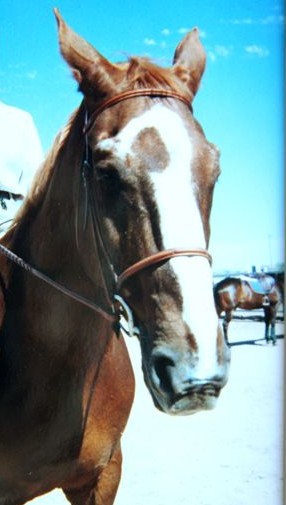
Willy

Willy – always letting you know how he feels!

Describing the nasty wound, our old-fashioned country vet said he’d prefer not to put stitches in a horse’s head due to the risk of infection and the difficulty in bandaging the area and keeping it clean given the equine tendency to rub on such things.  Like they do with show braids.  He suggested keeping an eye on it and making a “fresh wound” after it scabbed over, repeating the process until it was healing cleanly.

I put Willy in an empty box stall instead of returning him to the pasture with a rapidly-swelling, bleeding forehead and thought of the studies I’d read about the ability of red light to increase wound healing and tissue regeneration, to relieve pain and inflammation, and to prevent tissue death.

http://www.ncbi.nlm.nih.gov/pmc/articles/PMC2933784/  (Effect of Pulsing in Low Level Laser Therapy)

The only problem was I didn’t have a device that could deliver the specific frequencies of light and I needed it right away.  Willy was not going to let me anywhere near his head.  Any attempts to clean the wound were met with pinned ears and a “don’t you dare” expression.  Remembering I had a red bicycle light in the house, I thought I’d have nothing to lose by giving it a try.  It was so low-level as to be well out of the infrared range, and it certainly didn’t pulse, but it was LED-based nevertheless so it was worth a shot, even if the effect was minor.

I returned to the barn with the bicycle light in hand.  Willy was still in distress and not wanting me near his head.  That is, until he saw the red light in my hand.  I held it up to him and his expression changed immediately.  He literally dropped his head into my hand and allowed the light to be placed over the open wound.  Obviously the memory of what he felt during the BioScan treatment was still fresh in his mind.

I continued to treat the injury daily for a few days with nothing more than the bicycle light and was amazed at how quickly and cleanly it healed over.  I pretty much left it alone after that and within 10 days the hair was growing back.  The horrible looking wound needed no further treatment as it healed so well there was no scar, and no white hair as frequently occurs in horses at the site of a traumatic injury.

After I had a device made with the correct frequencies, I’d offer it to Willy who would turn his body into the light pad and point with his nose, indicating where he wanted the diodes placed, or he would ignore it altogether, which I took to mean he felt just fine that day.

How LIGHT Saved My Horse’s Life

In the late 1990s my aged Hanoverian gelding who had once been an upper-levels eventing horse and show jumper was retired to the job of a lesson horse.  Old injuries he’d sustained in his younger years as a competitive athlete were catching up with him and his level of discomfort increasing.  He had a large amount of scar tissue on the underside of his neck, bad hocks, spinal deformity and arthritic joints.  By the time he was essentially bracing himself on two legs and not wanting to roll any longer, my options for his care and comfort were diminishing.  I’d already rescued him from a trip to the slaughterhouse when he was 18, and was glad to have given him a good “second chance” in life and a far better ending than the one he’d been threatened with.  I thought maybe he’d reached “the end” for sure this time and was considering euthanasia.

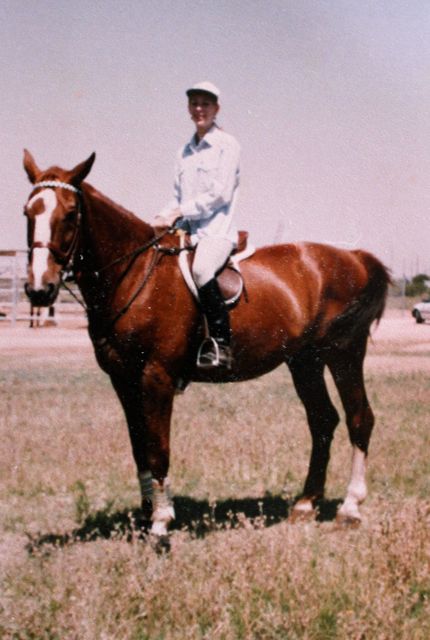
Willy & I

Willy & I

Given the results I’d seen with light therapy in humans and other animals however, I decided to give it a chance as a new company had emerged at the time with a system designed specifically for horses.

For some who may not have been introduced to Low Level Laser Therapy*, this might sound like it’s straight off the Holodeck of the Starship Enterprise.  I can assure you of the science behind it however, and will present both anecdotal accounts from my own experience with this remarkable healing modality as well as scientific references.  Oh yes, and if you search for the opinions that say it isn’t effective or that there isn’t supportive research, you’ll find them, and generally they stem from sources who don’t actually quote the lengthy list of well-funded studies that do prove the known mechanisms and successful case studies, in particular the currently FDA-approved monochromatic red wavelengths.  Everyone comes through their own belief systems, even scientists.  However, I’ve now used the technology for over 20 years and still use it to speed up the healing of sports injuries, wounds, and dental surgery.  Results are consistent with both humans and animals in my experience.

Some of the contemporary history leading to the FDA-approved research came through NASA and the University of Wisconsin’s Dr. Harry Whelan, M.D.:

http://spinoff.nasa.gov/Spinoff2005/hm_1.html

Dr. Harry Whelan, M.D., has been inducted into the NASA Space Technology Hall of Fame for his research into the use of near-infrared LEDs for wound healing and the treatment of brain tumors and neurofibromatosis:

http://www.mcw.edu/neurology/facult/HarryWhelan.htm

I was personally introduced to photo-therapy, or the application of colored light, via Dr. Jacob Liberman O.D., Ph.D, D.Sc. (hon), (author of Light; Medicine of the Future  http://www.jacobliberman.org/jacob/bio/).  He invited me to attend the annual conference and professional training session of the College of Syntonic Optometry in 1991.  I then experimented with the specific frequencies of visible light on myself, on waterfowl that were rescued from various states of illness and injury and brought to our ranch, as well as dogs, cats, horses and anyone who wanted to try it for themselves.  Over and over again the results were nothing short of miraculous.

The originator of syntonic phototherapy was Dr. Harry Riley Spitler, D.O.S., M.D., M.S. Ph.D who first published the Syntonic Principle in 1941.  Scientific research that began in the 1920s speculated that the power of light was primarily transmitted to the core of the human organism via the organ of sight – the eyes.  Dr. Spitler theorized in great detail the role of the eyes in phototransduction, as well as the role of light and color in total organismic function and development.  Most of his work has been scientifically validated, and that of the work of many others in the field.  Their collective bodies of work have formed the foundation for today’s most advanced approaches to light therapy.

Glowing LEDs

Glowing LEDs

The issues up until the 1990s were conflicts between the FDA, DEA, and classifying both the devices and frequencies of light into their respective categories of drugs and medical devices.  It was NASA’s work in developing the technology with the Marshall Space Science Centre and Dr. Whelan that brought at least a portion of photonics research into the mainstream.

After I was trained in the application of colored light through the eyes, I made a set of filters and worked with those and a light source.  The technology that emerged at the time my Hanoverian, Wilhem, was literally on “his last legs” was that of BioScan Light, then out of New Mexico.  The application was quite different than what I had been taught, but understanding the mechanism of light on the cells of the body made me call a local woman who occasionally rode at our barn and had been through the BioScan training.  Desperate, I called her and had her come out to treat Willy.

http://youtu.be/mfueJv3OK9c

I found the scanning unit took quite a long time and when Sandra was finished the initial session, Willy had dots of grease pencil all over his body.  Then she treated each dot with a cluster-head set of red LED lights.  I noticed he immediately began taking deep breaths and almost fell asleep in the cross ties.  His whole body relaxed so much by the end of the session he looked like a different horse.  I was anxious to see how he moved.  His tail was up for the first time in quite awhile.  It had been clamped in chronic discomfort as his soundness deteriorated.  As it turned out, the old scar tissue under his neck had been causing him more pain than I’d originally thought too.

Conventional veterinary medicine had done all it could for this horse, saving his life when he was injured after flipping over a cross-country fence and splitting his neck near the jugular vein.  His hocks had been x-rayed, determining the condition they were in and finding a bone spur, and the farrier did everything he could to put a good, supportive foot under the big gelding’s aging body.  Everything else Willy needed, he got, but life had caught up with him and it was time to find an alternative and compassionate way to make him comfortable, or else let him end his life in peace.

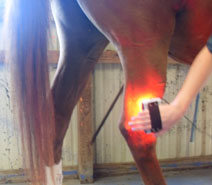
Applying red light with the Respond System.  www.emersonww.com

Applying red light with the Respond System. http://www.emersonww.com

After Willy’s first light treatment I put him back out to the pasture with the other old horses and he proudly marched to the middle of the field, stood up square like a statue, then took off in an elevated trot towards the horses.  I was amazed to say the least.  The other horses saw him coming and they all took off running too!

Sandra came back two more times and each time the number of grease-pencil dots from the Bio-Find unit decreased.  I noticed the old scar tissue softening under Willy’s neck.  The real test would come when I put him into one of the outdoor pens that he loved to roll in, but hadn’t done so in months.  I believe he thought he might not be able to get back up from the deep, soft dirt, once he got down into it for a roll.

Sure enough, after the final treatment I put Willy in the turnout and he immediately tossed a big hoof-full of dirt into the air.  That was the signal he was going to drop and roll.  He pretty much had a big grin on his face, as much as a horse can actually smile, then collapsed into the dirt and rolled, and rolled and rolled!  I knew from that point on he was going to be alright.

He stayed serviceably sound and remained bright and happy.  The other horses seemed to enjoy hanging around him more as well.  He even managed to commandeer two of them to swat flies from his face out in the pasture and his gentle nature made him a favourite for babysitting youngsters, sick horses and horses that needed to calm down.

I had an LED pad custom made and began to experiment on other horses, some with horrendous spinal deformities, dropped hips and sacroiliac displacement.  The results were consistent and every horse improved, some dramatically, even just using this very basic, simple version of light therapy.  It is a completely non-invasive, gentle method of remediation for injuries involving soft tissue and seems to help with joint stiffness as well as reducing the effects of old scar tissue.  I noticed the spine and hips realign, most likely due to the release of tightness and muscle damage that was pulling the musculoskeletal system out of alignment, allowing the bony structures to move back into a more normal state.  The horses all showed a marked increase in their ROM (range-of-motion).

In recent years, many new companies have emerged and new research and information continues to support the use of LLLT.  Dr. Schoen and I are looking forward to following the progress of the latest devices to enter the market for advanced and professional delivery of red light for the healing of horses.

The MR4 Super Pulsed Laser

The MR4 Super Pulsed Laser

Dr. Schoen and myself both recommend a thorough veterinary workup if your horse exhibits signs of pain or lameness or is otherwise in apparent distress as there could be many causes.  A good lameness veterinarian is invaluable to every horse owner and sometimes they may recommend a second or third opinion also.  It isn’t unusual to find several causes of lameness in a horse and some are very difficult to diagnose.  As each practitioner comes from their own areas of expertise, you may find putting a good diagnostic team together the most compassionate thing to do for your horse’s wellbeing.  This includes a neurologic workup and checking for Lyme Disease if your horse’s behaviour has changed and he seems to have chronic, yet indeterminate symptoms of discomfort.

LLLT works wonderfully in conjunction with conventional medicine and is highly applicable as a supportive mechanism for speeding up healing along with standard protocols for treating sport-related injuries, wounds and post-surgical conditions.

_________________________________

*Laser Therapy is a form of phototherapy which involves the application of monochromatic light over biological tissue to elicit a biomodulative effect within that tissue.

Low-level Laser Therapy (LLLT) – the most widely-used name given to this form of photobiomodulation – can have both a photobiostimulative effect and a photobioinhibitive effect within the irradiated tissue – each of which can be used in a number of therapeutic applications.

source:  http://www.spectra-medics.com/llltinfo.html